Skip to content

Taking a few more students for fall 2026

The guide library

See how the thinking is taught.

22 public guide excerpts across 10 courses. Read the reasoning, the choice of method, and the worked solution. Each sample shows the kind of explanation a student receives every session.

The library

Choose a course and unit

These are public excerpts, with their original instruction and worked examples intact. Read in the browser or save the PDF for printing. You can request full guides for upcoming units below.

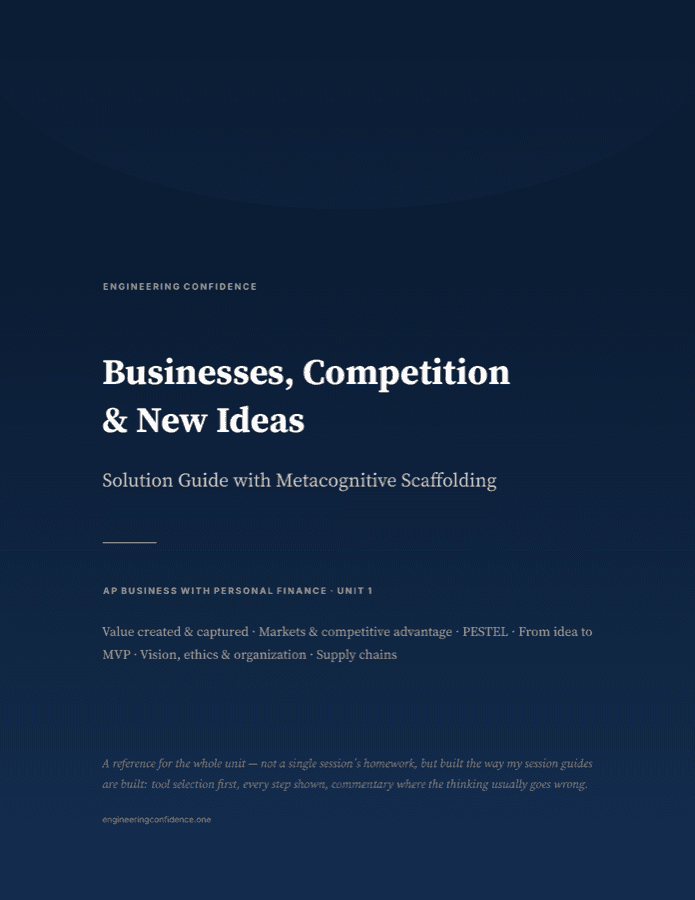
Cover of the AP Business with Personal Finance guide on Business, competition, new ideas

AP Business with Personal Finance

Name the factor in the course’s words, then explain how and why

Business, competition, new ideas

Unit 1 is the language of business, and the exam’s two verbs are describe and explain. Name the factor with the course’s word and the scenario’s detail as the evidence; explain as a mechanism, because this condition holds the business does this in order to get that. Value created against value captured, the market before the strategy, PESTEL as an evaluation.

Read the HTML guide
Cover of the AP Macroeconomics guide on National income and price determination

AP Macroeconomics

Four moves on one picture: demand, supply, the long run, and the push

National income and price determination

Almost every question in the unit is one of four moves on the aggregate demand–aggregate supply diagram: aggregate demand shifts, short-run aggregate supply shifts, wages walk the economy back to full employment, or fiscal policy pushes it there and a multiplier sizes the push. Label the axes Price Level and Real GDP, say which run, and write the multiplier before the number.

Read the HTML guide

Cover of the AP Microeconomics guide on Production, cost, and perfect competition

AP Microeconomics

Marginal decides output; the averages only say what profit is

Production, cost, and perfect competition

A firm produces every unit whose marginal revenue covers its marginal cost and stops at the first that does not; the average curves say what profit is once output is chosen, never what output to choose. Shutting down is a short-run question answered against average variable cost, exiting a long-run one answered against average total cost, and entry drives a competitive price to minimum average total cost.

Read the HTML guide
A sample of the system

The system, built around your student.

Working with me, your student’s own coursework guides the session. The evening guide preserves the explanation, the set between sessions changes the shape of the question, and what comes back is graded.

Engagements start at $800 every four weeks.

Guides for the year ahead

Get the next guide for your student’s course.

The public excerpts are free to read now. Leave one course below and I send the full guides by email as the year progresses, about a week before most classes reach each unit.

One course. I send the full guide myself when that unit comes up in most classes, and the next one after that, for the rest of the year. Only guides for that course. You can stop them or request another course by replying.