How it works
A system your student learns to drive.
One engineer, no handoffs. Every session is a session on how your student thinks: their own coursework comes in, the session finds the model behind the mistake and rebuilds it, a worked guide and a written report go out that evening, one set of problems tests whether it held, and the transcript gets a second read before the next one.
The subject is the vehicle. The student is the work.
The system, in a real week
AP Precalculus, the week of a test.
The report excerpts and worked pages below came from the same session. Names are changed in the report and removed from the guide. The guide's opening pages are public — explore the guide excerpt.
Before
The class's own review packet arrived the night before the test — the problem set, the quiz that went sideways — and the session was built on it. Before the first session I read everything a family has: quizzes, exams, homework. I have seen the work before I meet the student.
What arrived, from the report
We worked through the first 15 problems of the Unit 10 review packet together ahead of tomorrow’s test. I also sent Vince the full worked-solution packet so he can review the remaining problems tonight if he’d like.
The session
Fifty minutes, out loud. I ask far more questions than I answer: why that step, what are you thinking, if you had to guess. I want the student reasoning out loud, because that is the only way to see the model they are using, and the model is what we fix. A right answer with no why is the gap the exam finds.
From the report, written against the transcript
The strongest conceptual moment came during a divergence-test problem. He kept pressing on why a certain expression approaches a constant instead of zero, and once we connected it to cancelling leading terms in rational expressions, it clicked cleanly for him.
That evening
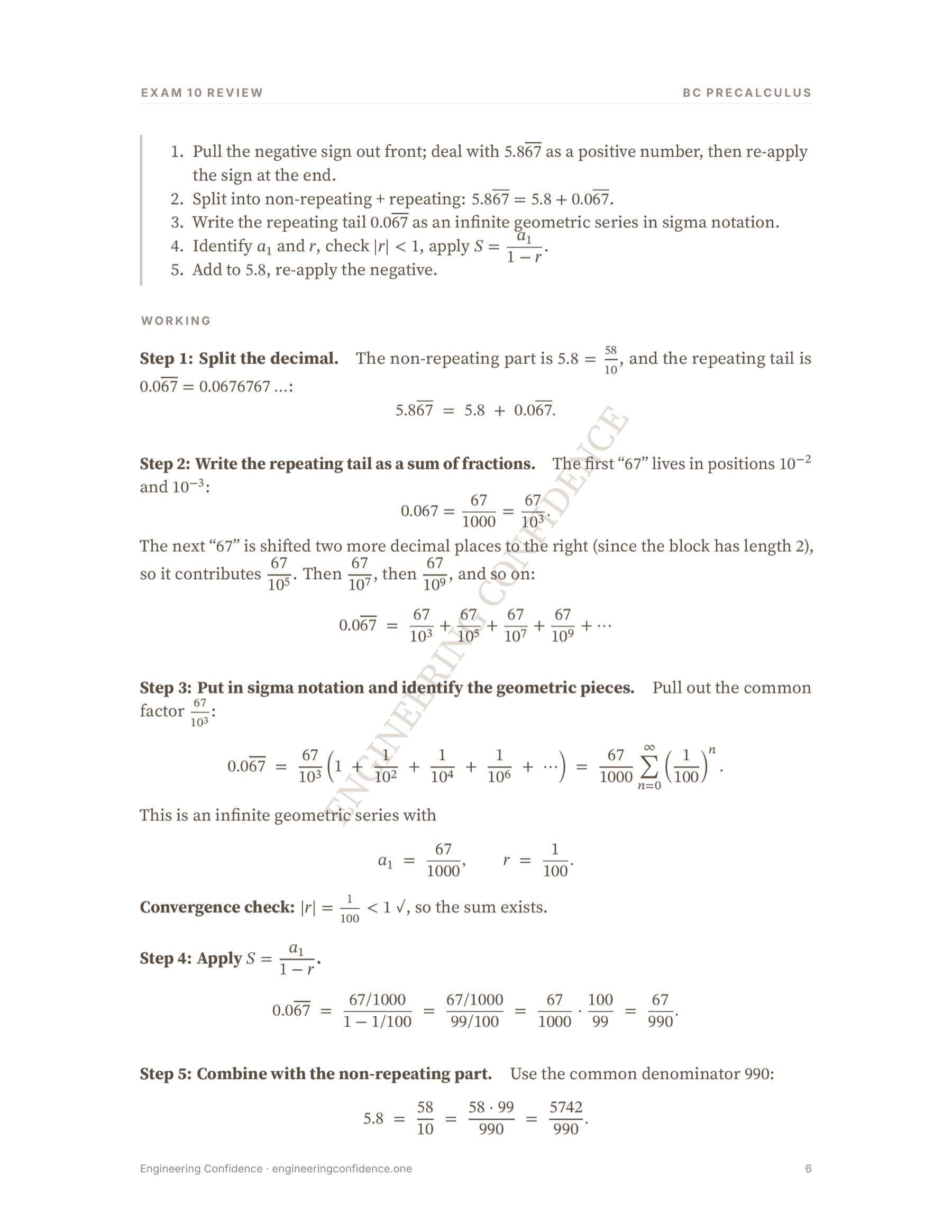
Every problem solved together comes back typeset, to the student, that evening, so the reasoning is there to revisit. Parents receive a report — what we tackled, where the student stands, what comes next — written against the session transcript, not from memory. The complete example is below.
The work between
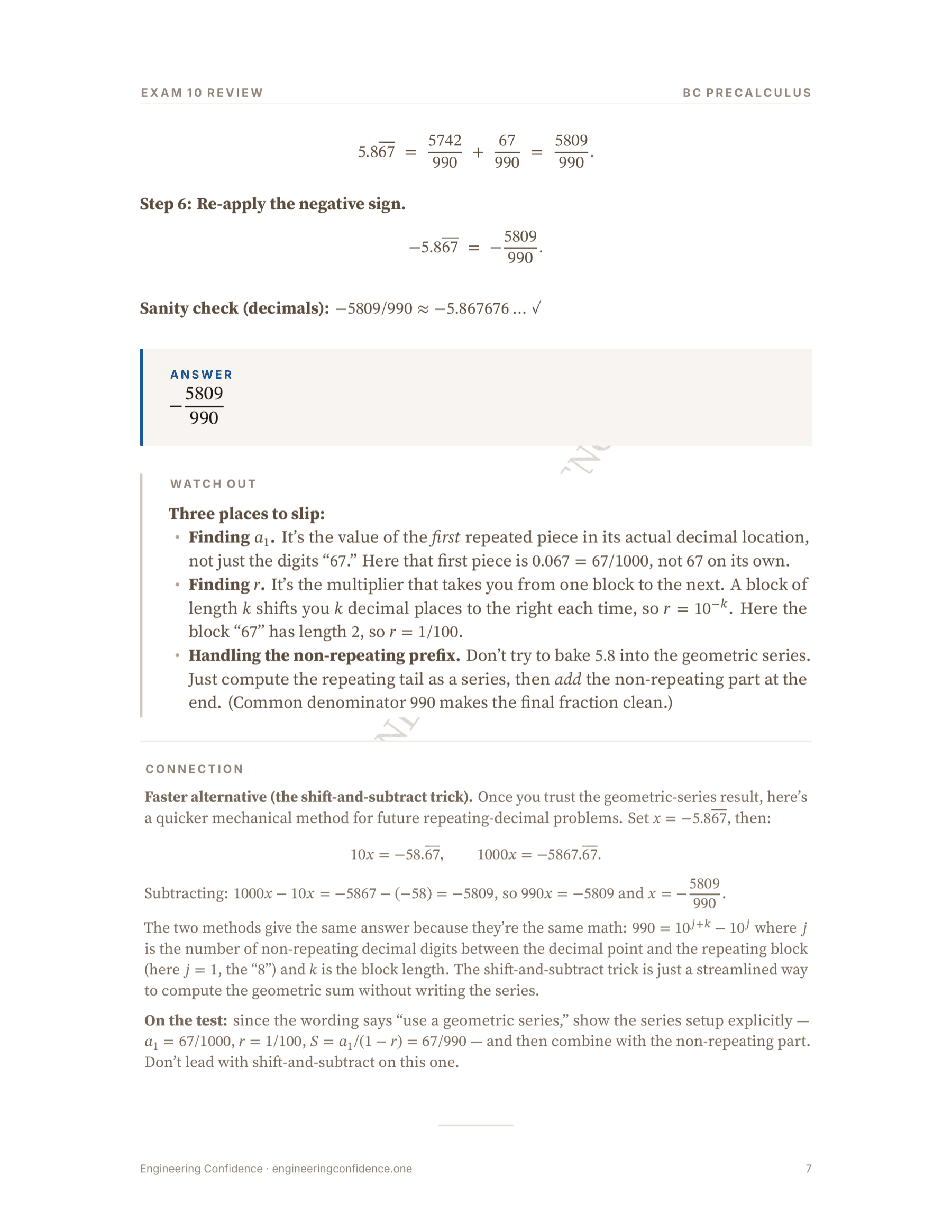
One set per session, built from where the work got hard that day: the same idea with the shape changed, never the same problem with new numbers. Solutions in the back. What your student finishes comes back graded, every problem. Shown here: the worked guide's answer and its common-error notes.
Next time
The transcript gets a second read — where the reasoning went sideways, where a different question would have landed better — and that review is what I prepare the next session from. It is why I can tell you in March what changed since September.
From the same report — what the next sessions were built toward
- Wednesday — Unit 10 test
- Thursday, and Tuesday next week — pivot into final-exam prep
- The following Wednesday — possible final-exam exemption interview
- Thursday — becomes optional if the exemption is granted
- Friday — final exam, if needed
One real evening
This is the summary a family received the night of a Unit 10 review, names changed and dates removed. Its wording is preserved. The guide it mentions is the same 34-page guide, its opening pages public; the family received the whole thing.
One real summary, sent the same night — names changed, dates removed
Hi Dana and Nate,
A quick recap of tonight’s session.
Focus of the session
We worked through the first 15 problems of the Unit 10 review packet together ahead of tomorrow’s test. I also sent Vince the full worked-solution packet so he can review the remaining problems tonight if he’d like.
Topics included:
- repeating decimals as geometric series
- sigma notation and arithmetic-series sums
- interval-of-convergence problems
- explicit formulas for alternating and fractional sequences
- the lottery/perpetuity problem
- the Taylor series for ex
- the Test for Divergence
- finite and infinite geometric sums
What went well
- Vince showed strong number sense throughout the session. On one sigma-notation problem, he bypassed the standard algebra and came up with his own mental shortcut immediately — fast and correct.
- On several sequence problems, he independently identified the underlying structure before I prompted, including spotting when rewriting a middle term revealed the hidden pattern.
- He also caught a setup trap right away on a shifted-index summation problem, which is exactly the kind of thing these review packets are designed to test.
- The strongest conceptual moment came during a divergence-test problem. He kept pressing on why a certain expression approaches a constant instead of zero, and once we connected it to cancelling leading terms in rational expressions, it clicked cleanly for him.
Looking ahead
- Wednesday — Unit 10 test
- Thursday, and Tuesday next week — pivot into final-exam prep
- The following Wednesday — possible final-exam exemption interview
- Thursday — becomes optional if the exemption is granted
- Friday — final exam, if needed
Overall, a strong review session. Vince was engaged, asking good questions, and showing real growth in the pattern-recognition side of the unit.
Warmly,
Matt
The report and the AP Precalculus guide excerpt show the same session.
The gap is in the model, not the answer.

Matt Starolis
Engineer-Mentor · Founder
A gap rarely looks like a wrong answer. More often it is a right answer with no why — the student can work the problem and cannot explain the step. That is the difference between a procedure and a model, and the AP exam is built to find it: the free-response section is a handful of problems worth half the score, and it pays for the reasoning, not the number.
Most of the gaps I find in bright students are small and old — a word like “term” that never landed in seventh grade, carried silently into calculus. It takes one conversation to fix and years to hide. The student who has been telling themselves they are not good at math usually has the engine. They do not have the right fuel and parts in it yet.
We fix the model, not the problem.
What this asks of your student, and of you
There is no secret. It's smart work.
Smart work is what the research calls deliberate practice: work aimed at what is not yet mastered, with feedback on the next attempt.
I prepare the sessions, explain the ideas, build the practice, and grade what comes back. Your student brings the class materials, works through the practice, and sends back what they finish. You support the follow-through at home.
Think of a personal trainer. You hire one for the roadmap, the knowledge, and someone in your corner — not to do the work for you, and not to make you do it. I am not an enforcer, and I am not your student's parent. If the end of our session is the end of your student's work for the week, the session will still help. It will not get them a five.
Your student does not have to arrive confident. The one thing I cannot supply is the wanting. A course the parents chose and the student did not is a hard year for everyone, and I will say so on the fit call, not in March.
Getting started
First, a conversation about your student.
Share the courses, the goals, and what you would like to be different. I reply personally within 24 hours. A 20-minute fit call covers your student's working style, the support they need, and whether the system fits.
Your first four weeks
You are not buying a standing appointment. Here is the actual sequence, and you can hold me to it.
- Week one — I find out what they do alone.
- I give your student coursework I have not taught them and watch how they open it. Not to grade it. The way a student attacks a problem they have not seen is the whole diagnosis — the model they are using — and it is the thing a report card cannot tell you.
- Weeks two and three — the habit, not the topic.
- We work whatever the class is on, but the thing I am installing is the move above, written into how every solution is set down, until it stops being something they remember to do. Topics come and go. The habit is what sits the exam.
- Week four — you get a straight read.
- What has moved, what has not, and whether I am the right person for this. If the answer is no, I will say so and tell you what I think they need instead. That has happened and it will happen again.
The engagement
Engagements start at $750 every four weeks.
One 50-minute session each week, with preparation, the evening guide and parent report, and one practice set per session, graded when your student returns it.
A twice-weekly cadence is available; the scope and exact fee are agreed before you begin. No contract or minimum term.
Each semester, we review progress and goals as a family. When something cannot wait, ask and we will find a time to talk.
With 24 hours' notice, I make a best effort to reschedule within the same week. A replacement time cannot be guaranteed. Read the practical FAQ for scheduling, holidays, privacy, and service details.