Read the public excerpt
The same instruction and worked examples appear here and in the printable PDF excerpt. You can request full guides for upcoming units below.
READ THIS FIRST
About this guide. Unit 2 asks one question in seven costumes: what holds these particles together, and what does that predict? The classification habit reads electronegativity and, better, the measured properties to name the bond. The Coulomb habit explains bond strength, bond length, and lattice strength with charge and distance, the same law Unit 1 used for atoms. The drawing habit builds a Lewis diagram by procedure, repairs it with formal charge and resonance, and reads shape, angle, and polarity off it with VSEPR. Treated as one system, those three habits check one another; treated as seven lists, they are seven things to forget.
On the current AP Chemistry exam, Unit 2 accounts for 7–9% of the multiple-choice questions, and its skills — drawing a Lewis diagram, predicting a shape, arguing from a model — are scored again inside the free-response questions of later units. The exam is hybrid: the questions appear in the Bluebook application, and you handwrite the free-response work, including the diagrams. A drawn Lewis structure is graded on what is on the page: every valence electron, every lone pair, every charge.
If you arrive with something already going wrong, use the symptom map or The Stuck Toolkit. Both are organized by the sentence you would say out loud — “I don’t know if this is ionic,” “my electron count is off,” “I can’t tell if it’s polar” — because that is usually easier to recognize than the name of the missing tool.
The pages that follow are a whole-unit reference: a routing tree, a symptom map, the Master Toolbox, nine method-named worked problems, and one final synthesis problem whose title does not choose the method for you. Use the front matter as a reference rather than assigned reading — open the card you need. Find the shape of what you were given, open the matching card, and attempt the problem before reading its solution. The “Before you compute” rail is there to catch a wrong turn without giving away the answer.
WHERE THE POINTS GO ON THIS UNIT
The College Board’s own course description names the losses. On the exam, students “must be able to construct Lewis structures and make predictions or claims based on them,” and the mistakes it lists are specific: using the incorrect number of valence electrons, violating the octet rule, or confusing molecular geometry with bond angles. Three habits answer those three losses.
Count before you draw, and audit after. Total the valence electrons by summing each atom’s valence-electron contribution — then add one per negative charge, subtract one per positive charge, and write that number down. When the diagram is finished, count the electrons on the page. If the two numbers differ, the diagram is wrong no matter how reasonable it looks. This one habit removes the most common error in the unit.
Geometry is a name; the angle is a number; they are two answers. “Trigonal pyramidal” names the arrangement of atoms; is the H–N–H angle in ammonia, smaller than the of the electron-domain arrangement because a lone pair pushes harder than a bond. A question that asks for both wants both, and the second is where the point is lost.
The claim, then the evidence, then the principle. “ is polar” is a claim. “Its bond dipoles do not cancel because the molecule is bent” connects evidence to a principle. Make that connection explicit; the question-specific rubric determines credit. And every number you write carries its units on the same line — a bond energy in kJ/mol, a length in pm — because on the 2025 exam the number and its units were scored separately: 64% of students earned the point for the value and 33% earned the point for its units, on the same calculation.
Diagnostic Decision Tree
TWO PASSES: WHAT IS THE SUBSTANCE, THEN WHAT IS THE JOB
These routes overlap on purpose. A formula can lead to a bond type, a diagram, a shape, a dipole, or a comparison of strengths. First name what kind of substance the prompt hands you — two nonmetals, a metal and a nonmetal, a metal alone; then name the job it asks.
1. “What kind of bond?” or “explain this property.” Electronegativity difference gives the first guess; the measured properties give the verdict. Metal + nonmetal, high melting point, conducts only when molten or dissolved: ionic. Two nonmetals, low melting point, does not conduct: molecular. A metal: metallic. Say which evidence you used.
2. A potential-energy curve, or a bond length and bond energy. The minimum of the curve is the bond: its position is the bond length, its depth is the bond energy. Higher bond order means a shorter, stronger bond; larger atoms mean a longer, weaker one. Read the axes before the shape.
3. Two ionic compounds, or two ions — which interaction is stronger? Coulomb’s law: charge first, distance second. beats ; smaller ions sit closer and attract harder. Then say what the stronger attraction predicts — a higher melting point, a harder solid.
4. A Lewis diagram. Run the procedure, do not improvise: count electrons, pick the central atom, connect, complete octets outward-in, convert lone pairs to bonds if the center is short, audit the count.
5. More than one valid diagram. Equivalent structures: draw them all, connect them with double-headed arrows, and say what resonance predicts — equal bond lengths, fractional bond order. Nonequivalent structures: compute formal charges and choose the one closest to zero, with any negative charge on the most electronegative atom.
6. Shape, bond angle, polarity, or hybridization. Count electron domains on the central atom (each bond, single or multiple, is one; each lone pair is one). Domains give the electron-domain geometry and the hybridization; atoms alone give the molecular geometry; lone pairs squeeze the angle; symmetry decides whether bond dipoles cancel.
Last pass: what form must the response take? Draw means the diagram is the answer — every lone pair, every charge, every bond on the page. Predict means the name of the shape or the value of the angle. Justify means the model and the evidence: “four electron domains, one a lone pair, so trigonal pyramidal, and the lone pair compresses the angle below .”
Where to Look When You’re Stuck
SYMPTOM FIRST MOVE WORKED MODEL
What is happening | First move | Where |
|---|---|---|
“I can’t tell if it’s ionic or covalent” | Look at the elements (metal + nonmetal?), then at the properties; the properties outrank the electronegativity table. | p. 11, Prob. 1 |
“I don’t know what the curve is telling me” | Find the minimum: its is the bond length, its depth is the bond energy. | p. 12, Prob. 2 |
“Which ionic compound melts higher?” | Compare charges first, then ionic sizes; write the Coulomb reason. | p. 13, Prob. 3 |
“My Lewis diagram has the wrong number of electrons” | Recount the valence total, including the charge; then count the page. | p. 16, Prob. 6 |
“I have two diagrams and don’t know which is right” | Equivalent: resonance, draw both. Nonequivalent: formal charge decides. | p. 18, Prob. 7 |
“I keep confusing the shape and the angle” | Count domains for the electron geometry; count atoms for the shape; lone pairs shrink the angle. | p. 20, Prob. 8 |
“I can’t decide whether it’s polar” | Draw the bond dipoles as arrows on the shape; ask whether they cancel by symmetry. | p. 22, Prob. 8, 10 |
“Sigma, pi, hybridization — which is which?” | One sigma per bond; every extra bond in a multiple bond is pi; domains give the hybridization. | p. 24, Prob. 9 |
“I have an answer but no independent check” | Electron count, formal-charge sum, symmetry, and the measured property. | Stuck Toolkit |
Master Toolbox — Everything These Problems Use
ELECTRONEGATIVITY AND THE BOND CONTINUUM
Electronegativity is an atom’s pull on the electrons it shares in a bond. It rises left to right across a period and falls down a group, and Unit 1 already told you why: across a period the effective nuclear charge grows with the valence electrons in the same shell; down a group the shared electrons sit a shell farther from the nucleus. Fluorine, top right, pulls hardest; cesium, bottom left, barely pulls at all.
Two atoms in a bond pull against each other, and the difference in their electronegativities says who wins:
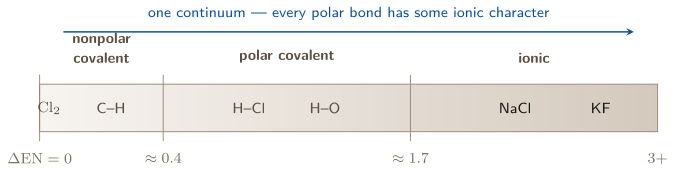
The boundaries are conventions, not walls. The exam’s own words: “the difference between ionic and covalent bonding is not distinct but rather a continuum.”
Read the bar in the direction the exam does.
- Similar electronegativities share evenly: a nonpolar covalent bond. C–H counts here — carbon is slightly more electronegative than hydrogen, but the bond is effectively nonpolar, and the CED says so explicitly.
- Unequal electronegativities share unevenly: a polar covalent bond, with a partial negative charge () on the more electronegative atom. In single bonds, a larger difference means a larger bond dipole.
- A large difference, and in practice a metal with a nonmetal, transfers electrons: ionic. The nonmetal takes them; the two ions attract.
- A metal alone: metallic, with valence electrons delocalized over the whole solid — not attached to any one atom.
The properties are the verdict; the difference is the guess. The CED is direct about this: “examination of the properties of a compound is the best way to characterize the type of bonding.” An ionic solid melts high, shatters when struck, and conducts electricity only when molten or dissolved (its ions must be free to move). A molecular substance melts low and does not conduct. A metal conducts as a solid and bends instead of shattering. When a prompt gives you a property table, argue from the table and use electronegativity as the supporting reason, not the other way around.
POTENTIAL ENERGY AGAINST DISTANCE: THE CURVE THAT IS THE BOND
Bring two atoms toward each other and plot the potential energy of the pair against the distance between their nuclei. Far apart, nothing happens: the energy is zero by convention. As they approach, each nucleus begins to attract the other atom’s electrons, and the energy falls — attraction lowers potential energy. Closer still, the two nuclei repel each other and the two electron clouds repel, and the energy climbs steeply. Between the two lies a minimum, and the minimum is the bond:
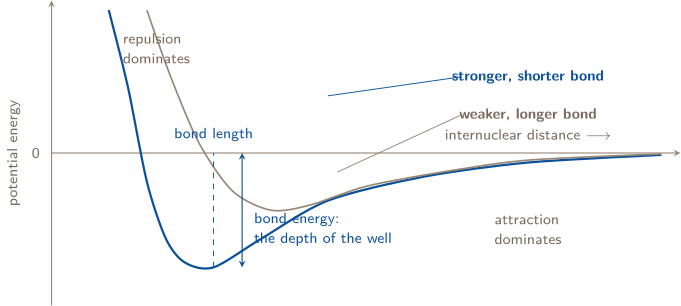
Two bonds on one graph. The deeper and farther-left the minimum, the stronger and shorter the bond. The steep left wall is nucleus–nucleus repulsion; the gentle right tail is attraction fading with distance.
Three readings, in order. The horizontal position of the minimum is the bond length — the distance at which attraction and repulsion balance. The vertical depth of the minimum, measured from zero, is the bond energy — what it costs to pull the atoms apart to infinity. And the curvature near the bottom says how stiff the bond is, which is a Unit 7 idea you will meet in vibrational spectra; for now, read length and energy.
What moves the minimum. Two things, and the CED names both. Bond order: a double bond is shorter and stronger than a single bond between the same atoms, a triple shorter and stronger still — more shared electrons, more attraction to both nuclei. Atomic size: larger atoms have their bonding electrons farther from the nuclei, so the bond is longer and, typically, weaker. Between those two levers, most bond-length and bond-energy comparisons are settled.
Two numbers worth knowing as anchors, not for memorizing but for sanity: the H–H bond, the simplest there is, is about 74 pm long with a bond energy near 436 kJ/mol; the NN triple bond is about 110 pm and near 945 kJ/mol, which is why nitrogen gas is so hard to react. A bond energy in the tens of kJ/mol is not a covalent bond; one in the thousands is not either.
COULOMB’S LAW FOR IONS: CHARGE FIRST, THEN DISTANCE
Unit 1 used Coulomb’s law inside one atom. Unit 2 uses it between two ions, and the form is the same:
Two levers, and they are not equal. Charge multiplies. A pair of and ions attracts four times as strongly as a pair of and ions at the same distance — against . That single factor is why magnesium oxide melts near C and sodium chloride near C. Distance divides. Smaller ions sit closer, so their charges act over a shorter and the attraction is stronger; that is why lithium fluoride melts higher than potassium iodide even though both are .
The order of operations when comparing two ionic compounds. Compare the charges first. Only when the charges tie do you compare the sizes — and then the sum of the two ionic radii is the distance to use, because the ions touch. Write the reason in that order, and say what the stronger attraction predicts: a higher melting point, a larger lattice energy, a harder crystal.
Where the ionic radii come from. A cation is smaller than its atom (electrons removed, the rest pulled in); an anion is larger (electrons added, repulsion expands the cloud); and down a group both grow, a shell at a time. You will usually be handed the radii; the habit is to add the two that touch, not to compare one ion’s size in isolation.
IONIC SOLIDS: A LATTICE, AND WHY IT SHATTERS
An ionic solid is not molecules. It is a three-dimensional array in which every cation is surrounded by anions and every anion by cations — the arrangement that puts opposite charges as close as possible and like charges as far apart as possible. The CED asks for exactly that statement and no more: you will not be asked to name a crystal structure, but you will be asked to draw or explain a particulate model that is consistent with Coulomb’s law.
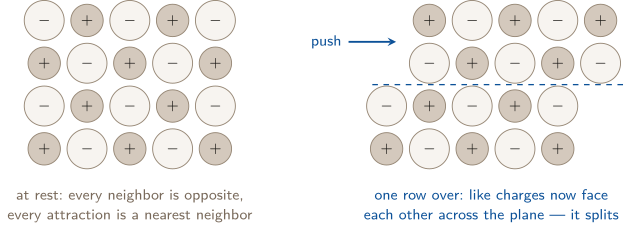
Brittleness, explained by the model. Slide one layer of the lattice a single ion over and every attraction across the plane becomes a repulsion.
The properties the model predicts, and the reason for each. High melting point: every ion is held by several strong Coulombic attractions at once, and all of them must be overcome. Brittle: the figure above — a shear puts like charges opposite one another. Conducts only when molten or dissolved: conduction needs mobile charges; in the solid the ions are locked in place, so it is an insulator until the lattice is broken up. Say the property, then the particulate reason; that pairing is the whole of skill 4.C.
METALS AND ALLOYS: A SEA OF ELECTRONS, AND WHAT YOU DROP INTO IT
A metal’s valence electrons are not attached to individual atoms. The model the CED asks for is a lattice of positive metal ions in a sea of delocalized valence electrons: the electrons belong to the whole solid, and the attraction between the mobile sea and the fixed cations is the metallic bond.
That one picture predicts the metallic properties. Conducts as a solid: the electrons are already free to move. Malleable and ductile: slide one layer of cations over another and every cation is still sitting in the same electron sea — nothing changes sign, so nothing repels, so the metal bends instead of breaking. Compare that to the ionic lattice one card up: the same push that shatters salt merely dents copper.
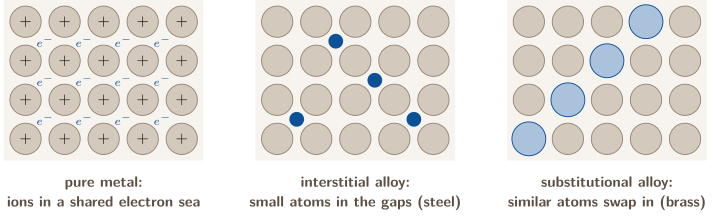
Three lattices. In steel, carbon atoms are small enough to sit in the spaces between iron atoms; in brass, zinc atoms are close enough in size to copper to take copper’s places.
Alloys, and how to tell which kind. Compare the atomic radii. Atoms of very different size make an interstitial alloy: the small ones fill the interstices — the gaps — between the large ones, as carbon does in iron. Atoms of comparable size make a substitutional alloy: one replaces the other in the lattice, as zinc does for copper in brass. Either way the added atoms interrupt the smooth sliding of layers, so an alloy is typically harder and less malleable than the pure metal, while the electron sea stays and the alloy still conducts. That “harder because the layers can no longer slide freely” is the sentence the exam wants.
LEWIS DIAGRAMS: THE PROCEDURE, NOT THE GUESS
A Lewis diagram is an inventory of valence electrons arranged so that each atom gets what it needs — eight for most main-group atoms, two for hydrogen. Draw it by procedure every time, because the procedure is what you audit when something looks wrong:
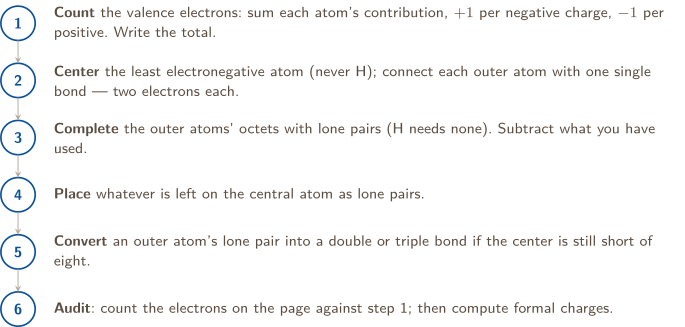
Six steps, and step 6 is the one that is skipped. A diagram that looks right and has the wrong count is wrong.
Worked once, fast, on . Step 1: C brings 4, each O brings 6: . Step 2: carbon is the center; two C–O single bonds use 4, leaving 12. Step 3: three lone pairs on each oxygen use 12, leaving 0. Step 4: nothing left for carbon — and carbon has only 4 electrons around it. Step 5: convert one lone pair from each oxygen into a second bond: OCO, carbon now sees 8, each oxygen still sees 8 (two lone pairs and a double bond). Step 6: on the page.
The exceptions the CED expects you to handle. Hydrogen wants two electrons, not eight. Boron and beryllium centers are often short of an octet and stable that way ( has six around boron, all formal charges zero — do not force a double bond that gives fluorine a positive charge). A center in Period 3 or below can hold more than eight — , , — and the CED’s instruction is to draw the diagram and predict the shape without any theory of how the extra pairs are held: hybridization involving d orbitals is not assessed. And a molecule with an odd number of valence electrons, such as NO with 11, cannot satisfy every octet; that is a limitation of the model, and the exam may ask you to say so.
A check first. One question opens three of the cards below and is answered at that card’s end. Answer it before you read on. Getting it wrong is the point — that is what makes the card stick.
1. READ RESONANCE CORRECTLY
Two valid contributors put a double bond in different places. Does the molecule switch back and forth between those drawings?
RESONANCE AND FORMAL CHARGE: WHEN ONE DIAGRAM IS NOT ENOUGH
Formal charge is bookkeeping: the charge an atom would carry if every bond were shared exactly evenly.
where is the number of valence electrons of the free atom, the number of nonbonding electrons on it in the diagram, and the number of bonding electrons it shares. Compute it for every atom of every candidate diagram. The formal charges must sum to the overall charge of the species — that is a check, and it is free.
Case one — equivalent diagrams: resonance. Draw the nitrate ion, , and you must put the double bond on one oxygen. But the three oxygens are identical, so there are three equally valid diagrams, and no one of them is the molecule:
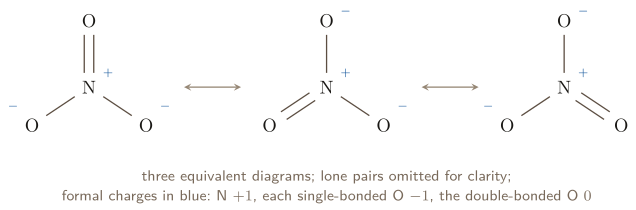
The real ion is the average: three identical N–O bonds, each of bond order , all the same length — shorter than a single bond and longer than a double. That measured fact is the evidence the exam asks you to connect to resonance.
The double-headed arrow means “the true structure is the blend,” never “the molecule flips between these.” What resonance predicts is measurable: all three N–O bonds in nitrate are the same length (about 124 pm, between the single-bond and double-bond values), and each carries one-third of the negative charge.
Case two — nonequivalent diagrams: formal charge helps rank. When the same atomic skeleton has different electron arrangements that are not equivalent by symmetry, their contributions may differ. Prefer the diagram whose formal charges are closest to zero; if charges are unavoidable, prefer the one that puts the negative charge on the more electronegative atom. Adjacent like charges are a sign the diagram is poor. The cyanate ion, , is the standard test, and Problem 7 runs it.
Case three — the model’s limit. Some species have no diagram that satisfies every rule: an odd electron count (NO, ) leaves one atom short of an octet whatever you do. The exam’s expectation is that you say what the model cannot do, not that you invent an electron.
CHECK 1 — READ RESONANCE CORRECTLY
No. Nothing flips. The atoms are connected the same way in every contributor — only the electrons are drawn differently — and the real molecule is a single, unchanging structure that none of the drawings shows on its own. That is why equivalent contributors predict bonds that are all the same length, intermediate between single and double, rather than a mixture of long and short ones alternating in time. The double-headed arrow means “the truth is between these,” never “the molecule alternates.”
2. COUNT DOMAINS FIRST
A central atom has four bonded atoms and one lone pair. Is its molecular shape tetrahedral? Name the count that decides.
VSEPR: COUNT DOMAINS, THEN COUNT ATOMS
Valence-shell electron-pair repulsion is a single idea: electron domains around a central atom spread out as far as they can, because electrons repel. Everything else is counting.
An electron domain is one region of electron density on the central atom: a single bond, a double bond, a triple bond, or a lone pair each count as one. Count them from the Lewis diagram — which is why the Lewis diagram comes first, always.
Domains give the electron-domain geometry; atoms give the molecular geometry. Two names, and the exam asks for the second. The lone pairs occupy positions in the domain arrangement but are invisible in the shape, which is named by the atoms alone:
| Domains | Lone pairs | Electron-domain geometry | Molecular geometry | Ideal angle | Example |
|---|---|---|---|---|---|
| 2 | 0 | linear | linear | ||
| 3 | 0 | trigonal planar | trigonal planar | ||
| 3 | 1 | trigonal planar | bent | ||
| 4 | 0 | tetrahedral | tetrahedral | ||
| 4 | 1 | tetrahedral | trigonal pyramidal | () | |
| 4 | 2 | tetrahedral | bent | () | |
| 5 | 0 | trigonal bipyramidal | trigonal bipyramidal | , | |
| 5 | 1 | trigonal bipyramidal | seesaw | , | |
| 5 | 2 | trigonal bipyramidal | T-shaped | ||
| 5 | 3 | trigonal bipyramidal | linear | ||
| 6 | 0 | octahedral | octahedral | ||
| 6 | 1 | octahedral | square pyramidal | ||
| 6 | 2 | octahedral | square planar |
Why the angle shrinks. A lone pair is held by one nucleus, not two, so it spreads out and pushes the bonding domains closer together. Ammonia’s H–N–H angle is about , not ; water’s, with two lone pairs, about . When a question asks for a bond angle, give the number and the direction of the deviation and its cause — that is the whole answer, and the CED singles out “confusing molecular geometry with bond angles” as a named loss.
Five and six domains. With five domains the positions are not all alike: three sit in a plane (equatorial, apart) and two stand above and below (axial, to the plane). Lone pairs take the roomier equatorial positions first, which is why is a seesaw and is T-shaped. With six domains all positions are equivalent, and two lone pairs sit opposite each other, which is why is square planar and, being symmetric, nonpolar.
CHECK 2 — COUNT DOMAINS FIRST
No — it is see-saw. Two counts do two different jobs: the domain count fixes the electron geometry, and here five domains give trigonal bipyramidal; the atom count names the molecular shape, and four atoms out of five domains is see-saw. Tetrahedral would need four domains and four atoms. Count domains first, always, then subtract the lone pairs to read the shape — naming the shape from the number of bonded atoms alone is the error this card exists to prevent.
3. SEPARATE LOCAL FROM NET
Both and contain polar bonds. Why can one molecule have zero net dipole while the other does not?
POLARITY: BOND DIPOLES ARE ARROWS, AND ARROWS ADD
A bond dipole exists whenever two bonded atoms differ in electronegativity: draw it as an arrow pointing toward the more electronegative atom. A molecular dipole is the vector sum of the bond dipoles over the shape. So polarity is a two-step question, and both steps are needed:
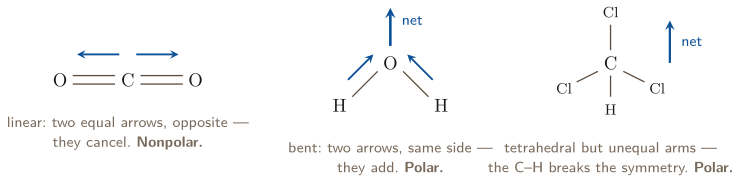
Same test three times: draw the arrows on the shape, then ask whether symmetry cancels them. would be nonpolar; replace one Cl with H and the cancellation fails.
The rule that covers most cases. A molecule with polar bonds is nonpolar only when its shape is symmetric and every position around the center carries the same atom: linear , trigonal planar , tetrahedral , trigonal bipyramidal , octahedral , and square planar with two opposite lone pairs. A lone pair on the center, or one different outer atom, almost always leaves a net dipole. Say both halves — “polar bonds, and a shape that does not cancel them” — because each half alone is a partial answer.
CHECK 3 — SEPARATE LOCAL FROM NET
Because the shape decides whether the arrows cancel. Both molecules have polar bonds, so both are polar locally. is linear: its two bond dipoles point opposite ways and sum to zero, so the molecule is nonpolar. is bent: its two dipoles do not oppose, so they add to a net dipole. Bond polarity is a property of a bond; molecular polarity is a property of a sum. A molecule can be built entirely of polar bonds and still be nonpolar.
HYBRIDIZATION, SIGMA, AND PI: ONE VOCABULARY FOR THE SAME COUNT
The CED wants three things named and nothing derived. Hybridization is a label for the arrangement of electron domains on an atom, and the label follows the domain count you already made for VSEPR:
| Domains on the atom | 2 | 3 | 4 |
|---|---|---|---|
| hybridization | sp | ||
| ideal angle |
Five or six domains: name the shape and stop. The CED does not assess hybridization involving d orbitals, and it does not assess how hybrid orbitals are constructed — only the sp, , labels and what they imply about angle.
Sigma and pi. Every bond has exactly one sigma () bond, made by head-on overlap along the line between the nuclei. A double bond is one sigma plus one pi () bond, made by side-by-side overlap above and below that line; a triple bond is one sigma plus two pi. So count sigma bonds by counting bonds, and count pi bonds by counting the extra lines in the multiple bonds. Two consequences the exam uses:
- A sigma bond is stronger than a pi bond — the head-on overlap is larger. That is why a CC double bond (about 614 kJ/mol) is strong, but less than twice a C–C single bond (about 347 kJ/mol).
- A pi bond locks rotation. The side-by-side overlap breaks if one end twists, so the two ends of a double bond cannot rotate freely, and a molecule with a double bond can have geometric isomers — cis and trans — that a single bond, rotating freely, cannot.
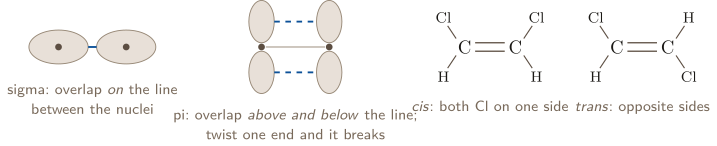
Why the double bond matters: the pi overlap is what a twist would destroy, so 1,2-dichloroethene comes in two distinct molecules. The single-bonded 1,2-dichloroethane does not.
PROBLEM 1
Naming the bond: the elements guess, the properties decide
Four substances are listed with electronegativity values and measured properties.
| KBr | HBr | Br | Cu | |
|---|---|---|---|---|
| electronegativities | K 0.82, Br 2.96 | H 2.20, Br 2.96 | Br 2.96 | Cu 1.90 |
| melting point (C) | 734 | 1085 | ||
| conducts as a solid? | no | no | no | yes |
| conducts when molten? | yes | no | no | yes |
(a) Classify the bonding in each substance and justify each choice with one property and one electronegativity argument. (b) A student argues that HBr must be ionic “because the electronegativity difference is large.” Use the table to settle it. (c) Explain, at the particulate level, why KBr conducts only when molten.
BEFORE YOU COMPUTE
Route 1: what kind of substance, then what the properties say. Compute the three electronegativity differences first, because they are cheap and they sort the covalent cases; then let the melting points and the conductivity rows deliver the verdict, because the CED says the properties are “the best way to characterize the type of bonding.” A difference alone never finishes the argument.
WORKING
(a) The differences, one line each:
Now the verdicts, each tied to a property. KBr — a metal and a nonmetal with a large difference; it melts at C and conducts when molten but not as a solid, which is the signature of mobile ions locked in a lattice: ionic. HBr — two nonmetals with a moderate difference; it melts at C and never conducts, so it is made of discrete molecules with no charged particles free to move: polar covalent (the bromine end carries ). Br — one element bonded to itself, difference zero, melts at C, no conduction: nonpolar covalent. Cu — a metal alone; it conducts as a solid, which only delocalized electrons can explain, and melts at C: metallic.
(b) The student’s premise is wrong on the table’s own terms: is a moderate difference, in the polar-covalent range, not a large one. But the stronger reply is the property row, which is the evidence the exam rewards: an ionic compound conducts when molten because its ions are freed; HBr does not conduct when molten. No mobile ions, no ionic bonding. The melting point agrees — C is a molecular solid’s number. Conclusion: HBr is a polar covalent molecule, and the properties, not the difference, settle it.
(c) In solid KBr every and is held in a fixed position in the lattice by attractions to all its neighbors; the charges exist but cannot travel, so no current flows. Melting breaks the lattice: the same ions are now free to move, and charged particles that can move carry current. The particles that conduct are the ions themselves — not electrons, which is the metal’s story — and they can do it only once the solid has been taken apart.
ANSWER
(a) KBr ionic; HBr polar covalent; Br nonpolar covalent; Cu metallic — each from a property and the electronegativity difference (b) HBr never conducts, even molten: no ions; is a moderate difference in any case (c) the ions are locked in the solid lattice and freed to move by melting
WATCH OUT
Two ways this item is lost. Classifying from the electronegativity table alone — the CED lists that as the weaker evidence, and a difference near the boundary (aluminum chloride, for instance) misleads. And “it conducts” without saying what carries the current: ions in a molten salt, electrons in a metal. Name the particle.
CONNECTION
This property table is Unit 3’s opening move, where the four kinds of solid — ionic, molecular, metallic, and covalent network — are told apart by melting point, conductivity, and hardness, and the forces between particles join the forces within them. The faster method survives the transition: metal with nonmetal and conducts only when molten, ionic; two nonmetals and never conducts, molecular. Two lines of evidence settle most classifications before any table is consulted.
ABOUT THIS EXCERPT
This is the opening of a 39-page guide: the diagnostic tree, the full Master Toolbox, and the first worked problem. 9 more problems follow in the complete guide, each worked the same way — what to notice before you start, every step shown, and the mistake that problem invites. The complete guide is shared with families during the fit conversation.
Engineering Confidence — engineeringconfidence.one
Source and review notes
What this resource is
Complete browser edition of the public excerpt from an original Engineering Confidence AP Chemistry unit-reference packet. Every problem and scenario was written for this guide.
- Published
- Last reviewed
- Printable edition
- 17 pages
Course reference: official College Board course page.
Read this public excerpt above, or save the PDF for printing and offline reading.
Download the 17-page PDF excerpt