Read the public excerpt
The same instruction and worked examples appear here and in the printable PDF excerpt. You can request full guides for upcoming units below.
READ THIS FIRST
About this guide. Unit 1 is the language of the course, and the College Board says so in the unit’s own exam note: it “introduces students to the language of business — an essential foundation when preparing for the AP Exam,” and the concepts of “value, competitive advantage, differentiation, and risk” are the “terminology that recurs throughout the course.” The exam’s verbs for this unit are two: describe the factors that affect a business or a person, and explain how and why a business or a person pursues a goal or a strategy. A definition recited is the first; the second is a sentence with a mechanism in it — because the market is a commodity market, the strategy is the lowest price, so the supply chain is built for cost.
Every scenario below is original; the AP Program’s own business cases — Bombas, Incredible Health, Corley Plumbing and the rest — are the classroom’s, and are named here only where the CED names them. The method they teach is the one this guide runs: read the scenario for the factor, name it with the course’s word, and explain what the business does about it and why.
Three mistakes to learn to catch:
- Value created and value captured used as one word. A product’s worth to the customer and the price the business charges are two different numbers, and the difference between them is who gets what. The exam asks for the distinction by name.
- A strategy named without the market that calls for it. A lower price can be useful in either market, but the reason and the economics differ. Identify the customer benefit, cost and likely response before recommending it.
- PESTEL as a list instead of an evaluation. The six letters are the easy part. The point is which factors matter for this product in this market, whether each one is an attraction or a risk, and what changes when one of them moves.
Every topic in the unit, and where it lives. The College Board lists eight; here is each one and the page that teaches it.
- 1.1 what a business is; customers and consumers; problem-solution fit; value creation and value capture — card 2 (p. 11); Problem 1.
- 1.2 markets, the market price, competitive advantage, competitiveness, barriers to entry, monopoly — card 3 (p. 13); Problem 2.
- 1.3 PESTEL factors, viability and careers, the evaluation — card 4 (p. 14); Problem 3.
- 1.4 where ideas come from, the risk and the incentive, the design-thinking process and the MVP — card 5 (p. 15); Problem 4.
- 1.5 core values and competencies, vision and mission, the goals of businesses, social enterprises and nonprofits — card 6 (p. 17); Problem 5.
- 1.6 business ethics, stakeholders, and how leaders respond to a dilemma — card 7 (p. 18); Problem 5.
- 1.7 the four forms of organization, roles, departments, outsourcing — card 8 (p. 19); Problem 6.
- 1.8 production processes and supply chains — card 9 (p. 20); Problems 7 and 8.
How to use it. The decision tree, the symptom map and the Master Toolbox are reference, not assigned reading. Route the scenario, open the matching card, and write your own answer before reading the worked one — the “Before you answer” notes are there to catch the usual wrong turn while it is still visible. What eight problems cannot do is give you enough repetitions; each is the clearest instance of its shape, so a problem you found easy is a signal to go find five more scenarios like it.
WHERE THE POINTS GO ON THIS UNIT
This course sits its first exam in May 2027, so no pass rate, mean or cut point exists for it yet; what exists is the record of first cohorts. AP Precalculus’s first cohort, in 2024, had 75.6% score a 3 or higher; AP Physics 1’s, in 2015, had 39.2% — and the difference was not the students. The College Board’s own note on this unit says where its points will be: exam questions “will ask students to describe factors that affect businesses and individuals and explain how and why businesses and individuals pursue specific goals and strategies.”
So the shape of a full-credit answer is fixed even though the cut points are not: use the facts in the case, define the concept, connect it to a specific fact, and explain the mechanism. Where the case does not settle the decision, say what evidence would — and then still commit. A recommendation with its condition stated scores; a list of things you would need to know does not.
Describe is a factor named with the course’s word. Not “the economy is bad” but “an economic factor — rising interest rates — reduces customers’ ability to buy.” The word is the point; the scenario’s detail is the evidence for it.
Explain is a mechanism. How and why: the market is highly competitive with undifferentiated products, so the business seeks advantage by producing as efficiently as possible, because the only lever left is price. A strategy without the market condition that calls for it, or a goal without the reason a business pursues it, is half the sentence.
Distinguish is two definitions and the difference. Value creation against value capture; customer against consumer; vision against mission; internal against external stakeholders; artisan against mass production. The exam pairs them on purpose, and a student who defines one of the pair has answered half.
Evaluate is a judgment with the criteria named. A PESTEL evaluation says which factors are attractions and which are risks for this business; a supplier choice weighs cost, quality, efficiency, convenience and risk and says which one decided it; a plan for competitive advantage is judged against the market’s competitiveness. The verdict without the criteria is an opinion.
Diagnostic Decision Tree
HOW TO READ THE SCENARIO
Run these in order. The first two find the topic; the rest are the checks that turn a definition into an explanation.
1. Whose problem is the scenario about? A customer’s need that a product answers — value, problem-solution fit, Topic 1.1. A business trying to beat rivals — competitive advantage, 1.2. Forces outside the business’s control — PESTEL, 1.3. An idea not yet a business — 1.4. What a business is for — vision, goals, ethics, 1.5 and 1.6. How it is built and staffed — 1.7. How its product gets made and delivered — 1.8.
2. Is it asking what, or how and why? Identify and describe want the course’s word and the scenario’s evidence. Explain wants the mechanism: because this condition holds, the business does this, in order to get that. Write the “because” before the “does.”
3. Which side of a pair is it? Value created or captured; customer or consumer; need or want; artisan or mass production; vision or mission; internal or external stakeholder; sole proprietorship or corporation. Name both, then say which the scenario shows and why.
4. What kind of market is it? Count the rivals and ask whether the products differ. Many rivals, identical products — a commodity market, and the strategy is efficiency and the lowest price. Rivals with differentiated products — quality, features, service, marketing, or price. No rivals — a monopoly holding its barriers to entry. The market’s competitiveness decides the strategy; say that.
5. Which PESTEL factors actually matter here? Not all six. For this product, which factors are attractions, which are risks, and what happens to viability and to jobs if one changes. The framework is an evaluation, and the evaluation ends in a judgment about entering or staying.
6. Who is affected, and what does each one lose or gain? For an ethical dilemma, list the stakeholders, internal and external, and weigh benefit and harm for each — or ask which response fits the vision. For an organization or supply-chain choice, name what is traded: control against funding, liability against growth, cost against quality and risk.
7. Does the strategy match the chain? A low-price strategy builds a cost-focused supply chain and scales; a quality strategy buys quality inputs and methods; a barriers strategy signs exclusive agreements. If the scenario’s chain does not fit its strategy, that mismatch is the answer.
Where to Look When You’re Stuck
FIND THE SENTENCE THAT SOUNDS LIKE YOUR SITUATION
What is happening | First move | Where |
|---|---|---|
“Is that value created or captured?” | Created: worth to the customer above cost. Captured: price above cost. Two numbers; the gap between them is the customer’s. | p. 11, Prob. 1 |
“Customer or consumer?” | The one who pays is the customer; the one who uses is the consumer; they can be the same person or not. | p. 11, Prob. 1 |
“What strategy should this business use?” | Classify the market first — commodity, differentiated, or monopoly — then the strategy the CED lists for it. | p. 13, Prob. 2 |
“What is a barrier to entry here?” | Patents and IP, regulation, locked-up suppliers, high startup costs, low prices from scale. Name the one the scenario shows. | p. 13, Prob. 2 |
“Which PESTEL letter is this?” | Government policy: P. The economy’s condition: E. Consumers and culture: S. Available technology: T. Climate and resources: En. Specific laws: L. | p. 14, Prob. 3 |
“Evaluate the market” | For each relevant factor: attraction or risk, for this product; then a verdict on entering. | p. 14, Prob. 3 |
“What comes first in the process?” | Validate the problem (observe, interview, survey), then a solution, then validate the solution with an MVP. Never the product first. | p. 15, Prob. 4 |
“Vision or mission?” | Vision: values and aspirations. Mission: what the business does and how it will reach its long-term goals. | p. 17, Prob. 5 |
“What should the leader do?” | Stakeholders, internal and external; benefit and harm for each; the greatest total benefit or least harm — or the response most consistent with the vision. | p. 18, Prob. 5 |
“Which form of organization?” | Trade control and profits against liability and access to funding. LLC keeps control and removes personal liability; a corporation funds growth and cedes control. | p. 19, Prob. 6 |
“Which supplier?” | Cost, quality, efficiency, convenience, risk — and the strategy the supply chain is meant to serve. | p. 20, Prob. 7 |
“Describe the supply chain” | Goods: raw materials, manufacturing, warehouse, distribution or retail, customer. Services: the people, resources and delivery system. | p. 20, Prob. 7 |
If none of those is your sentence, the last section of this guide is the longer version, organized by what went wrong.
Master Toolbox — Everything These Problems Use
Use these cards as you work. Name the decision you need to make, then open the relevant card. Each card stands on its own; you do not need to read the whole toolbox before attempting a problem.
1. THE VERBS, AND THE SENTENCE WITH A MECHANISM IN IT
Identify / describe | the course’s word for the factor, and the detail in the scenario that is the evidence for it. |
|---|---|
Explain how and why | the mechanism: because this condition holds, the business does this, in order to achieve that. Three clauses, in that order. |
Distinguish | both definitions, then which one the scenario shows and why. |
Develop or evaluate | a plan or a judgment with its criteria named — the market’s competitiveness, the relevant PESTEL factors, the stakeholders, the supplier’s cost and risk. |
The habit under all four: the scenario carries the evidence, the course carries the words, and the sentence marries them. “Corley Plumbing faced a labor shortage” is a fact; “a social factor — an aging workforce — reduced the supply of skilled labor, so the business invested in training to stay viable” is an answer.
A check first. One question opens each of the next three cards and is answered where that card ends. Answer it before you read on; getting it wrong is the point, because that is what makes the card stick.
1. SEPARATE VALUE FROM PRICE
A customer is willing to pay $50 for a product that costs $20 to provide and sells for $30. Find the value created, the value the business captures, and the customer’s surplus.
2. BUSINESSES, CUSTOMERS, AND VALUE
A business produces and distributes products — goods, services, or both — at any size and by any channel. A customer buys; a consumer uses; a parent who buys a teenager’s phone is the customer and the teenager is the consumer, and the exam keeps them apart. Businesses find customers’ problems, needs and wants — market opportunities — and develop products that address them; a product that does is said to have problem-solution fit. No business can serve everyone, so choosing which problems and which customers is itself the decision.
Value is a product’s worth or benefit to the customer. Value creation happens when the product responds to a real problem, need or want; value capture happens when the business can charge more than the product cost to produce. They are two different numbers, and the picture keeps them apart:
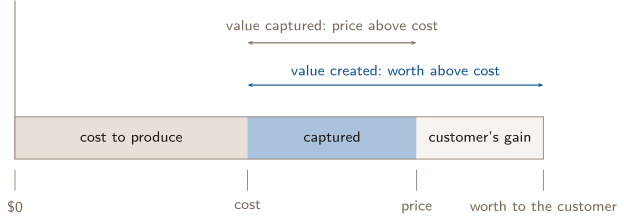
A business can create a great deal of value and capture little of it (a price near cost), or capture most of what it creates (a price near worth). Which it does is a choice, and Topic 1.2’s market decides how much choice it has.
CHECK 1 — SEPARATE VALUE FROM PRICE
Value created $30, value captured $10, customer surplus $20. Read them off the bar above: value created is worth above cost, ; the business captures price above cost, ; the customer keeps worth above price, . The two shares add back to the whole, , which is the check to run every time — if your two numbers do not sum to the value created, one of them was measured from the wrong end. The trap is reading value created as the price, or as the worth on its own. Neither is a difference, and value is always a difference here. And notice what the split is not: a fair division or a target. It is a description of where this price sits between cost and worth, and card 3’s market is what decides how far the business can move it.
2. ASK FOR THE MISSING EVIDENCE
A coffee shop in a differentiated market proposes a 30% price cut. Is knowing that the market is differentiated enough to decide whether the cut is a mistake?
3. MARKETS, THE MARKET PRICE, AND THE STRATEGIES COMPETITIVENESS ALLOWS
A market is any space, physical or virtual, local or global, where sellers meet buyers. Voluntary exchange there earns sellers revenue and gives buyers products they need or want. Sellers seek higher prices for profit, buyers lower prices for savings, and in a competitive market that push and pull settles on a prevailing market price. (Supply-and-demand graphs are excluded from this exam; the words are enough.)
Competitive advantage is the ability to outperform rivals in the same market — more market share, and potentially more profit. How competitive a market is depends on how many rivals there are, how differentiated their products are, and how easily a rival can offer the same thing cheaper. That competitiveness picks the strategy:
the market | what it looks like | how a business seeks advantage |
|---|---|---|
commodity | many rivals, identical products (wheat, gravel) | produce as efficiently as possible and charge the lowest price |
differentiated | rivals whose products differ | show customers the product is superior: quality, unique features, service, lower prices, better marketing |
protected | rivals kept out | create or strengthen barriers to entry: patents and other intellectual property, regulation that limits rivals, locked-up access to suppliers, high startup costs, low prices from operating at scale |
monopoly | one business, a unique product, no rivals | protect the position by maintaining its barriers |
The exam’s question is rarely “what is a barrier to entry” and usually “why does this business pursue this strategy” — and the answer starts with the row it is in.
CHECK 2 — ASK FOR THE MISSING EVIDENCE
No. The market tells you which strategies are available — in a differentiated market price is one lever among quality, features, service and marketing, where in a commodity market it is the only one — but availability is not the same as advisability, and a 30% cut turns on numbers the sentence has not given you: the contribution per bag at the new price, how much extra volume it would take to make that back, the capacity to serve that volume, and how rivals respond. Name those four and you have the answer the exam is buying. Then commit: on the evidence as it stands, test the cut as a limited promotion against the current price rather than making it permanent, because that is the version whose result tells you which way to go. A recommendation with its condition attached scores; “we cannot say” does not, however carefully it is argued.
4. PESTEL: THE SIX OUTSIDE FORCES, AND THE EVALUATION THEY ADD UP TO
PESTEL factors are the external forces that shape which businesses are viable in a market — and, the CED adds, which careers are available there.
factor | what it covers | how it moves viability |
|---|---|---|
Political | trade policy, taxes and subsidies, mandates, bans, political stability | subsidies and mandates support an activity; bans and taxes limit it |
Economic | stability, household income, inflation, unemployment, interest rates | spending by consumers, businesses and government rises or falls with the economy; some businesses thrive in a weak one |
Social | demographics, cultural norms, lifestyle trends, population growth | consumers’ needs and wants, and so what a consumer-facing business can sell |
Technological | internet access, automation, the pace of innovation | the systems available for producing, distributing and reaching customers |
Environmental | geography, resource access, waste policy, consumers’ environmental views, disasters | the ability to produce and distribute; customers’ purchasing choices |
Legal | employment, consumer-protection, safety, environmental, IP and antitrust law | operating costs, and whether some operations are legal at all |
The evaluation. A business applies the framework to a market by naming the factors relevant to its product, judging each as an attraction or a risk, and deciding whether the market fits its business model — a tech company wants cheap high-speed internet and power, a farm-to-table restaurant wants customers who prize local food. A change in a factor can end viability in an existing market by changing what customers want or can buy, which systems are available, or what resources can be reached; the same change moves jobs, which is the personal-finance half of the topic.
3. TEST THE ACTUAL CUSTOMER
Parents say they love a student’s product, but the school will be the one buying it. Has willingness to pay been established?
5. WHERE IDEAS COME FROM, THE RISK OF A NEW PRODUCT, AND THE DESIGN-THINKING PROCESS
An entrepreneur develops a new business and takes on its risks and its potential rewards. Ideas come from observing, interviewing and surveying potential customers to find needs, from market and technical research that finds gaps, and from experimentation that builds new capabilities.
The risk is that a new product needs financial, physical and human resources, which cost money, and there is no guarantee it earns enough revenue to cover them. The incentives to bear it: the prospect of future profit, the satisfaction of solving a problem, the chance to pursue a passion — and, on the personal-finance side, the income an owner draws from a business they run.
The entrepreneurial design-thinking process, in the CED’s order:
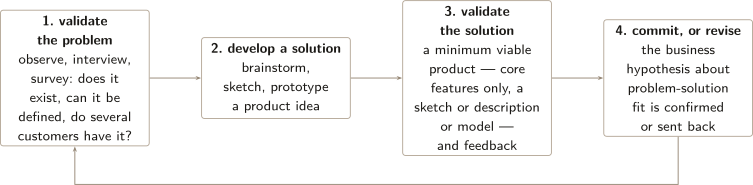
The order is the content. Validation before solution: the exam’s wrong answer is the entrepreneur who builds the product and then looks for the problem. And a minimum viable product is deliberately minimal — the simplest version with only core features, so that feedback arrives before the expensive resources are spent.
CHECK 3 — TEST THE ACTUAL CUSTOMER
No. Enthusiasm has been established, from people who are not going to pay. The card’s own distinction is doing the work: the customer buys and the consumer uses, and here a third role has appeared — the parent who advocates. Three roles, and only one of them signs a purchase order. A school buys against a budget line, a procurement process, a term, and whatever it already owns; none of that is visible in a parent saying they like it. So the validation step is not done, and the fix is specific rather than general: put the price in front of the person who approves the spend and ask for a commitment, not an opinion. That is what design thinking means by validating before building, and it is why “everyone I showed it to loved it” is the most expensive sentence in this unit.
6. CORE VALUES AND COMPETENCIES, VISION AND MISSION, AND WHAT DIFFERENT ORGANIZATIONS ARE FOR
Core values are the defining beliefs and principles that guide action — creativity, excellence, transparency, empathy, reliability. A business communicates them to align employees to a shared purpose and to steer decisions toward courses consistent with them. Core competencies are the capabilities, skills and expertise that let a business, or a person, outperform rivals — innovation, customer service, communication, ethical behavior, efficiency. Businesses weigh their competencies when choosing which opportunities to pursue and where to put resources; individuals weigh their values and competencies when choosing education, careers and jobs.
| vision statement | mission statement |
|---|---|---|
says | the business’s core values and aspirations, concisely | what the business does, and how it will achieve its long-term goals |
for whom | employees, to guide decisions and share a purpose; customers and investors, to know the goals and values | the same audiences, told the how |
sounds like | “a world where every student is met at their level” | “we provide one-to-one engineering-led tutoring and report every session the same night” |
What organizations are for. Businesses seek profit and its growth — by raising revenue, cutting costs, or both — while fulfilling their mission and staying viable and competitive over the long term. Social enterprises seek profit and a social objective at once, through their products, their operations or their financial model. Nonprofits serve the public good rather than owners: any surplus of revenue over cost must, by law, be reinvested in the organization, and grants and donations are often part of their revenue.
7. ETHICS: WHAT GOES WRONG, HOW A BUSINESS PREVENTS IT, AND HOW A LEADER DECIDES
Unethical behavior — falsifying or concealing information, misusing company property, harming employees or customers — can occur at every level, and incentive structures can push individuals toward it when the gain is theirs. Businesses encourage ethical behavior with codes of conduct, training, internal repercussions for transgressions, and leaders who model it; and ethical practice pays, in customers, employees and brand loyalty, while a business’s response to a lapse changes its relationships, its reputation and its profitability.
An ethical dilemma is a conflict between a core value — transparency, fairness, empathy — and another value, a goal, or a practice. Leaders facing one consider the effect of each possible response on stakeholders:
- internal — directly involved in operations and outcomes: owners, managers, employees;
- external — not employed by the business but with a stake in its decisions: customers, government agencies, the community.
Two ways to decide, and the exam accepts either when it is named: weigh the benefits and costs of each response for each stakeholder group and choose the greatest total benefit or least total harm; or choose the response most consistent with the business’s vision and goals. The answer that scores names the stakeholders, the effect on each, and which rule chose.
8. THE FOUR FORMS OF ORGANIZATION, THE ROLES INSIDE THEM, AND OUTSOURCING
form | control and profits | liability | funding and growth |
|---|---|---|---|
sole proprietorship | the owner’s alone | personally liable for all business debts | limited access to funding |
partnership | the partners’, divided by strength and interest | personally liable | limited |
limited liability company (LLC) | the owners’ | no personal liability for business debts | limited |
corporation | ceded to shareholders and an elected board; the company controls profits | the company, not the owners, is liable | greater access to funding, more ability to grow |
The trade is one line: keep control and profits and accept limited funding, or fund growth by giving up control. The LLC is the middle: the owner’s control with the corporation’s shield.
Roles. A sole proprietor is every role at once — CEO, marketer, product developer, financial manager, operations manager; partners split them by strength. As a business grows it needs more people with specific skills, so it organizes into specialized departments: sales and marketing (research, sales strategy, brands, customer relationships), research and development (new and better products and processes), operations (making and delivering the product), accounting (tracking money and preparing financial statements), finance (securing and managing funds, recommending strategy from the data), human resources (recruiting, training, evaluating). Executive leaders own vision, strategy and performance; department managers report to them; in a corporation the executives report to the board and the shareholders. A business outsources a function when another business can do it more efficiently or cheaply — when it lacks the skills, or its own labor costs are high.
9. PRODUCTION PROCESSES AND SUPPLY CHAINS — AND THE STRATEGY THAT SHAPES THEM
A business chooses a production process: artisan — skilled labor and attention to detail, in smaller quantities — or mass production — technology, assembly lines and machinery for larger quantities. The choice follows what customers prioritize (quality, price, customization), the business’s core competencies, and the competitive landscape.
A supply chain connects everyone involved from raw materials to the customer’s hands, and it can be local, regional or global:

Choosing suppliers weighs cost, quality, efficiency, convenience and risk — natural disasters, political instability, resource shortages, production errors, a supplier’s reputation — because a delay or a cost increase threatens both competitive advantage and profit.
The strategy shapes the chain. A business competing on low prices uses mass production and builds its chain to cut cost — cheaper resources, more efficient processes — and may scale, building higher-capacity chains where revenue rises faster than cost. A business competing on quality builds a chain of quality resources and methods, artisan or mass. A business competing through barriers to entry signs exclusive or restrictive agreements — a supplier who will not sell the part to rivals, a retailer who will not carry them.
PROBLEM 1
Value created, value captured, and who the customer actually is
Tessa assembles day-hike kits — a map, a first-aid pouch, water tablets, a whistle — and sells them at a trailhead stand for $38. Each kit costs her $22 in parts and packaging. A parent buys one for a sixteen-year-old who is hiking with friends; the parent says they would have paid up to $50 for the peace of mind. (a) Identify the customer and the consumer, and explain the difference. (b) Identify the problem, need or want the kit addresses, and say what problem-solution fit means here. (c) Calculate the value Tessa captures on the kit and the value the kit creates, and explain the difference in one sentence. (d) Tessa is asked to sell kits to a school’s outdoor club at $25 each. Assume the club values each kit at $50 and unit cost remains $22. Explain, using value creation and value capture, what changes and what does not.
BEFORE YOU COMPUTE
Rung 1 and rung 3: this is Topic 1.1, and every part is one of its pairs — customer against consumer, need against want, created against captured. Before (c), fix the three numbers in card 2’s picture: cost, price, worth. Value captured is price above cost; value created is worth above cost; and the customer’s own gain is what is left between the two. Before (d), decide which of the three numbers a lower price moves, and which it cannot.
WORKING
(a) The customer is the parent — the individual who purchases the kit. The consumer is the sixteen-year-old — the one who uses it on the trail. The exam keeps them apart because a business must satisfy both: the parent decides on peace of mind, the teenager decides whether the kit gets carried.
(b) The parent’s problem is a specific worry — a teenager on a trail without the basics — and, in the course’s words, a need for safety rather than a want. Problem-solution fit means the kit answers exactly that: the map, the first-aid pouch, the whistle are the things the worry is about, in one package at the place the worry occurs. Tessa cannot serve every hiker; she has chosen parents of new hikers, at trailheads, and the kit is built for them.
(c) Value captured is price above cost:
Value created is worth above cost:
The kit creates $28 of value; Tessa captures $16 of it as the margin between her price and her cost, and the parent keeps the other $12 as the gap between what the kit was worth to them and what they paid. Value creation is about the customer’s benefit; value capture is about the business’s price.
(d) At $25, the value created does not change: the kit is the same product, worth the same to the family, costing the same $22 to make. What changes is the capture: per kit, and the club keeps $25 of the created value instead of $12. Tessa is still creating $28 of value per kit; she is choosing to capture almost none of it — which can be a sound choice for volume or goodwill, and the exam wants the choice described in those two words.
ANSWER
(a) customer: the parent (buys); consumer: the teenager (uses) (b) a safety need; the kit’s contents match the worry, at the place it occurs (c) captured $16; created $28; the $12 between them is the customer’s (d) value created unchanged at $28; capture falls to $3
WATCH OUT
Calling $16 “the value.” It is the value captured; the value created is $28, and a student who reports one number for both has missed the topic’s distinction. Second, in (a): naming the teenager as the customer because the kit is “for” them — the customer is the one who pays. Third, in (d): saying the kit “creates less value” at a lower price. Price moves capture, not creation; the worth to the family and the cost to Tessa are what they were.
CONNECTION
The $16 Tessa captures is Unit 3’s gross profit per unit, and Unit 2’s marketing is the work of raising the worth — the $50 — so that a higher price captures more without losing the customer. Card 3 explains why she can charge $38 at all: at a trailhead with no rival stand, the market is closer to a monopoly than to a commodity, and the price she sets is the strategy that market allows.
ABOUT THIS EXCERPT
This is the opening of a 37-page guide: the diagnostic tree, the full Master Toolbox, and the first worked problem. 7 more problems follow in the complete guide, each worked the same way — what to notice before you start, every step shown, and the mistake that problem invites. The complete guide is shared with families during the fit conversation.
Engineering Confidence — engineeringconfidence.one
Source and review notes
What this resource is
Complete browser edition of the public excerpt from an original Engineering Confidence AP Business with Personal Finance unit-reference packet. Every business scenario is fictional and original; the AP Program’s business cases are named, never reproduced.
- Published
- Last reviewed
- Printable edition
- 15 pages
Course reference: official College Board course page.
Read this public excerpt above, or save the PDF for printing and offline reading.
Download the 15-page PDF excerpt