Read the public excerpt
The same instruction and worked examples appear here and in the printable PDF excerpt. You can request full guides for upcoming units below.
READ THIS FIRST
About this guide. Unit 1 described motion and refused to ask why. Unit 2 asks why, and the answer is always the same shape: an object’s velocity changes because something else is pushing or pulling on it. That something else is a force, and a force is never a property of one object — it is an interaction between two. Nearly every mistake in this unit comes from forgetting one of those two objects: a force drawn with no partner, a “force of motion” that nothing exerts, a normal force set equal to the weight because it usually is.
What dynamics actually is. Newton’s second law, , is the whole unit. Everything else — gravity, friction, springs, tension, circular motion — is a way of finding the forces to put on the left-hand side, or a special case of what the right-hand side looks like. Once you see that, the unit stops being nine topics and becomes one procedure with nine kinds of input: draw the forces, choose axes, add the forces along each axis, set the sum equal to along that axis. This guide runs that procedure on eleven problems and never varies it.
How to use these pages. The next two sections are your concept reference: a diagnostic decision tree (which kind of dynamics problem you’re holding) and a Master Toolbox (every force law and every rule the problems use, in one place, with the exam’s own boundary statements). You do not have to read every card before you start — open the one you need, and expect to flip back to them.
Then work each problem before reading its solution: read the prompt, read the “Before you compute” note, put the guide down, and try it. The note hands you the strategic decision — which forces, which axes, system or part — and stops short of the algebra, so you can still earn the problem. Recognition is not recall.
Afterward, close the guide and say which decision made the problem manageable. An answer you got right but cannot explain is the one to come back to.
A note on . This guide uses throughout, because that is the value the AP Physics 1 Exam uses whenever a number is required (the CED says so, and says is never penalized). A newton per kilogram and a meter per second squared are the same unit; the first name says what the field does to a mass, the second says what a free mass does in it, and the unit’s gravitation toolbox is about why those are equal.
WHERE THE POINTS GO ON THIS UNIT
Unit 2 carries – of the exam — with Unit 3, the heaviest — and its points are lost in a small number of predictable places.
The free-body diagram is scored on its rules. The CED is explicit: individual forces are drawn as straight arrows starting on the dot and pointing in the direction of the force; forces in the same direction sit side by side, never overlapping; components are not drawn on the diagram. A diagram that resolves the weight into and on the dot has drawn a force that does not exist and lost the point. The toolbox shows a right diagram beside three wrong ones.
The joined argument. On the 2025 exam, in College Board’s own words, less than 20% of responses correctly combined all steps in the derivation. A correct diagram, a correct equation and a correct number, written as three separate facts, is not an argument. Every solution here runs as one line of reasoning — diagram, axes, the sum along each axis, then the algebra — because that is the line the rubric follows.
The QQT question. The fourth free-response question asks for a claim and its reasoning without equations, then a derivation, then a sentence connecting the two. Students trained on numbers stall at the first step. So each problem’s “Before you compute” note is written as the claim you would make in words, and the Connection box says how the equation confirms it.
The normal force is not the weight. It equals the weight in exactly one situation — a level surface, no other vertical forces, no vertical acceleration — and the exam’s questions are built to leave that situation: elevators, hills, inclines, a hand pressing down. Solve the perpendicular equation for every time. Related, and scored the same way: apparent weight is the normal force.
The slope sentence. About one in five could say how a quantity is found from a graph’s slope. A spring’s is the slope of against ; a mass is the slope of against . Say what the slope is, physically, when you use one.
Mass is not weight. Mass in kilograms is the same on every planet; weight in newtons is and changes with . A “60-kg person weighs 600 N” on Earth and N on the Moon and has a mass of kg in both places. The word the question uses tells you which one it wants.
Diagnostic Decision Tree
Dynamics problems come in a handful of shapes, and the shape decides the setup. These seven questions run in order. Questions 1–3 ask what kind of motion the object has, because that fixes the right-hand side of Newton’s second law before you write a single force. Questions 4–7 ask which forces are present, and each one names the toolbox entry that supplies the force law. Then the procedure is the same for every problem, and it is the last line of the diagram.
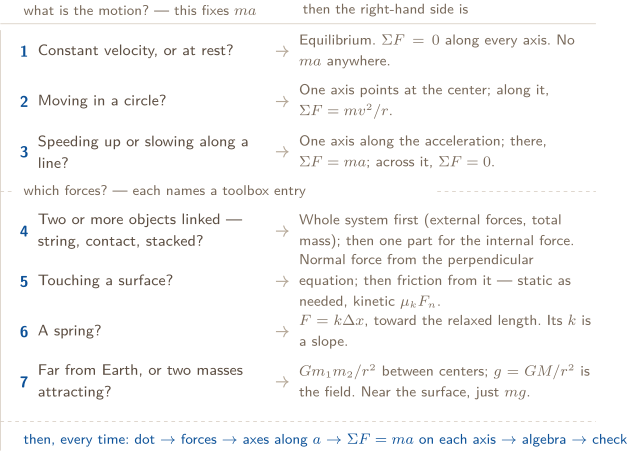 Seven gates and one procedure. The first three decide what
looks like; the next four decide what goes on the other side; the last line is the same for every problem in the
unit.
Seven gates and one procedure. The first three decide what
looks like; the next four decide what goes on the other side; the last line is the same for every problem in the
unit. HOW TO READ THE PROMPT
1. What is the object doing? Read for the verbs before the nouns: “at rest,” “constant speed,” “hangs,” “sits” all mean equilibrium, and equilibrium means — a much easier problem than the same picture with an acceleration in it. “Speeds up,” “slows,” “accelerates,” “the elevator starts moving” mean on one axis. “Turns,” “circles,” “orbits,” “swings through the bottom” mean toward the center. Decide this first; it is the right-hand side of every equation you are about to write.
2. Which forces are present? Only two kinds exist in this course: contact forces from something the object touches (normal, friction, tension, a push, a spring) and gravity, which acts at a distance. Walk around the object in your mind and name everything touching it; each contact is one force. Then add the weight. Then stop. There is no “force of motion,” no “centrifugal force,” no force “from the throw” still acting on a ball in flight.
3. One object, or several? If two things are tied, stacked or pushed together and the question wants the acceleration, treat them as one system: only external forces count, and the mass is the total. If the question wants the tension or the contact force between them, that force is internal to the system and invisible to it — pull one part out and draw its diagram alone.
4. What does the question actually want? “Derive” means symbols all the way to the end, numbers never. “Predict how changes if doubles” means read the functional dependence off the derived expression, not recompute. “Draw” means the free-body diagram, by the exam’s rules. “Justify” means the sentence after the equation, and it is worth as much as the equation.
Master Toolbox — Everything These Problems Use
SYSTEMS AND CENTER OF MASS — TOPIC 2.1
A system is whatever you decide to draw the box around. Everything inside interacts with everything else inside through internal forces; everything outside pushes on the system through external forces. The whole unit turns on one consequence of that choice: internal forces cannot change the motion of the system’s center of mass. Two skaters who push each other apart move oppositely, but the point between them, weighted by their masses, stays put. A person cannot lift themselves by their own belt.
When a system is one object. If the parts do not matter for the question — a car’s engine, a person’s arms — treat the whole thing as one object located at its center of mass. This is the same object model as Unit 1, and it is why a free-body diagram is a dot: the dot is the center of mass, and every force is drawn from it. When the parts do matter — two blocks tied together and the question asks for the tension — the system comes apart into its objects, each with its own diagram.
Locating the center of mass. For a symmetrical shape it lies on the lines of symmetry — the center of a uniform rod, disc or box. For separate masses along an axis,
— a mass-weighted average of the positions, and the same formula on the -axis gives . The center of mass sits closer to the heavier part, and it need not be inside any of the objects: a doughnut’s is in the hole. The course limits the calculation to five or fewer particles in two dimensions, or to highly symmetrical systems; anything more is qualitative.
Why it is here, at the start. Newton’s second law, stated properly, is about the center of mass: the acceleration of the system’s center of mass is proportional to the net external force. Everything that follows in this toolbox is that sentence applied to particular forces.
FORCES AND FREE-BODY DIAGRAMS — TOPIC 2.2, AND HOW THE EXAM SCORES THEM
A force is an interaction between two objects: one exerts it, one receives it. Every force in this course is either a contact force — the macroscopic result of atoms in one surface pushing on atoms in another: normal, friction, tension, a push, a spring — or gravity, the only force acting at a distance in AP Physics 1. An object cannot exert a net force on itself, which is why “the force of the ball’s motion” is not a force: nothing outside the ball is exerting it.
The free-body diagram is the tool for turning a picture into equations, and it has rules the exam scores directly:
- The object is a dot (its center of mass). Nothing else is drawn — not the surface, not the rope, not the ground.
- Each force is a straight arrow that starts on the dot and points in the direction of the force, labeled by what exerts it ( or , , , , ).
- Two forces in the same direction are drawn side by side, never on top of each other.
- Components are never drawn on the diagram. The diagram shows the forces that exist; resolving them is the next step and belongs in the algebra. A diagram carrying and on the dot has drawn two forces that nothing exerts.
- Velocity and acceleration are not forces and do not go on it. If you want to note the direction of , put a small arrow beside the diagram, not on the dot.
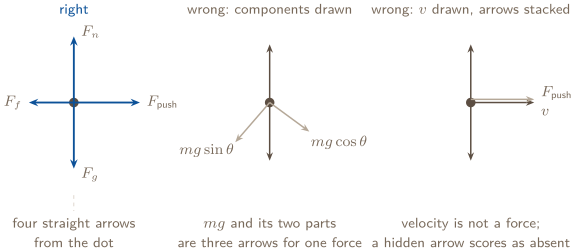 The scored diagram is the left one. On the exam a force drawn as components, a velocity drawn as a force, or
two arrows stacked so one is hidden each lose the point — the CED lists these rules in a boundary
statement.
The scored diagram is the left one. On the exam a force drawn as components, a velocity drawn as a force, or
two arrows stacked so one is hidden each lose the point — the CED lists these rules in a boundary
statement. Then choose axes. Put one axis along the direction of the acceleration (or of the velocity, if ) and the other perpendicular to it. On an incline that means one axis along the slope, so that the normal force and the acceleration each live on one axis and only the weight needs resolving. Choosing horizontal–vertical on an incline resolves two forces instead of one and doubles the algebra for no gain.
A check first. One question opens three of the cards below and is answered at that card’s end. Answer it before you read on. Getting it wrong is the point — that is what makes the card stick.
1. CHANGE THE SYSTEM
Two touching blocks push on each other. Why do their contact forces belong on separate free-body diagrams, yet disappear when you add the equations for both blocks?
NEWTON’S THIRD LAW — TOPIC 2.3: STRINGS, PULLEYS, AND THE PAIR YOU CANNOT CANCEL
Every force is one half of a pair: if A pushes on B, then B pushes on A with a force of equal size and opposite direction,
The two forces of a pair act on different objects, which is why neither can cancel the other inside a single object’s force sum, and why they never appear on the same free-body diagram. The Earth pulls the book down; the book pulls the Earth up. The table pushes the book up; the book pushes the table down. The weight and the normal force on the book are not a pair — they act on the same object, come from different partners (Earth, table), and happen to be equal only because the book is not accelerating.
The identification test. Name the pair by swapping the nouns: “the force of the hammer on the nail” pairs with “the force of the nail on the hammer.” If the swap changes the kind of force (gravity to normal), it is not a pair.
Inside a system, pairs are invisible. Internal forces come in pairs that add to zero, so they cannot move the system’s center of mass (topic 2.1 again). That is the whole justification for the “system first” move in the decision tree: pull the box around two connected blocks and the tension between them vanishes from the equation, leaving only external forces and the total mass.
Strings and tension. Tension is what the segments of a string exert on each other in response to an external pull. An ideal string has negligible mass and does not stretch, and its tension is the same at every point along it — including around an ideal pulley, which has negligible mass and turns without friction and therefore changes the string’s direction and nothing else. A string with mass is different: its tension is larger toward the end that supports more of it — a hanging chain is tightest at the top. The course asks about that only in words, never in numbers.
CHECK 1 — CHANGE THE SYSTEM
They act on different objects, so they cannot cancel inside either block’s own force sum — cancellation needs both forces on one diagram. Add the two blocks’ equations together and they do cancel, because now they are internal to the system you chose. Which forces count as internal is not a fact about the blocks; it follows from where you drew the boundary.
NEWTON’S FIRST LAW — TOPIC 2.4: EQUILIBRIUM, AND ONE AXIS AT A TIME
The net force is the vector sum of every force on the system. If it is zero, the velocity does not change — the object stays at rest, or keeps moving in a straight line at constant speed, and the two are the same state. That is translational equilibrium, and it is a statement about the sum, not about any single force: a block sliding at constant speed across a floor is in equilibrium with a pull, a friction force, a weight and a normal force all acting on it.
Balanced on one axis, unbalanced on another. Forces are added axis by axis. A projectile has zero net force horizontally (so is constant) and a net force vertically (so changes) — balanced along , unbalanced along , and the velocity changes only in the direction of the unbalanced part. That sentence is the first law and the second law in one breath, and it is why every problem is worked one axis at a time.
Inertial frames. Newton’s laws hold in a frame where an object with no net force stays at constant velocity — an inertial frame. A smoothly cruising train is one; a braking train is not, and in it a suitcase slides forward with no force pushing it. The course assumes every frame is inertial unless it says otherwise, and every frame that moves at a constant velocity relative to an inertial one is inertial too (Unit 1, topic 1.4: they all agree on accelerations).
The procedure for equilibrium is the general one with : draw the diagram, choose axes, write and , solve. Two unknowns need two axes; a hanging sign with two cables at different angles is the standard example, and it is Problem 4.
NEWTON’S SECOND LAW — TOPIC 2.5: THE ONE PROCEDURE
The acceleration of a system’s center of mass has the size of the net external force divided by the mass, and points the way the net force points. Three consequences the exam tests directly: the velocity of the center of mass changes only if a nonzero net external force acts; doubling the net force doubles the acceleration; doubling the mass halves it. And one consequence students resist: the acceleration points along the net force, not along the velocity. A car turning left at constant speed has a net force pointing left, toward the center of its turn, while its velocity points ahead.
The procedure, every problem:
- 1.
- Decide the motion (decision tree 1–3): , along a line, or toward a center. Write what the right-hand side will be.
- 2.
- Draw the free-body diagram by the rules.
- 3.
- Choose axes with one along . Resolve only the forces that do not lie on an axis.
- 4.
- Write on each axis, with every force carrying its sign. On the axis across the acceleration, the right-hand side is .
- 5.
- Solve the perpendicular equation first — it usually hands you the normal force, which friction needs.
- 6.
- Solve for what was asked. Then read the answer back: sign, size, units, and the limiting case (, , ).
Step 6 is where derivations earn their credit. An expression like should be checked at (no motion down a flat floor) and at (the frictionless ) before it is trusted.
2. TEST A FAMILIAR SHORTCUT
A person stands on a scale in an elevator accelerating upward. Is the normal force equal to the person’s weight?
GRAVITATIONAL FORCE — TOPIC 2.6: THE FORCE, THE FIELD, AND WHAT A SCALE READS
The law. Any two objects with mass attract each other along the line joining their centers of mass, with a force proportional to each mass and inversely proportional to the square of the distance between the centers:
The force on each is the same size (a third-law pair); the Earth pulls the apple exactly as hard as the apple pulls the Earth. Only the accelerations differ, by the ratio of the masses. Double the distance and the force drops to a quarter; triple the mass of one body and the force triples — the functional dependence the “predict how it changes” questions live on.
The field. Rather than recompute the force for every test mass, define the gravitational field of a body at a point as the force per unit mass it would exert there:
Near Earth’s surface that number is about N/kg, and it is the same that appears as in Unit 1, because if gravity is the only force on an object, . Weight is the gravitational force an astronomical body exerts on a nearby object: . It is a force, measured in newtons, and it changes with ; mass does not.
When “constant ” is allowed. If the object’s distance from the center of the Earth changes by a negligible fraction — anything you can throw, drop or drive — the field is the same at the start and the end and is exact enough. Satellites and moons are the exception: use with measured from the center, and expect to shrink with altitude.
Apparent weight is the normal force. A scale reads the force it exerts on you, which is the normal force, not . On a level floor at rest the two are equal, and that coincidence is the source of most elevator errors. Accelerating upward, and you feel heavier; accelerating downward, and you feel lighter; in free fall and you are weightless — gravity has not vanished, it is merely the only force acting, which is why astronauts in orbit float. The equivalence principle says an observer in a closed accelerating box cannot tell apparent weight from real gravity: a rocket accelerating at in deep space feels exactly like standing on Earth.
Two masses that agree. Inertial mass is how much an object resists having its motion changed (the in ); gravitational mass is how strongly it is pulled by gravity (the in ). Nothing requires them to be the same number; experiment says they are, to extraordinary precision — which is why every object falls at the same : the heavier one is pulled harder and resists harder, in exactly the same proportion.
CHECK 2 — TEST A FAMILIAR SHORTCUT
No. With upward positive, , so — larger than whenever the elevator accelerates upward. “Normal equals weight” is the result of one particular force balance, standing still on level ground, and not a definition of the normal force. The scale reads , which is why it reads high on the way up and low on the way down. Problem 5 is this with numbers.
KINETIC AND STATIC FRICTION — TOPIC 2.7: A FORCE THAT ADAPTS
Friction acts along the surfaces in contact, and it comes in two kinds that behave differently enough to be two different rules.
Kinetic friction acts while the surfaces slide relative to each other, opposes that relative motion, and has a fixed size:
where is the normal force — the perpendicular force the surface exerts, directed away from the surface — and depends on the two materials, not on the size of the contact area or on the speed. A wide block and a narrow block of the same mass and material feel the same friction.
Static friction acts while the surfaces do not slide, and it is not a fixed number. It takes whatever value and direction are needed to prevent slipping, up to a maximum:
Push a heavy box gently and static friction matches your push exactly; the box sits still. Push harder and it still matches, until your push exceeds ; then the box breaks free, kinetic friction takes over at — typically smaller than the maximum static value, since for most pairs of surfaces — and the box lurches forward. The graph of friction against applied force has a rising line, a peak, and a drop, and Problem 7 draws it.
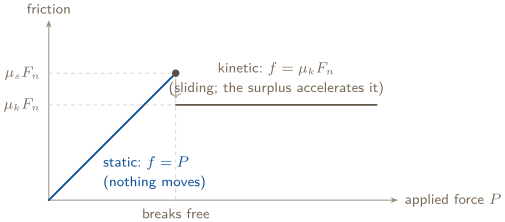 Static friction climbs with the push, one to one, until the push reaches
; then the block slides and friction
falls to the smaller, constant .
Below the break, friction is whatever equilibrium needs, not a formula.
Static friction climbs with the push, one to one, until the push reaches
; then the block slides and friction
falls to the smaller, constant .
Below the break, friction is whatever equilibrium needs, not a formula. Two habits. First, never write for a static friction force unless the problem says the object is on the verge of slipping — below that point static friction is found from equilibrium, not from a coefficient. Second, find from the perpendicular equation before writing any friction — on an incline , in an elevator , under a downward push exceeds . The coefficient multiplies the normal force, never the weight.
Which way does static friction point? Toward whatever prevents the slip: up the slope for a parked car, forward for a walking foot (the foot pushes back on the ground; the ground pushes the foot forward), toward the center for a car rounding a flat curve. If the direction is not obvious, draw it either way, solve, and read the sign.
SPRING FORCES — TOPIC 2.8: HOOKE’S LAW, AND AS A SLOPE
An ideal spring has negligible mass and exerts a force proportional to how far it has been stretched or compressed from its relaxed length:
where is the change in length from the relaxed length (not the length itself) and , the spring constant in N/m, says how stiff the spring is. The force always points toward the relaxed position: stretch it and it pulls back, compress it and it pushes back. Written with a sign along the spring’s axis, ; the minus sign is that restoring direction, and it is why springs oscillate in Unit 7.
is a slope. Hang masses from a spring, measure the stretch, and the graph of force against stretch is a straight line through the origin whose slope is . This is the exam’s favorite experimental-design question in the unit: what do you measure, what do you plot, and why does the slope beat any single pair of numbers? (Because one pair carries one measurement’s error; a line through many averages the errors out, and its intercept tells you whether the ruler was zeroed.) Say what the slope is: “the slope is , because Hooke’s law makes proportional to with as the constant.”
In equilibrium a hanging mass stretches the spring until . Two springs, or a spring on an incline, are the same procedure with the spring force as one more arrow on the diagram; the diagram does not care that the force comes from a spring.
3. SEPARATE SPEED FROM VELOCITY
A car follows a circle at constant speed. Is its net force zero? Name the change that decides.
CIRCULAR MOTION — TOPIC 2.9: WHERE THE ACCELERATION POINTS
An object moving in a circle at constant speed is accelerating, because its velocity is changing direction (Unit 1, topic 1.2). The acceleration points toward the center and has size
— larger for faster motion, larger for tighter circles. It is called centripetal, “center-seeking,” and it is not a new force. There is no centripetal force on a free-body diagram. Centripetal acceleration is produced by whichever real forces happen to point toward the center: tension in a string, gravity on a satellite, the normal force on a banked track, static friction on a flat road, or a component of any of them. The procedure is the general one with a radial axis: choose “toward the center” as positive, add the real forces along it, and set the sum equal to .
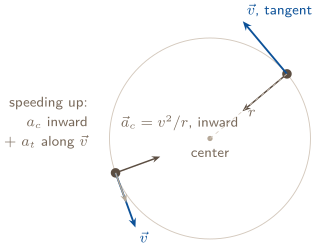 The velocity is always tangent to the circle; the centripetal acceleration always points at the center. If the speed is also changing,
a tangential piece
is added along the velocity, and the net acceleration is the vector sum of the two.
The velocity is always tangent to the circle; the centripetal acceleration always points at the center. If the speed is also changing,
a tangential piece
is added along the velocity, and the net acceleration is the vector sum of the two. Speed changing too. If the object speeds up or slows as it circles, there is also a tangential acceleration along the velocity, and the total acceleration is the vector sum of and . Uniform circular motion is the special case .
Period and frequency. One trip around takes the period ; the number of trips per second is the frequency . At constant speed the circumference is covered in one period, so
The four standard sources of , each a problem below:
- Over a hill, through a dip, at the bottom of a swing: gravity and the normal (or tension) force act along the vertical radius. At the top of a hill, , so the car feels lighter; go fast enough that and it leaves the road at . At the top of a loop the same is the minimum speed to stay on the track — there, gravity alone supplies the whole centripetal force. At the bottom of a dip or a swing, and the object feels heavier; a pendulum bob at the bottom of its arc is not in equilibrium even though it is neither speeding up nor slowing down at that instant.
- A banked curve, no friction: the normal force is the only force with a horizontal component, and that component is the whole centripetal force: , , so — the one speed at which the bank alone holds the car. The course computes only this frictionless case; with friction, banked curves are discussed in words.
- A conical pendulum: a bob swinging in a horizontal circle on a string at angle from the vertical. The horizontal component of the tension is the centripetal force, the vertical component holds the weight — the same two equations as the banked curve with tension in place of the normal force.
-
A satellite: gravity is the only force, so . Substitute and the mass of the satellite cancels:
— Kepler’s third law, derived rather than memorized. The period depends on the central mass and the orbit radius, and on nothing about the satellite. (Kepler’s first and second laws are not in the course.)
CHECK 3 — SEPARATE SPEED FROM VELOCITY
No. Velocity is a vector and the car’s direction changes at every instant, so it accelerates — inward, at — and something has to supply that net force. Constant speed removes the tangential acceleration only. The change that decides is the change in direction, not the change in speed.
VERIFICATION HABITS — HOW TO CHECK WITHOUT REDOING
- Limiting cases. Set , , , in your derived expression and ask whether the physics you already know comes out. A formula that gives a nonzero acceleration on a flat frictionless floor with no push is wrong before any numbers go in.
- Direction. Does the acceleration point along the net force? Does static friction point toward preventing the slip? Does the normal force point away from the surface?
- The normal force check. Is larger than where the object should feel heavier (dip, upward acceleration, a downward push) and smaller where it should feel lighter (hill, downward acceleration, incline)?
- Units. N/kg and m/s are the same unit; N/m times m is N; kgm/s is N. A derived has units m/s.
- A second route. System-then-part gives the tension; part alone gives it again with a different equation. If the two agree, the answer is defended.
PROBLEM 1
Where the system is: the center of mass
(a) Three blocks sit on a frictionless track: kg at , kg at m, and kg at m. Find the system’s center of mass. (b) Three point masses lie in a plane: kg at , kg at and kg at . Find the center of mass. (c) Two carts, kg and kg, rest on a frictionless track with a compressed spring between them. The spring is released and the -kg cart moves m to the left. How far, and which way, has the -kg cart moved — and where is the center of mass now?
BEFORE YOU COMPUTE
Part (c) is the one worth thinking about; (a) and (b) are the formula. The claim to make in words first: the spring’s push on each cart is an internal force, so the center of mass of the two-cart system cannot move. The carts move; the point between them, weighted by mass, does not. So the answer to “where is the center of mass now” is “where it was,” and the heavy cart’s displacement follows from keeping it there.
For (a) and (b): the center of mass is a mass-weighted average of positions, computed one axis at a time. Expect it nearer the heavier masses, and expect that it need not sit on any of them.
WORKING
(a) One axis, three masses, total kg:
Between the -kg block at m and the -kg block at m, closer to the heavier one — and on empty track, where no block sits.
(b) Two axes, the same formula on each, total kg:
The center of mass is at — inside the triangle the three masses outline, pulled toward the -kg mass at the top and the -kg mass on the right.
(c) Put the origin at the center of mass before release, and let right be positive. The spring pushes the carts apart with a third-law pair of forces — equal in size, opposite in direction, both internal to the two-cart system — and no external horizontal force acts (the track is frictionless). So the system’s center of mass stays at the origin:
With m for the -kg cart,
The -kg cart has moved m to the right — one third as far, because it has three times the mass — and the center of mass is exactly where it started. Check: .
ANSWER
(a) m (b) (c) the heavy cart moved m to the right; the center of mass has not moved
WATCH OUT
Averaging the positions instead of weighting them. m is the center of the positions, not of the mass; it treats a -kg block like a -kg one. The weights in the average are the masses, which is the whole point of the formula.
Giving the heavy cart the same displacement. Equal and opposite forces do not mean equal and opposite displacements. The forces are equal (third law); the accelerations are not (second law, ); the heavier cart moves less in the same time, by exactly the mass ratio.
Reading “frictionless” as decoration. It is the condition that makes (c) work: with friction, the track would exert an external force and the center of mass could move. Say the condition out loud when you use it.
CONNECTION
Part (c) is Unit 4 in disguise: “internal forces cannot move the center of mass” becomes “momentum is conserved” once momentum is defined, and the line is the first conservation law you have written. It is also why every free-body diagram in this unit is a single dot — the dot is the center of mass, and Newton’s second law, stated exactly, is about how that dot accelerates under the external forces alone.
ABOUT THIS EXCERPT
This is the opening of a 45-page guide: the diagnostic tree, the full Master Toolbox, and the first worked problem. 10 more problems follow in the complete guide, each worked the same way — what to notice before you start, every step shown, and the mistake that problem invites. The complete guide is shared with families during the fit conversation.
Engineering Confidence — engineeringconfidence.one
Source and review notes
What this resource is
Complete browser edition of the public excerpt from an original Engineering Confidence AP Physics 1 unit-reference packet. Every problem and scenario was written for this guide.
- Published
- Last reviewed
- Printable edition
- 16 pages
Course reference: official College Board course page.
Read this public excerpt above, or save the PDF for printing and offline reading.
Download the 16-page PDF excerpt