Read the public excerpt
The same instruction and worked examples appear here and in the printable PDF excerpt. You can request full guides for upcoming units below.
READ THIS FIRST
About this guide. Kinematics is the first unit of AP Physics 1, and the first place the course punishes a habit that worked in earlier math classes: grabbing an equation before deciding what kind of problem you’re holding. In algebra, the problem told you what to do — it appeared in the section on quadratics, so you used the quadratic formula. Physics stops labeling. Eight problems that look almost identical on the page can want five different tools, and the work of deciding which one is now yours. That decision is the hard part, and it is invisible in most solution manuals, which start at line one of the algebra as though the choice made itself. Every problem in this guide therefore starts the same way — with the decision, not the algebra.
What kinematics actually is. It is the description of motion without asking what caused it. No forces, no masses, no pushing — those arrive in Unit 2. Here you have four quantities (position, velocity, acceleration, time), a small set of relationships between them, and the job of moving among them. That narrowness is a gift: there is a genuinely finite list of things that can be asked, and this guide is organized around that list.
How to use these pages. The next two sections are your concept reference: a diagnostic decision tree (how to tell which kind of problem you’re holding) and a Master Toolbox (everything the problems draw on, in one place). You do not have to read every card before you start — open the one you need, and expect to flip back constantly while you work. That is what they are for, not a sign you failed to memorize something.
Then work each problem before reading its solution. Read the prompt, read the “Before you compute” note, put the guide down, and try it. That note sits between the question and the working on purpose — it hands you the strategic decision and stops short of the arithmetic, so you can still earn the problem. If you read straight through to the worked solution, everything will look obvious and none of it will be available to you on a test. Recognition is not recall.
Afterward, close the guide and say which decision made the problem manageable. An answer you got right but cannot explain is the one to come back to.
A note on the figures. Graphs are not a side topic here — reading and producing them is part of what Unit 1 is about, and nearly every problem in this unit gets easier the instant you draw it. So if you take one habit from this packet, make it this one: draw the situation before you write an equation, every time, including the times you’re sure you don’t need to.
WHERE THE POINTS GO ON THIS UNIT
Four habits earn most of the credit that Unit 1 questions carry, and the College Board says so in its own scoring reports.
The joined argument. On the 2025 exam, in College Board’s own wording, less than 20% of responses correctly combined all steps in the derivation. They report the joining, not the pieces. A correct equation, a correct substitution and a correct number, written as three disconnected facts, is not the same as one argument that runs from the situation to the answer — and only the argument scores fully. That is why every solution in this guide is written as one line of reasoning: what kind of problem, the picture, the sign convention, then the equation.
The slope sentence. On the same exam only about one in five could say how a quantity is found from the slope of a graph. Reading the slope is easy; the point is the sentence: “the slope is the acceleration, because the slope of a velocity–time graph is the rate at which velocity changes.” Say what the slope is, physically, every time you use one.
The sketch. One free-response question hands you a description and asks you to draw the graphs. It is scored on the shape and on the sign of the slope — curving up or down, straight or flat, positive or negative — not on numbers. The graph toolbox below ends with the procedure.
The exam’s . Whenever a number is required, the exam uses ; using or is never penalized. This guide works its numbers with , so that you see the physics at full precision and can check against any textbook. When a question specifies , use that value. Otherwise use on a multiple-choice question — the choices are built on it, so with your answer will not be among them and you will spend a minute hunting for an error you did not make. The difference is about two percent.
The sign is a direction. A negative displacement, velocity or acceleration is a statement about direction and is often the whole answer. A negative speed or distance is an error — those are scalars, and scalars have no direction to be negative in.
Diagnostic Decision Tree
Choose a reference frame and a positive direction first. Then distinguish a value, a slope and an area before reaching for an equation.
A check first. One question opens each of the next three sections and is answered at that section’s end. Answer it before you read on. Getting it wrong is the point — that is what makes the section stick.
1. PREDICT BEFORE COMPUTING
An object has negative velocity and positive acceleration. Is it speeding up, slowing down, or neither? State when your answer applies.
Before any algebra, you have to know what you’re holding. These seven questions sort every kinematics problem in the unit, and they run in two passes. Questions 5–7 go first and ask what shape the problem is: how many objects, how many dimensions, is it a table of data? Their job is to cut the problem into pieces, not to name a tool — they add no new physics, which is why they sit below the line in the diagram. Then questions 1–4 run on each piece and name the tool for it. Within that second pass the order is deliberate: an early “yes” makes a whole category of work disappear, and the cheapest problem is the one you never have to compute.
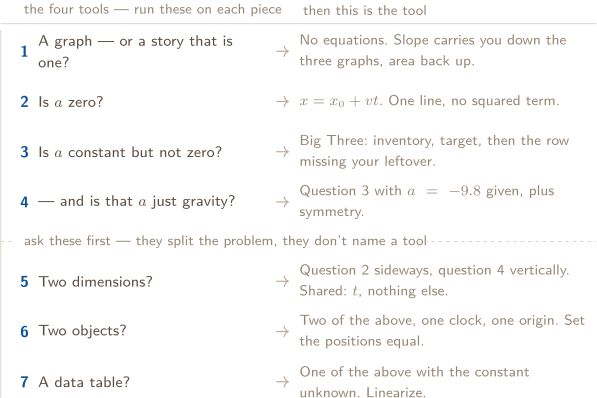 Seven gates, four ideas. The bottom three are not new physics — they are the top four in costume, which is why the list stops at
seven.
Seven gates, four ideas. The bottom three are not new physics — they are the top four in costume, which is why the list stops at
seven. HOW TO READ THE PROMPT
1. Am I given a graph — or a description that is really a graph? If yes, don’t reach for equations at all. The Big Three are a last resort here, not a first move, because a graph already contains the answer geometrically and geometry is faster and harder to get wrong. Translate it:
- Position–time: slope is velocity. Flat means stopped, steeper means faster, downhill means moving backwards. Curvature means acceleration.
- Velocity–time: slope is acceleration; area under the curve is displacement (signed — area below the axis counts negative).
- Acceleration–time: area is the change in velocity.
A prompt that narrates a sequence of steady legs (“walks forward, stops, walks back”) is a graph problem written in sentences. Sketch it and you have converted a reading-comprehension problem into a geometry problem.
2. Is the acceleration zero? Then constant velocity: . One equation, done — and notice it has no and no squared term, which is why spotting this case is worth the ten seconds it costs. The catch is that this case usually hides inside a bigger problem rather than making up the whole of it: the reaction-time leg of a braking problem, the coasting phase before the brakes, and the horizontal direction of every single projectile are all constant-velocity problems wearing a disguise. When you see one, solve it with and move on; don’t drag the Big Three into it.
3. Is the acceleration constant (but not zero)? The Big Three apply. The procedure is always the same three moves, and doing them in this order is what keeps you out of trouble:
- 1.
- Inventory. List all five variables (, , , , ) and fill in what you know — with signs.
- 2.
- Name the target. Which one does the question want?
- 3.
- Find the hole. There will be exactly one variable you neither know nor want. Pick the equation that doesn’t contain it.
This is the single most useful habit in the unit and it is developed at length in the Toolbox. Almost every “I don’t know which equation to use” is really “I skipped the inventory.”
4. Is it free fall? Then it is still question 3 — gravity is just a constant acceleration whose value you already know: with up chosen positive. Nothing thrown, dropped, kicked, or falling gets any other vertical acceleration, and that is true whether the object is rising, hanging at the top, or plunging. Free fall is not a new tool; it is question 3 with handed to you. What is genuinely new is the symmetry available (Toolbox) — use it before grinding algebra, because it routinely turns three lines of quadratic into one line of arithmetic.
5. Does the motion have two dimensions — launched, kicked, or thrown at an angle? Split it into two one-dimensional problems, both of which you already know how to do. Horizontal: constant velocity ( never changes, question 2). Vertical: free fall (question 4). The two directions share exactly one quantity — time — and nothing else. Almost every projectile problem is solved by finding the time in the vertical direction and spending it in the horizontal one. Once you have decomposed, there is no new physics left in the problem.
6. Are there two objects? Write a position function for each on the same clock and from the same origin, then set them equal. “Same clock, same origin” is not a formality — almost every failure on this problem type is a bookkeeping failure, not a physics one. The algebra hands you the meeting time; you decide which root is physical, and often the root you were going to discard is telling you something.
7. Is it a data table? You are being asked to be an experimentalist, not a calculator. Plot it — or better, linearize it (plot against , say) so that the physics constant you want becomes a slope. Lab questions also reliably ask a second thing: if a measurement were off in a stated direction, which way would the final answer be wrong? That is a distinct skill from computing, and it is taught in Problem 9.
WHY THE ORDER MATTERS
Inside the second pass, questions 1 and 2 are checked first because a “yes” to either can eliminate the algebra entirely, and the cheapest problem is the one you never have to compute. Everything below the line in the diagram is packaging rather than new physics — which is why the list runs to seven questions and not to seventy. There are only four ideas in this unit. The rest is recognizing them in costume.
CHECK 1 — PREDICT BEFORE COMPUTING
It is slowing down, and it stays slowing down only while the velocity is still negative: acceleration opposes velocity, so the speed falls. Once the velocity reaches zero the same positive acceleration makes it speed up in the positive direction. The sign pair alone does not answer the question — the answer needs the interval it applies to.
Master Toolbox — Everything These Problems Use
LANGUAGE FIRST: THE FOUR QUANTITIES
Physics uses several ordinary English words in a narrower sense than you do, and most early lost points are vocabulary, not physics.
Position is where you are, measured from an origin you chose. It is not “how far you’ve gone.” Position can be negative; that just means you are on the other side of the origin from the direction you called positive.
Displacement is the change in position, and it carries a sign. Distance is the odometer reading: total path length, never negative, never subtracting. Distance equals the size of the displacement as long as you never turn around, and the moment you do turn around they part ways permanently.
Walk 6 m forward, then 4 m back. Distance is m — your feet did all of it. Displacement is m — you finished 2 m from where you began, and the 4 m back canceled 4 m of the outbound trip. Displacement doesn’t care what route you took or how many times you doubled back; it compares two points and nothing else.
Average velocity uses displacement, so it inherits the sign and the not-caring-about-route. Average speed uses distance, so it is never negative. For the walk above over s: average velocity m/s; average speed m/s. Same trip, same clock, two answers differing by a factor of five. When a question says “velocity,” it wants the signed one, and the sign is part of the answer.
Instantaneous velocity is the velocity right now rather than averaged over an interval — the number a speedometer shows, with a direction attached. On an – graph it is the slope at that instant.
Acceleration is how fast the velocity changes. Across an interval that ratio is the average acceleration; the instantaneous acceleration is the slope of the – graph at a single instant — the same distinction velocity just drew. This unit assumes the acceleration is constant, which is the one case where the two are the same number. A – graph that curves is telling you they aren’t. Read the definition again, because the trap is in it: acceleration is not speed, and it is not “speeding up.” A car braking from m/s to rest in three seconds has a large acceleration. A car cruising at m/s has none. Acceleration measures change, so a fast object that isn’t changing has zero acceleration and a slow object that’s changing quickly has a lot. An object slowing down has an acceleration pointed against its motion — which is why acceleration needs a sign of its own, independent of the sign of the velocity, and why the two signs together are worth their own toolbox entry below.
Scalars and vectors — the classification the exam names. A scalar is a quantity with a size only: distance, speed, time, mass. A vector has a size and a direction: position, displacement, velocity, acceleration. In one dimension a vector needs no arrow — the sign of the number is its direction, which is why the sign toolbox below matters so much — and a vector sum in one dimension is just addition with those signs: two velocities in opposite directions have opposite signs and partly cancel. A scalar can never be negative. If a speed or a distance comes out below zero, that is not a direction; it is a mistake.
The object model. Every problem here treats the moving thing as a single point that carries its mass: a car, a ball and a student are all dots. Size, shape and what is happening inside are ignored, because they do not change where the dot is. When a later unit asks about a system’s parts, the dot becomes several dots; in this unit it never does.
Accelerating means the velocity is changing — in size or in direction. A car rounding a bend at a steady 20 m/s is accelerating, because its velocity (a vector) is changing direction even though its speed (a scalar) is not. Nothing in this unit turns, so the distinction costs you nothing here; in Unit 2 it becomes circular motion, and the students who remember it are the ones who are not surprised.
From average to instantaneous. Take the average over a shorter and shorter interval and the number settles toward the instantaneous value — which is exactly why the slope of a tangent line, the limit of shorter and shorter secants, is the instantaneous velocity on an – graph.
READING MOTION GRAPHS — THE HIGHEST-VALUE SKILL IN THE UNIT
Three graphs describe the same motion. They are not three unrelated pictures; they are one story told at three levels, and exactly two operations move you between them.
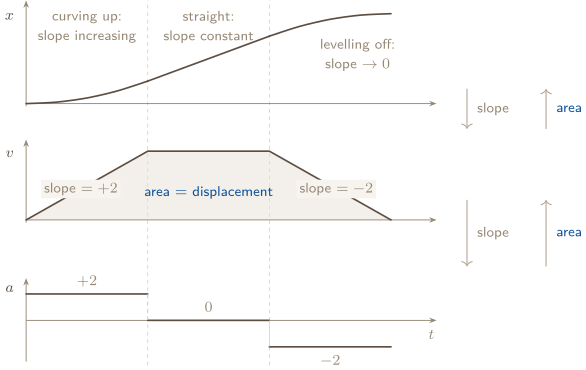 One motion, three graphs, aligned on the same clock. Read downward with slopes, upward with areas.
 Going down (slope). The slope of the – graph at any instant is the velocity at that instant. That isn’t a rule to memorize — it is the definition, arriving in graph form. Slope means rise over run; the rise on an – graph is and the run is , so slope is , which is precisely what velocity means. Check the units and you’ll never doubt it again: meters on the vertical divided by seconds on the horizontal gives m/s. The same argument one level down: the slope of the – graph is , in (m/s)/s m/s, which is acceleration.
Going up (area). The area under the – graph is the displacement. Here is why, and it is worth seeing once rather than accepting. Suppose the velocity were constant at for a time . Then — and on the graph, is the height and is the width, so is literally the area of that rectangle. Now take a velocity that is changing: chop the time axis into slices thin enough that the velocity barely changes across any one of them. Each slice contributes its own little rectangle of displacement, and the total displacement is the sum of all of them — which is the area under the graph. Units again: (m/s) s m. Height times width gives meters, so the area under a – graph could not be anything but a displacement. One level down, identically: the area under the – graph is , the change in velocity (m/s s m/s).
Now read the figure across the dashed lines, which is the part worth your time. In the first phase is a positive constant, so is a straight line climbing at a constant rate, so curves upward — the slope of is itself getting bigger. In the middle phase , so is flat, so is straight: unchanging slope, unchanging velocity. In the last phase is negative, falls back toward zero, and levels off.
Notice what the last phase is not. The object does not move backwards there. Its velocity stays positive right up to the final instant — look at the panel, which is above the axis the whole time — so keeps increasing; it just increases more and more slowly. Negative acceleration with positive velocity means slowing while still going forward. That one sentence resolves a large fraction of all sign confusion in this unit, and the figure is where you can see it rather than take it on faith.
Producing the sketch — the move the exam scores. One free-response question gives you a story or one graph and asks you to draw the others. The procedure is the two operations above, run deliberately:
- 1.
- Cut the story into phases wherever the acceleration changes — speeding up, cruising, braking. Each phase is one piece of each graph, and the boundaries line up vertically across all three.
- 2.
- Draw – first: a horizontal step in each phase (positive, zero, negative). It is the simplest graph and the other two are built from it.
- 3.
- Then –: straight segments whose slope is that phase’s ; a zero- phase is flat; the segments join without jumps, because velocity cannot jump.
- 4.
- Then –: curving up where , curving down where , straight where ; steeper where the speed is higher; never a corner, because velocity does not jump.
- 5.
- Check with signs: where is negative, falls; where and have opposite signs, the object is slowing.
The scorer looks at shape, slope sign and where the pieces meet. Label the axes, mark the phase boundaries, and do not invent numbers the prompt did not give.
A boundary you should know. If the acceleration is not constant — a – graph that curves — the course asks you to sketch and discuss, never to compute. The Big Three below are constant-acceleration equations and do not apply across a curved – segment; the area under it is still the displacement, and you may be asked to estimate it by counting squares, but no equation in this unit will produce it.
SIGNED AREA, AND THREE HABITS THAT PREVENT MOST GRAPH ERRORS
Area below the time axis counts as negative displacement, because the object is moving backwards during that stretch and giving back ground it had already gained.
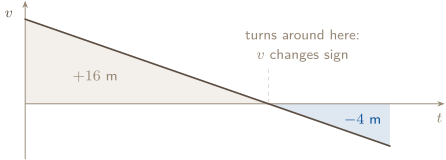 Displacement m.
Distance traveled
m. Add the areas’ sizes for distance; add them with signs for displacement.
Displacement m.
Distance traveled
m. Add the areas’ sizes for distance; add them with signs for displacement. That picture is the whole distance/displacement distinction in one place. If a question asks for displacement, subtract the area below the axis; if it asks for distance traveled, add it. And note where the turnaround happens — not where the graph is steepest, not where the graph is highest, but where it crosses zero. A zero crossing on a – graph is the only place an object reverses.
Three habits:
- Check which graph you’re on before you interpret a feature. A flat line means “not moving” on – and “moving at a steady speed” on – — opposite situations, identical appearance. The most expensive graph error there is reads a – graph as though it were –: a line rising from the origin looks like “moving away steadily,” but on – it means “speeding up from rest.”
- A value and a slope answer different questions. “Where is it moving fastest?” on an – graph means “where is it steepest,” not “where is it highest.” The highest point of an – graph is usually a place where the object has stopped.
- Below the axis is not “less” — it is “the other way.” A velocity of m/s is the same speed as m/s, pointed opposite. Rank speeds by distance from the axis, not by height on the page.
THE BIG THREE, AND HOW TO CHOOSE AMONG THEM
These apply only when the acceleration is constant. Every one of them is a statement about five quantities: displacement , starting velocity , final velocity , acceleration , and elapsed time .
Plus a fourth that most courses under-use: . It is just “average velocity times time” — and when the acceleration is constant, the average velocity really is the plain midpoint of the starting and ending velocities, which is why the formula is so simple.
Here is the structural fact that makes choosing easy. There are five variables, and every equation involves exactly four of them. So each equation has a hole — one variable it never mentions. Line them up and the selection rule stops being something you memorize:
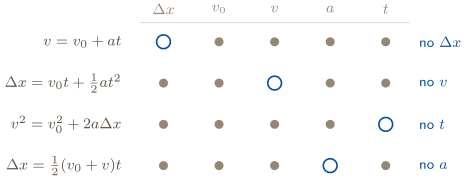 Filled dot: the equation contains that variable. Open ring: it doesn’t. Find the variable you neither know nor want —
there is exactly one row without it.
Filled dot: the equation contains that variable. Open ring: it doesn’t. Find the variable you neither know nor want —
there is exactly one row without it. Read the open rings down the diagram: , then , then , then . Four equations, four different holes. Whichever variable you neither know nor want, exactly one row is missing it, and that row is your equation. You never have to solve simultaneously, and you never have to guess.
The procedure, every time:
- 1.
- Write the five variables in a column and fill in every value you know, with its sign. Leave blanks where you don’t know.
- 2.
- Circle the one the question asks for.
- 3.
- Look at what’s left. One blank is the variable you neither know nor need. Go to the row without it.
Work an example against Problem 3’s braking phase. Known: m/s, , . Wanted: . Left over: — you don’t know it and the question didn’t ask for it. So use the row with no : . That took four seconds and no algebra, and it is the entire skill.
Two things people get wrong about these equations. First, constant acceleration is a condition, not a decoration. If the acceleration changes partway through — a car that cruises and then brakes — you cannot run one Big Three equation across the whole story. Break the motion into pieces, each with its own constant acceleration, and hand the ending velocity of one piece to the next as its .
Second, is displacement, not distance. If the object reverses inside the interval you’re using, the equation reports where it finished, not how far it traveled. When you need distance and a reversal happened, split the interval at the turning point (where ) and add the sizes.
Third, the exam’s . When a number is required, the AP Physics 1 Exam uses , and it computes every multiple-choice choice with it; is accepted on free response and never penalized. The worked numbers in this guide use so that you can check them against any textbook. Read a multiple-choice question with in your head: a ball thrown up at m/s rises m on the exam’s arithmetic and m on this guide’s, and both are right — but only one of them is printed among the choices.
SIGN CONVENTIONS: CHOOSE ONCE, THEN LIVE WITH IT
Kinematics in one dimension has no arrows, only signs — a sign is a direction. Which means the very first line of your solution should be a decision, written down: I am calling this direction positive. Up, right, east, downfield — whatever suits the problem. It does not matter which you pick. It matters enormously that you pick before you start and never revisit it.
Once chosen, everything else follows and nothing is negotiable. If up is positive, then a ball’s launch velocity is m/s, gravity is , and a point 20 m below the launch is at m — including while the ball is on its way up, including at the peak, including on the way down. The acceleration does not flip when the motion does.
The confusion that costs the most points is treating the sign of as a synonym for “slowing down.” It isn’t. The sign of tells you which way the acceleration points; whether the object speeds up or slows down comes from comparing that direction to the direction of :
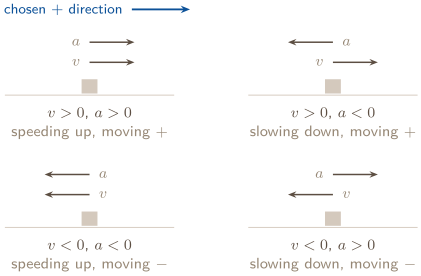 Same signs speeding
up. Opposite signs
slowing down. That is the whole rule, and it does not care which direction you called positive.
Same signs speeding
up. Opposite signs
slowing down. That is the whole rule, and it does not care which direction you called positive. Two sentences worth stealing, because they are what a sign flip would wrongly claim:
- Writing for a falling ball, after choosing up as positive, asserts that gravity pulls upward. Nothing in the problem said that, and nothing ever will.
- Writing m for a landing point below the launch asserts that the ball finished 20 m higher than it started. The ball fell into a river. Read your own equation back as an English sentence and errors like this announce themselves.
You may choose a different convention for a different problem — and Problem 7 deliberately takes down as positive, because everything in that problem moves downward and the arithmetic is cleaner with no minus signs at all. That is a fresh decision made at the start of a new problem, which is allowed. Changing your mind halfway through a problem is not.
FREE FALL — AND WHERE ITS SYMMETRY COMES FROM
“Free fall” means gravity is the only thing acting. In AP Physics 1 that covers essentially everything thrown, dropped, kicked, or launched, because the course tells you to neglect air resistance unless it says otherwise. The consequences:
- Choose up as positive; then for the entire flight — on the way up, at the top, on the way down.
- Free fall does not mean “falling.” A ball still rising is in free fall. The name describes what forces act, not which way the object happens to be going.
- At the peak, but is still . This is the single most-tested conceptual point in the unit, so be clear on why. Velocity passes through zero the way a thrown ball’s height passes through any other value — instantaneously, without stopping. If really were zero at the peak, the velocity would have no reason to change, and the ball would hang there forever. It doesn’t. What pauses at the top is the velocity’s value, not its rate of change.
- Mass is not in any of this. A heavy ball and a light ball thrown identically do identical things. If a problem gives you a mass in a kinematics question, it is either scenery or setup for a later part.
The symmetry facts, derived rather than asserted. Take a launch at upward from some height, and let the object return to that same height.
Time up equals time down. Going up, the velocity has to get from to , and gives . Coming back down from the peak, the velocity starts at and falls to some over the same drop . But the trip up covered exactly that too, so the two legs are the same journey run backwards with the same constant acceleration. Formally: from the peak, , and from the launch, . Setting those equal, .
Same speed at the same height. Use the equation with no in it, between launch and return, where because you’re back where you started:
Same size, opposite sign: same speed, opposite direction. Notice the argument never used the specific numbers, so it holds at every height, not just the launch height — pick any and the two crossings of that height give the same .
Where the symmetry stops. It only holds between two points at equal height. A ball thrown from a bridge and landing in the water below has a symmetric rail-to-rail portion and a completely unsymmetric rail-to-water portion. Problem 4 uses symmetry for the first and honest algebra for the second; knowing which is which is the actual skill.
2. CHANGE THE FRAME
A belt moves at constant velocity. A walker accelerates opposite the belt. Does changing from the belt frame to the ground frame reverse the walker’s acceleration?
REFERENCE FRAMES AND RELATIVE MOTION, ONE DIMENSION
Every velocity in this unit has been measured by someone, and the someone matters. A passenger on a train doing m/s sees the seat in front of her at rest and the platform sliding past at m/s; the person on the platform sees the seat at m/s and the platform at rest. Neither is wrong. They are measuring from different reference frames, and the frame decides the direction and the size of every velocity written down.
The rule, in one dimension. If observer B moves at velocity (measured by A) and an object moves at (measured by A), then B measures the object at
— a subtraction of signed numbers, because in one dimension a vector sum is a sum of signs. Turned around: what A measures is what B measures plus B’s own velocity. A walker doing m/s relative to a belt that carries her at m/s is doing m/s relative to the floor. The course restricts this to one dimension; two-dimensional relative motion is Physics 2 and beyond.
Why the highway feels the way it does. Cruising at m/s, you are passed by a car doing m/s. Relative to you it is doing m/s, so it drifts forward slowly. Relative to it, you are doing m/s: you appear to slide backwards. Nobody reversed. The CED’s own essential question — why it can seem that you are moving backwards when a car passes you — has this one-line answer.
The thing every frame agrees on. Velocities differ from frame to frame by the frame’s own velocity. If that frame velocity is constant — an inertial frame, which every problem in this course assumes unless it says otherwise — then the difference between the two velocity readings never changes, and so the acceleration is the same in both. Two observers who cannot agree on how fast something is going will agree exactly on how fast that is changing. On a graph it shows as curvature: the two – curves have different slopes everywhere and the same bend everywhere.
 One accelerating object, two observers. The blue curve is its position as the road
sees it; the grey curve is the same motion as seen from a truck moving at constant
. The slopes disagree at
every instant by exactly ;
the curvature — the acceleration — is identical.
One accelerating object, two observers. The blue curve is its position as the road
sees it; the grey curve is the same motion as seen from a truck moving at constant
. The slopes disagree at
every instant by exactly ;
the curvature — the acceleration — is identical. How the exam asks it. A velocity “relative to the water,” “relative to the ground,” “as measured by the passenger” — the phrase names the frame. Write each given velocity with its frame beside it before you add or subtract anything, then convert everything to one frame and work the problem there. Problem 6 does exactly this.
CHECK 2 — CHANGE THE FRAME
No. Two frames moving at constant velocity relative to each other disagree about velocity at every instant and agree exactly about acceleration, because a difference that never changes cannot change how fast the velocity changes. With the positive direction along the belt, the walker’s acceleration is negative in both frames. Only the offset moves — which is why Problem 6 can hand you the same number in two frames and mean it.
VECTOR COMPONENTS — THE TRIG THESE PROBLEMS NEED
Two-dimensional problems start by splitting one velocity into two, and end by putting two back together. That is all the trigonometry the unit requires, but you need it cold.
Splitting (launch). A velocity of magnitude at angle above the horizontal has
Cosine goes with the horizontal and sine with the vertical when the angle is measured from the horizontal, which it almost always is. Rather than memorizing which is which, check with a limiting case, which takes two seconds and never lies: if the launch is flat, so all the speed should be horizontal — and , delivers exactly that. If the angle is instead given from the vertical, the roles swap, and the same limiting-case check catches it.
Recombining (impact). Given components and , the speed is the hypotenuse and the direction is the arctangent:
Two sanity checks on the recombination. The speed must come out larger than either component — a hypotenuse always beats its legs. And the angle must land on the side you expect: if the motion is steeper than , and if it is shallower. State the direction in words along with the number (“ below the horizontal”), because a bare angle is ambiguous and loses credit.
Why components are legal at all. The horizontal and vertical directions are independent: what gravity does to has no effect whatsoever on , and how fast the object travels sideways has no effect on how long it takes to fall. That independence is what lets you treat one two-dimensional problem as two one-dimensional problems, and it is the reason a marble rolled twice as fast off a table lands twice as far away in exactly the same amount of time.
PROJECTILES: THE TIME LIVES IN THE VERTICAL
Once decomposed, a projectile is two problems you already know, running side by side on one shared clock:
- Horizontal: . Constant velocity. No acceleration, ever. at landing equals at launch.
- Vertical: free fall, with as the starting velocity and throughout.
- Shared: time, and only time. The two directions communicate through and through nothing else.
The consequence you use constantly: the time is in the . Flight time is set entirely by the vertical story — launch height, launch vertical speed, gravity. The horizontal direction contributes nothing to it and simply spends whatever time the vertical hands over. So the standard solution order is fixed: decompose, solve the vertical for , then use horizontally.
The other consequence: “at the wall” questions run backwards through the same channel. When a question asks about a specific place — “does it clear the fence at 55 m,” “is it above the net,” “where does it hit the wall” — you cannot answer from the vertical equation directly, because that equation speaks in time, not in . The conversion is always the same two moves:
Position to time to the other position. Every “at the wall” problem in the course is that chain, and Problem 8 walks it.
Two useful landmarks. At the top of the arc, but is unchanged — so the projectile is still moving, horizontally, at . Its speed there is a minimum, and for any launch with it is never zero. (Straight up is the exception, and it is why Problem 4’s ball does stop at the top: with there is nothing left to keep moving.) And for a launch and landing at the same height, the vertical symmetry facts carry over intact: the flight time is twice the time to the peak, and the landing speed equals the launch speed with reversed.
TWO OBJECTS, ONE CLOCK
When two things move and the question is about them meeting, passing, or catching, the entire method is bookkeeping:
- 1.
- Choose one origin and one , and use them for both objects. If one object starts 100 m ahead, that shows up as its , not as a separate coordinate system.
- 2.
- Write a full position function for each: and .
- 3.
- Translate the question into an equation about those functions.
Step 3 is where the thinking is, so be precise about the translation. “Catches up,” “meets,” “passes,” and “collides” all mean same position: . “Same speed” means , which is a different equation with a different answer, and the two moments are generally nowhere near each other. Confusing them is the classic error on this problem type, and Problem 5 draws the picture that makes the difference obvious.
Then interpret every root. Setting two position functions equal usually produces a quadratic, so you get two times. Neither is automatically garbage. A root of typically means “they were together at the start,” which is true and is not the answer you want. A negative root usually means “if this motion had been running before the problem began, they’d have met then” — physically meaningless here, so discard it, but say why. Two positive roots means they genuinely meet twice, and both are real answers. Never discard a root silently; name what it says first.
LINEARIZING DATA — TURNING A CONSTANT INTO A SLOPE
Lab questions hand you a table and want a physical constant. The move is always the same, and it has three steps.
1. Write the model. What relationship should hold if the physics is right? For a dropped object, .
2. Choose axes that make the model a straight line. Compare the model to . Here, if you plot on the vertical and on the horizontal, the model reads — a line through the origin with slope . You have to make a new column for ; that column is the work.
3. Read the constant out of the slope. Slope , so . Note that the slope, not any individual data point, is the measurement — that is the point of graphing at all.
Why bother, when you could just solve for from one row? Because a straight line is testable and a single row isn’t. If the points fall on a line, the model is behaving; if they curve away, your model is wrong or something systematic is interfering, and you can see it. And the slope uses all the data at once, so a single sloppy measurement moves it far less than it would move a one-row calculation. A curve can be neither verified nor measured reliably by eye; a line can be both.
The directional-error question, which is a separate skill. Lab questions reliably follow up with: if this measurement were off in this direction, would the result come out too high or too low? Answer it by tracing, not by intuition:
- 1.
- Which measured quantity does the error affect, and which way?
- 2.
- Where does that quantity sit in the formula — numerator or denominator?
- 3.
- Therefore the computed result goes which way?
Then write the conclusion in that exact shape: “this makes the measured value too high because…” Graders are looking for the chain, not the verdict.
VERIFICATION HABITS — HOW TO CHECK WITHOUT REDOING
Every solution in this guide ends with at least one of these, and you should make them reflex. They cost seconds and catch most of what goes wrong.
- Units. Do the units of your expression come out as the units of the thing you wanted? m/s times s gives meters, so can be a displacement. If your answer for a distance has seconds in it, you have found an error without checking any arithmetic.
- Sign. Read the sign back as a direction, out loud if necessary. “Negative, so it’s below the launch point — yes, that’s the river.”
- Size. Is the number the right order of magnitude for a physical object? A car braking in 3 s, a ball rising 11 m, a marble landing 1 m from the table: plausible. A ball rising 1100 m is not.
- Bounds. An average must lie between the minimum and the maximum. A final speed after braking cannot exceed the initial. An angled projectile’s speed at the top cannot be zero — it still carries its full . (Thrown straight up, like Problem 4, is the exception.)
- A second route. Where a problem can be done two ways, do the second one on the numbers you already have — it takes one line and it is the strongest check available. An answer you can defend two ways is an answer; an answer you can defend zero ways is a draft.
3. NAME THE QUANTITY
An object travels away from its starting point and then returns to it. Which of these must be zero: displacement, distance, average velocity, average speed?
PROBLEM 1
Reading a position–time graph
A student walks along a straight hallway. Her position is at ; she walks forward at a steady pace to m at s, stands still until s, then walks back at a steady pace, reaching m at s. (a) During which interval is her velocity zero? (b) What is her velocity during the final leg? (c) What is her average velocity for the whole walk? (d) What total distance did she travel, and what is her displacement?
BEFORE YOU COMPUTE
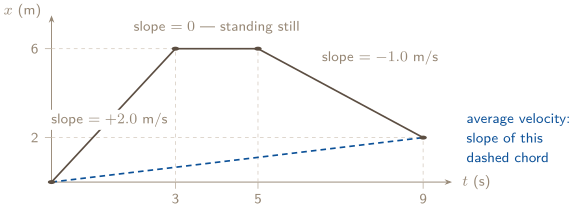
Question 1 of the decision tree, in disguise. Nobody handed you a graph — they handed you three sentences — but three sentences describing three steady legs is a graph, and your first move is to draw it. Do that before reading further; the sketch takes twenty seconds and converts the whole problem into geometry.
Once it’s drawn, every part is answered by slope, and you can see the structure: three straight segments, so three constant velocities, so no acceleration anywhere and no Big Three equation needed at any point. The one place to be careful is part (d), where distance and displacement stop agreeing — and they stop agreeing at the exact instant she turns around, which on your sketch is the corner at s.
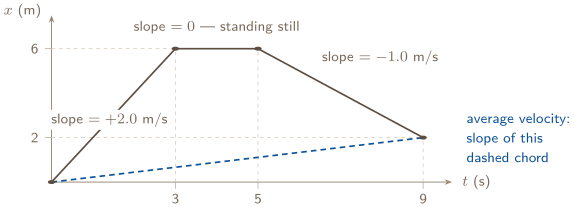 The walk, drawn. Every part of this problem is now a slope you can point at.
 WORKING
(a) Velocity is the slope of the – graph, so “velocity zero” means “slope zero” means “flat.” The graph is flat from s to s: her position stops changing, which is what standing still is.
Be careful about what this does not say. Her position during that interval is m, not zero — she is a long way from where she started. It is the change in position that is zero. A flat graph high above the axis and a flat graph on the axis describe the same behavior (not moving) at different places.
(b) The final leg runs from to . Slope is rise over run, and both of those are differences, always taken as (later minus earlier):
Two things to notice. The subtraction order matters and there is only one correct one: final minus initial, on top and on the bottom. Reverse both and you get the same answer; reverse one and you get the wrong sign.
And the minus sign is not a blemish — it is half the answer. It says she is moving in the negative direction, back toward her starting point. The speed is m/s; the velocity is m/s. If the question asks for velocity and you write m/s, you have withheld the direction and answered a different question.
(c) Average velocity is defined as net displacement over total time, full stop:
On the figure this is the slope of the dashed chord from the first point to the last — and drawing that chord is a good habit, because it makes the answer visually obvious: the chord is much shallower than the outbound leg, so the average must be much smaller than m/s.
Now look at what the tempting shortcut would have given. Averaging the three segment velocities:
That’s wrong by 50%, and it is wrong for a specific reason: it treats the three legs as equally important when they lasted , , and seconds. If you insist on averaging the segment velocities, you have to weight each by its duration — and then it works:
Same answer, more work. The definition was the shortcut all along.
(d) Distance is the odometer reading — add up every meter her feet covered, ignoring direction: m out plus m back m. Displacement compares two points and nothing in between: she finished at m having started at , so m.
The gap between and is exactly the doubling-back: the m return trip added m to the distance and subtracted m from the displacement, an m difference. That is always the relationship — every meter traveled backwards costs you two meters of the gap between distance and displacement.
Worth computing alongside, because the exam likes the contrast: her average speed is m/s, five times her average velocity of m/s. One trip, one clock, two legitimate numbers — which is why the words matter.
ANSWER
(a) – s (b) m/s (c) m/s (d) distance m; displacement m
WATCH OUT
“Average velocity” is not the average of the velocities, as part (c) just demonstrated in numbers. The plain average treats a two-second stand as equal in weight to a four-second walk. Go back to the definition every time — net displacement over total time — and you never have to think about weighting at all.
The same trap has a second door on it. Because the answer to (c) is m/s and she was never actually moving at m/s at any instant of the walk, students sometimes decide the answer must be wrong. It isn’t. An average velocity is a summary of the whole trip, not a description of any moment in it, and it routinely equals a speed the object never had.
CONNECTION
Notice that you answered four questions about this motion without writing a single kinematics equation. That will keep happening in this unit: when the information arrives as a graph, or as a description that becomes a graph, geometry beats algebra — fewer steps, fewer places to drop a sign, and the sense-check is built in because you can see the answer’s size before you compute it. The equations are for when the geometry runs out.
CHECK 3 — NAME THE QUANTITY
Displacement and average velocity must both be zero: the trip ends where it started, so the signed change in position is zero, and average velocity is that change divided by the time. Distance and average speed are not — they add path length without regard to sign, and the object did travel. Two of the four are signed and two are not, and that single distinction is the whole answer.
ABOUT THIS EXCERPT
This is the opening of a 51-page guide: the diagnostic tree, the full Master Toolbox, and the first worked problem. 8 more problems follow in the complete guide, each worked the same way — what to notice before you start, every step shown, and the mistake that problem invites. The complete guide is shared with families during the fit conversation.
Engineering Confidence — engineeringconfidence.one
Source and review notes
What this resource is
Complete browser edition of the public excerpt from an original Engineering Confidence AP Physics 1 unit-reference packet. Every problem and scenario in the packet was written for this guide.
- Published
- Last reviewed
- Printable edition
- 22 pages
Course reference: official College Board course page.
Read this public excerpt above, or save the PDF for printing and offline reading.
Download the 22-page PDF excerpt