Read the public excerpt
The same instruction and worked examples appear here and in the printable PDF excerpt. You can request full guides for upcoming units below.
READ THIS FIRST
About this guide. One sentence runs under every question in this unit: a limit is about the approach, never the arrival. Where the function was heading as closes in on , and what it actually does at , are two separate facts — and Unit 1 is built almost entirely out of the cases where they disagree. That is why so much of it feels like a trick until you see that it never was one.
The habit that turns that sentence into procedure is diagnose before you compute. Substitution is the stethoscope: what it returns tells you which tool the problem actually needs, and students who skip that diagnosis end up doing algebra on autopilot.
Three things go wrong in this unit, and they go wrong for nearly everybody. This guide goes after each one deliberately rather than hoping you absorb it in passing.
- Answering the wrong question. Reporting where the function landed when the question asked where it was heading. Every other error below is a variation on this one.
- Treating as a verdict. It is not an answer and it is not a failure. It is an instruction. Reading it as “undefined” and stopping is the most common way to lose a problem you were fully able to finish.
- Writing an answer where a justification was asked for. On the continuity and Intermediate Value Theorem questions, the exam grades a sentence. A correct number with the reasoning left in your head scores less than the same number with the reasoning said out loud.
The pages that follow are your concept reference: a diagnostic decision tree and a Master Toolbox, both built to be opened at the card you need rather than read front to back. What matters more is the order you work in. Try each problem before you read its solution — the “Before you compute” notes are placed to catch you at the exact moment a wrong turn usually happens, and they cannot do that if you have already seen the answer.
Every topic in the unit, and where it lives. The College Board lists sixteen; here is each one and the page that teaches it.
- 1.1 change at an instant — the first card of the toolbox (p. 13).
- 1.2 limit notation — the one idea (p. 15) and the one-sided card (p. 22).
- 1.3, 1.4 limits from a graph and from a table — Problems 11 and 10.
- 1.5 the limit laws, composition included (p. 17).
- 1.6 factoring, the conjugate, the stacked fraction, the trig forms — the playbook (p. 19) and Problems 2–5.
- 1.7 choosing the procedure — the decision tree and Problem 1.
- 1.8 the squeeze theorem (p. 20) and Problem 5.
- 1.9 one question, three representations — Problems 10 and 11 against Problems 1–9.
- 1.10, 1.11 the kinds of discontinuity and the three-part checklist (p. 26); Problems 6 and 8.
- 1.12 continuity on an interval, and which functions are continuous on their domains — the same card.
- 1.13 repairing a hole, choosing at a seam — Problems 2, 6, 8.
- 1.14 infinite limits and vertical asymptotes (p. 24); Problems 1(c) and 8.
- 1.15 limits at infinity, horizontal asymptotes, and which functions grow faster (p. 25); Problem 7.
- 1.16 the Intermediate Value Theorem (p. 28); Problem 9.
What eleven problems cannot do is give you enough repetitions. Each one is chosen to be the clearest instance of its shape rather than one of many, so treat a problem you found easy as a signal to go find five more like it, not as a topic finished. This guide is built to make you fast at recognizing which question you are looking at. Fluency is volume, and volume is homework.
WHERE THE POINTS GO ON THIS UNIT
Half of the AB exam is six free-response questions graded on the written justification, and in 2025 the average student earned 44% of those points — a number AB has not beaten in three years. The arithmetic of the score is blunt: with a perfect free-response section a student can miss 34 multiple-choice questions and still earn a 5; with the average free-response score, 8. Twenty-six questions of margin, every one of them bought with a sentence. Unit 1 is where the sentences start.
The sentence goes at the step where it matters, not at the end. A correct final number cannot show that you checked a hypothesis, and a grader scoring the line where the check belonged has nothing to read.
The hypotheses, then the conclusion. The College Board names the habit students lack: writing the given information down before drawing a theorem’s conclusion. “By the IVT there is a root” earns nothing; “ is continuous on because it is a polynomial, , so by the IVT there is a in with ” earns all of it. Problem 9 is that sentence, and the shape returns in Unit 5 with two more theorems.
The notation is the answer. One-sided limits carry their signs (, ); a nonexistent limit is reported as the two sides that disagree, not as “DNE” alone; a value read off a table carries . The exam’s own phrase is “correct mathematical notation,” and it is scored.
The name of the break is one of four words. Removable, jump, infinite, oscillating — each is a statement about what the limit did. “Asymptote” describes the graph, not the discontinuity, and a student of mine wrote it for “infinite discontinuity” on a quiz this month and lost the point with the mathematics entirely right. Say the kind, then say the evidence.
When a calculator is allowed, the set-up is still shown. Two sections of the exam forbid a calculator; where one is allowed, the expression you evaluated is written before the number, and the number is rounded (or truncated) to three places after the decimal point as the question specifies. Store intermediate values in the calculator; rounding twice is how a right method produces a wrong final digit.
Diagnostic Decision Tree
HOW TO READ THE PROMPT
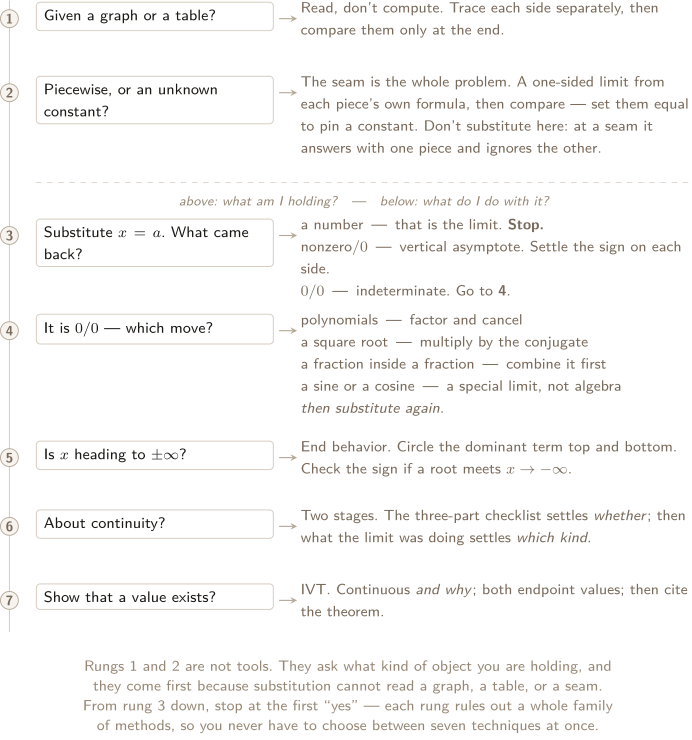
Four of those rungs hide a reason worth carrying, because a reason is what lets you rebuild the step on a morning you have forgotten it.
Why the first two come before any arithmetic. They are the only rungs that ask what you are holding, and a graph, a table, and a piecewise rule are three objects substitution cannot read. The first two have no formula to substitute into. The third has two formulas, and substitution will quietly pick one of them and answer as though the other did not exist — Problem 6(c) is that trap drawn out, a function whose value at the seam is a perfectly ordinary number while the limit does not exist at all. Settle what you are looking at, and rung 3 becomes trustworthy.
Why substitution comes next rather than last. It costs ten seconds, and it is a diagnosis rather than an attempt — its result names your next move instead of ending your turn. It is also legal for a specific reason: substituting works exactly when the function is continuous at . That is precisely what rungs 1 and 2 have just ruled on, which is why rung 3 can be trusted the moment they are clear.
Why the algebraic moves are one move. Factoring, the conjugate, and combining a stacked fraction are doing the same job: exposing the factor that is sitting in both the top and the bottom. They differ only in how that factor is hiding. Not every is that shape — a trigonometric one is not, which is why it gets its own line on rung 4 and its own problem — but every algebraic one you will meet here is, and the limit is not finished until the second substitution returns a number.
Why rungs 2 and 6 need no insight. “Find so the limit exists” is the equation left limit right limit; you solve it like any other equation. Classifying a discontinuity is bookkeeping too — but it is bookkeeping in two stages, and running them together is the single most common way to name one wrong. The checklist establishes that the function broke. How it broke is a second question, and its answer comes from what the limit was doing, not from which line of the checklist you stopped on.
Where to Look When You’re Stuck
FIND THE SENTENCE THAT SOUNDS LIKE YOUR SITUATION
The tree above is for a problem you are about to start. This table is for one you are already inside. Find your sentence, do the thing in the middle column, turn to the page on the right. You do not have to have read this guide in order for it to work.
What is happening | First move | Where |
|---|---|---|
“I’m not sure what it is even asking” | is the approach, is the arrival. Two questions, one point. | p. 15, Prob. 11 |
“I substituted and got a number. Am I done?” | Only if one formula covers both sides of . At a seam it answers with one piece and hides the other. | p. 18, Prob. 6 |
“I got ” | Not a verdict — a shape to match. Polynomial, root, stacked fraction, or trig? | p. 19, Prob. 2–5 |
“, but with a or in it” | Stop factoring; nothing will come out. Match , or trap it and squeeze. | p. 20, Prob. 5 |
“I got ” | Vertical asymptote. What’s left is the sign on each side, read off the surviving power. | p. 24, Prob. 8 |
“There is a seam, or a constant to find” | A one-sided limit from each piece’s own formula. Set them equal to pin the constant. | p. 22, Prob. 6 |
“ is going to ” | Dominant term top and bottom — and settle before anything else. | p. 25, Prob. 7 |
“The two sides disagree. What do I write?” | Both sides in one-sided notation, then the conclusion. “DNE” alone discards what you found. | p. 22, Prob. 11 |
“Is it continuous here?” | Three conditions in order: value, limit, agreement. All three or it isn’t. | p. 26, Prob. 6 |
“It is discontinuous. What do I call it?” | Not the checklist — what the limit did. Same finite number, different finite numbers, unbounded, or never settling. | p. 26, Prob. 8, 11 |
“I was handed a table” | Top half downward, bottom half upward. Both halves close in. | Prob. 10 |
“I was handed a graph” | The curve gives limits, the dots give values. An open circle means the curve arrived and the function didn’t. | Prob. 11 |
“It says show that a value exists” | IVT. Continuous and why, both endpoints with the target strictly between, then cite it. | p. 28, Prob. 9 |
If none of those is your sentence, the last section of this guide is the longer version. It is organized the same way — by what went wrong, not by what the topic is called.
Master Toolbox — Everything These Problems Use
Use these cards as you work. Name the decision you need to make, then open the relevant card. Each card stands on its own; you do not need to read the whole toolbox before attempting a problem.
WHERE THE UNIT STARTS: CAN CHANGE OCCUR AT AN INSTANT?
The course opens with a question that sounds like philosophy and is actually arithmetic. An average rate of change is a fraction — the change in one quantity divided by the change in another:
Ask for the rate at a single instant and the denominator is the change in over no interval at all: . The fraction is undefined. Not hard, not subtle — undefined, the way is undefined. A speedometer needle claims to answer a question the fraction cannot ask.
The way through is the idea this whole unit is built on. Do not ask for the rate over no interval; ask for it over smaller and smaller intervals containing the instant, and watch what the averages approach. A stone falls feet in seconds. Its average speed from to is
Over one second () that is ft/s; over a tenth of a second, ; over a hundredth, . The averages are closing in on , and nothing stops them. So the speed at is defined to be that number:
Notice what happened in the algebra. Substituting into the original fraction gives ; canceling the first gives a formula that substitution can read. That is the pattern of Unit 2’s derivative, arriving a month early — and every in this guide is a rehearsal for it.
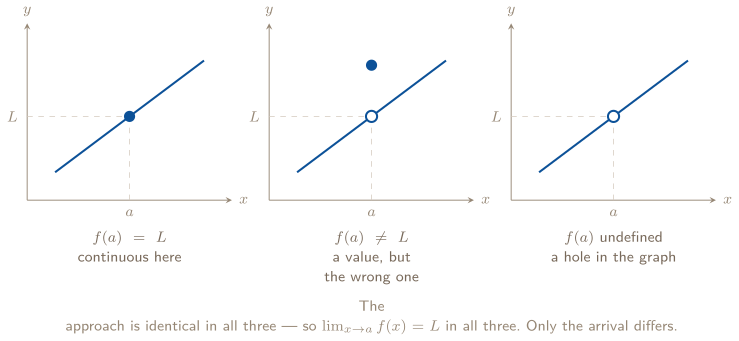
A check first. One question opens each of the next three cards and is answered where that card ends. Answer it before you read on; getting it wrong is the point, because that is what makes the card stick.
1. SEPARATE VALUE FROM APPROACH
For , compare with . Then say exactly where the cancellation that gets you there is valid, and where it is not.
THE ONE IDEA UNDER EVERYTHING
means: as gets arbitrarily close to (from both sides), gets arbitrarily close to . The limit is about the approach, never the arrival.
Read that definition once more and notice what it never mentions: . The value the function takes at is not part of the question being asked. It can equal , it can be some other number entirely, or the function can fail to be defined there at all — and the limit is in every one of those cases, because in every one of them the approach did exactly the same thing.
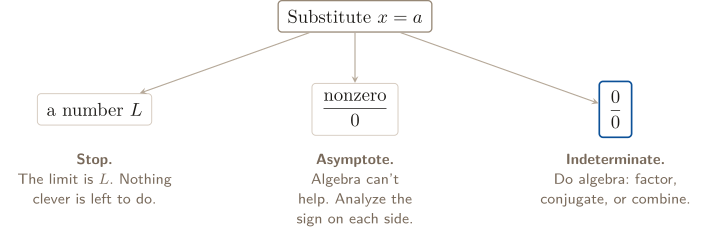
Those three pictures are the core of the unit in miniature. Every question about continuity at a particular point — does the limit exist there, is the function continuous there, what kind of discontinuity is this — is a question about how the second and third pictures differ from the first. Most limit mistakes are arrival answers to approach questions.
Not everything in the unit is that shape, and it is worth knowing which questions are not, so you don’t go looking for a single bad point when there isn’t one. A function can be broken at two points at once (Problem 8), and two of this unit’s questions are not about a single point at all: end behavior asks what happens infinitely far out (Problem 7), and the Intermediate Value Theorem makes a claim about a whole interval (Problem 9). Rung 5 and rung 7 exist for exactly those.
CHECK 1 — SEPARATE VALUE FROM APPROACH
is undefined: the denominator is there and no amount of algebra changes that. Everywhere else, and the divides out, so for every — and the limit is . That sentence is also the exact width of the license: cancellation is valid for , which is every point the limit ever looks at, and it is not valid at , which is the one point the limit never asks about. The two facts do not conflict; they are answers to different questions.
THE LIMIT LAWS — AND THE ONE HYPOTHESIS THAT EVER FAILS
Limits get along with arithmetic. If and , and both of those are real numbers, then
These are the reason substitution works at all. A polynomial is built out of constants and by adding and multiplying, and the laws say a limit walks straight through both operations — so of a polynomial is the polynomial evaluated at , and every “just plug it in” you have ever done was these six lines quietly doing their job.
The quotient law is the one with a condition, and that condition is the entire unit. is not fine print. When the bottom limit is zero, the law does not apply — and that is exactly the moment substitution hands you or and the decision tree takes over. So the awkward cases in this guide are not places where the rules broke. They are places where a rule politely declined, and the rest of the packet is what you do instead.
Reading them backwards is a trap the exam likes. The laws run one direction only: if the pieces have limits, the combination does. Not the reverse. Both and fail to exist, and their sum is everywhere except the origin, so the sum’s limit is a perfectly good . “ exists” tells you nothing about and on their own.
The seventh law, and the hypothesis it hides. A limit walks inside a function as well as through arithmetic — provided the outer function is continuous where the inside is heading. If and is continuous at , then
This is why needs no ceremony: the root is continuous at . The exam’s version hands you the pieces — and a graph of — and asks for . If is continuous at , the answer is and you are done. If it is not, the limit of stops being enough on its own, and you have to look at which inputs actually hands on the approach — above , below , or sitting exactly on it. Two functions with the same inside limit can give different answers. Take for with . If near zero then for every , so on the whole approach and the composite limit is . If instead is everywhere, its limit is still — but now on the whole approach, and the composite limit is . Same , different answers. Continuity of the outer function is the whole license, and without it there is no shortcut, only the inspection.
Where this shows up. Most often you are handed and — by a table, by a graph, or in a sentence — and asked to assemble something from them without ever seeing a formula. If and , then
and the only judgment involved was checking that the denominator’s limit wasn’t zero before using the quotient law. Say that check out loud; it is the part worth a point.
SUBSTITUTION IS A DIAGNOSIS, NOT AN ATTEMPT
Once rungs 1 and 2 are clear — you have a formula rather than a picture, and one formula rather than a piecewise rule with a seam at — every limit in this guide starts the same way: put in and see what comes back. That is not a guess, and it is not a first try that might fail. It is a test, and its result names your next move.
Why substitution works when it works. Plugging in is legal exactly when the function is continuous at — and polynomials are continuous everywhere, while a rational function is continuous everywhere its denominator isn’t zero. So for most of what you meet in this unit, “I can substitute” and “the function is continuous here” are the same sentence said two different ways. That is why the continuity material later in this guide is not a new topic bolted on at the end: it is the rule that made step one legal in the first place.
It is also the reason the seam question sits above this one on the ladder. A piecewise function has no single formula at its seam, so there is nothing there for “continuous at ” to be true of yet — and substituting anyway will hand you a number from whichever piece owns the endpoint, with no warning that the other piece went somewhere else entirely. Problem 6(c) is that exact number.
Outcome 1 — a number. You are done. Looking for something cleverer is how students turn a finished problem into a wrong one. If substitution returned , the answer is , and the fact that it felt too easy is not evidence of anything.
Outcome 2 — . The denominator is collapsing toward zero while the numerator is not. So you are dividing a number that stays put by a number that becomes arbitrarily small, and the quotient grows without bound. No algebra fixes this, because there is nothing to cancel — that zero is real and it isn’t going anywhere. Your remaining job is a sign question: which direction does it blow up on each side?
Outcome 3 — . Top and bottom are both collapsing, and the answer depends on which of them collapses faster — which is precisely the thing the symbol cannot tell you. This is called an indeterminate form, and the phrase means what it says: not “undefined,” but “not yet determined.” Compare , , and — all three substitute to , and all three have different answers. The form is a question, not a result.
For the algebraic limits in this guide, both top and bottom hitting zero at means both of them contain the factor . Finding it is the whole task.
THE PLAYBOOK
is an instruction to go looking. In the three algebraic shapes below the instruction is the same in substance — expose the shared factor and remove it — and only the technique changes, depending on how the factor is hiding. The fourth row is the exception worth knowing about before it turns up on a test: when the collapsing pieces are trigonometric, there is no shared factor to find, and no amount of algebra will produce one.
Shape you see | Move | Why that move works |
|---|---|---|
polynomials | factor, cancel, substitute again | factoring is finding the shared factor |
a square root | multiply by the conjugate | the difference of squares turns the root into a polynomial |
fraction inside a fraction | combine into one fraction first | there is nothing to cancel until the top is one object |
a sine or a cosine | a known special limit, or the squeeze theorem (Problem 5) | nothing cancels — has no factor of in it, so the answer has to come from a result you already have |
Why canceling is legal. This is the step students feel guilty about, so it is worth being exact. When you write
you have not divided by zero. The limit only ever looks at values near and never at itself — that is what “as approaches ” means. For every one of those , the quantity is a genuine nonzero number, and dividing by a nonzero number is something you have been allowed to do since seventh grade. The two functions above disagree at exactly one point, , and a limit cannot tell them apart, because a limit never asks about that point.
The same move, the other way up. Problem 4 puts the small fraction in the denominator; here it sits in the numerator. The move does not change: combine the inner fractions first, because there is nothing to cancel until the numerator is one object. Suppose
Substituting gives , and there is nothing to factor and no root to conjugate — because the numerator isn’t one object yet. Combine it over a common denominator first:
so the whole expression becomes
using to make the shared factor visible. Now substitute again: . The pattern is the same one you have been running all along — the combining step existed only to produce something that could be canceled.
THE THAT ISN’T ALGEBRA: SQUEEZE AND THE TRIG LIMITS
Every other in this guide had a factor hiding in it. A trigonometric one does not. There is no tucked inside waiting to be pulled out, so factoring, conjugates, and combining all have nothing to grip — and a student who has only ever been told “ means do algebra” will grind at until the clock runs out. Two results replace the algebra. Both are worth memorizing outright:
The first says something you can see: very near zero, and are the same number to as many decimals as you like. () The graph of leaves the origin along the line and only later peels away, so the ratio of the two starts at . That is also why the limit needs in radians — in degrees the sine curve leaves the origin along a much flatter line and the ratio is instead.
Matching the pattern. The result is not really about . It says for any quantity that is going to zero — the angle inside the sine and the thing underneath just have to be the same. So make them match, and pay for it with a constant:
Multiplying top and bottom by costs nothing and buys the pattern. That one move handles nearly every trig limit the exam asks for.
The squeeze theorem. When a function is too wild to evaluate but you can trap it, trap it. If
then as well. The argument is not subtle: the two outer functions are closing in on the same place and is pinned between them, so it has nowhere else to go.
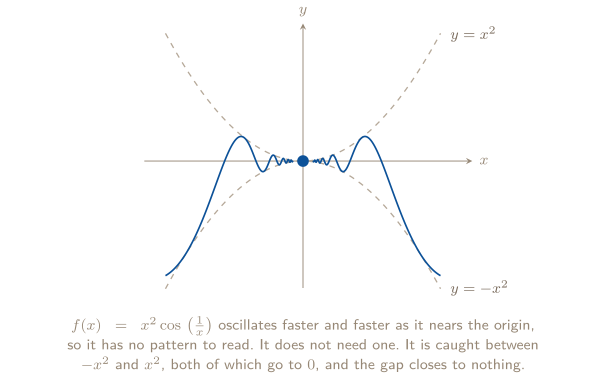
The trap to set is almost always the same one: a sine or a cosine is stuck between and no matter what you feed it, so multiply that sandwich by whatever is out front and you have your and . And note what the squeeze does not require — it never asks you to evaluate , or even to know what is doing. That is the whole point of using it.
2. CHECK BOTH SIDES
A function approaches 3 from the left of and 5 from the right. Can assigning a special value to make the two-sided limit exist?
ONE-SIDED LIMITS AND EXISTENCE
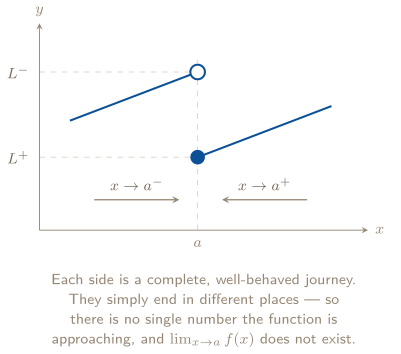
means: approach from the left, using only values less than . uses only values greater than . The two-sided limit exists only when both of these arrive at the same place — and “a place” has to mean an actual number:
Read the symbols aloud before you compute. is “the limit of of as approaches from the left.” The superscript is not an exponent and not a sign on the answer; it names the side you are coming from. Students who say the sentence get the side right; students who read the symbol as decoration substitute and answer a different question.
That word finite is doing real work, and leaving it out is a mistake you can make while doing everything else right. Take at : both sides run to , so in a loose sense they “agree.” But is not a number the function is getting arbitrarily close to — it is shorthand for the function escaping every number you name. The two sides matching there does not rescue the limit; nothing does. Agreement is necessary, not sufficient.
Notice what the picture does not show: anything wrong with either one-sided limit. Both exist, both are perfectly ordinary numbers. The failure is entirely in the comparison. That is why the honest way to report a nonexistent limit is to name both sides and then say they disagree — “does not exist” on its own throws away everything you actually found out.
When a limit fails to exist, there are only three ways it can happen, and saying which is part of the answer:
- the two sides disagree — a jump;
- the function is unbounded — it runs off to ;
- the function oscillates without settling, like near , which crosses every value between and infinitely often no matter how close you get.
CHECK 2 — CHECK BOTH SIDES
No, and there is nothing to try. The value at is not one of the things either one-sided limit looks at, so setting , or , or anything else, leaves both approaches exactly where they were: from the left, from the right. Two different numbers, so no single number is being approached, so the two-sided limit does not exist. A definition can fix the arrival. Only the function’s behavior near can fix the approach — which is the difference between repairing a removable discontinuity and being asked to repair a jump.
INFINITE LIMITS: WHEN THE DENOMINATOR ALONE GOES TO ZERO
This is outcome 2 from the diagnosis — — and it means the graph has a vertical asymptote at . Writing is not claiming the limit equals some number called infinity. It is a description of how the limit fails to exist: the function isn’t wandering or jumping, it is climbing without bound. That description is worth more credit than “DNE,” so give it.
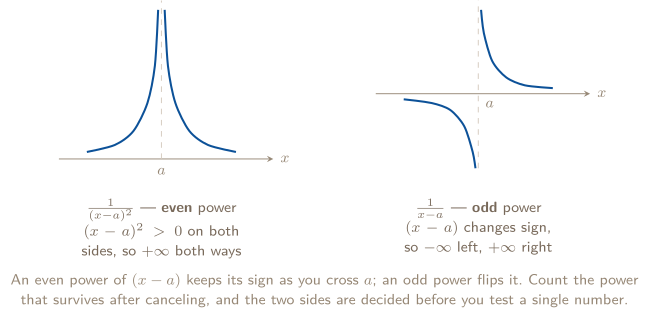
How to find the sign on each side. You are not guessing. Look at the factor in the denominator that is producing the zero, and ask what sign it has just to the left of and just to the right. If the fraction had a common factor and you canceled it first, read the power that is left in the denominator, not the one you started with — Problem 8 is exactly that case.
If counting powers feels abstract, there is a fallback that never fails: pick a number just to the left of and one just to the right, and read the signs of the top and bottom separately instead of computing the value. Take near . At the top is — positive — and the bottom is — negative and tiny — so the quotient is large and negative: the function runs to from the left. At the top is still positive and the bottom is , so the quotient is large and positive: from the right. Write those two checks down. Doing them in your head is where this goes wrong.
LIMITS AT INFINITY: END BEHAVIOR AND THE TRAP
is a different question wearing the same symbol. Here nothing is dividing by zero and nothing is blowing up at a point — you are asking what the function settles into far out along the axis. A finite answer means a horizontal asymptote .
Dominant terms. Out at large , the highest power in a polynomial is so much bigger than everything else that the rest are rounding error. In at , the first term is and the second is : the second term is not small, it is irrelevant. So for a rational function, compare the top and bottom degrees:
- top degree bottom degree the limit is (the denominator outruns the numerator);
- degrees equal the ratio of the leading coefficients (they grow at the same rate, so the ratio settles);
- top degree bottom degree (the numerator outruns the denominator — and now you must decide which sign).
Why that shortcut is legitimate. It is the result of dividing top and bottom by the highest power in the denominator. For example,
because every term of the form goes to . The “circle the dominant term” rule is just this calculation with the zeroes already taken. If you ever doubt the shortcut on an unusual problem, do the division — it always works and it is never wrong.
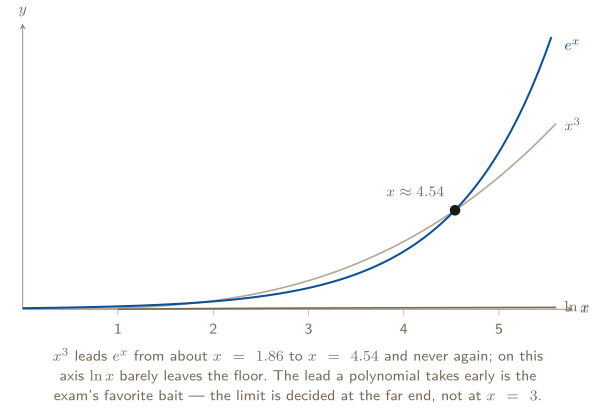
Not every race is polynomial against polynomial. Three families grow at three different orders, and the exam expects you to know the order without a calculation: a logarithm loses to every positive power of , and every power of loses to .
The middle one is the one people refuse to believe; is enormous at , and still wins, because past some point each extra unit of multiplies by and multiplies by a factor that shrinks toward . Growth is about the rate of growth, and the CED says exactly that: relative magnitudes of functions and of their rates of change are compared with limits.
The root trap. , not . The square root symbol returns the nonnegative root, always, so for you must write — which is a positive number, because itself is negative. Concretely, , and
This is the single most-missed step in the unit, and its consequence is that a function with a square root on top can have two different horizontal asymptotes — one as and a different one as . Problem 7 draws that picture.
CONTINUITY AT A POINT: THE THREE-PART CHECKLIST
Informally, is continuous at if you can draw through the point without lifting your pencil. Formally — and this is the version that scores — all three of these must hold:
Run them in that order. Each one is checking something the previous one assumed: (1) asks whether there is an arrival at all, (2) asks whether there is an approach at all, and (3) asks whether the two agree. You need all three because any one of them can fail while the others hold.
Continuity on an interval, and which functions have it for free. A function is continuous on an interval when it is continuous at every point of it; at a closed endpoint the limit is taken from inside the interval only. Six families are continuous at every point of their domains — polynomial, rational, power, exponential, logarithmic, and trigonometric — so for any of them the checklist never fails inside the domain, and the only candidates for a break are the points the domain leaves out: a zero denominator, a negative under an even root, a non-positive argument in a logarithm, the odd multiples of for tangent and secant. Write the domain and you have written the intervals of continuity. is continuous on and on — and the questions “is it continuous at ?” and “on ?” are answered by that sentence alone, no checklist required. The checklist is for seams and for functions defined in pieces, where nothing is free.
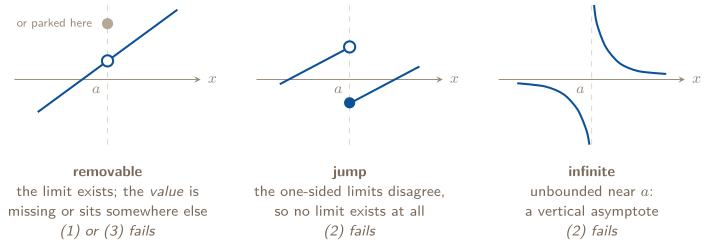
What the checklist does not do is name the break. It is tempting — three conditions, three kinds of discontinuity, surely they line up — and it is the most common way to classify one wrong. They do not line up. Look at the three pictures below and count: two of them fail condition (2), and the first one can fail either (1) or (3) depending on whether the value is missing or merely misplaced. Three failure modes, three names, no matching.
The reason is worth a sentence, because it makes the right method obvious. The checklist is a test for continuity — it is built to return yes or no, and it stops as soon as it has the answer. A classification is a different question asked afterward, and it has a different source of evidence: the checklist settles whether the function broke; what the limit was doing settles how.
So run it in two stages. Stage one is the three conditions. If any fails, stage two is one more look — at the limit, not at the checklist:
What the limit did | Name | Repairable? |
|---|---|---|
both sides reached the same finite number, but is missing or sits elsewhere | removable (a hole) | yes — define to be that number |
the two sides reached different finite numbers | jump | no |
the function ran off to on at least one side | infinite (a vertical asymptote) | no |
the function never settled — it kept oscillating | oscillating | no |
Two habits fall straight out of this. First, never name a discontinuity before you have computed the one-sided limits; the name is that computation. Second, be suspicious of any rule that lets you skip it. “ is undefined, so it’s a hole” is the classic — and at is the counterexample every AP class meets in the first week. Condition (1) fails there, exactly as it does at a hole. It is a vertical asymptote, because the limit is what tells you, and the limit ran away.
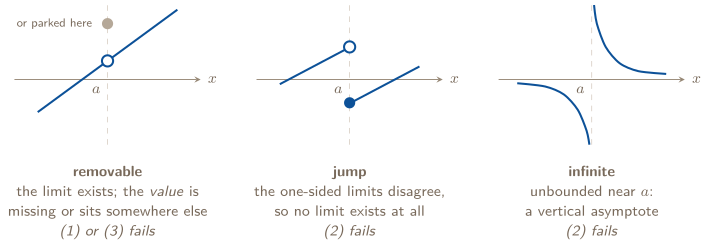
The name “removable” is literal, and it is worth knowing why. In the first picture you could define to be the limit value, plug the hole, and the function would be continuous — one point repaired and the problem is gone. Nothing you can do to a single point repairs any of the others, which is what the last column of the table was recording. The fourth kind, oscillating, is the one you cannot draw here: near , crosses every value between and infinitely often, so there is no picture with finitely many strokes in it.
3. READ THE GUARANTEE
A continuous function on has values of opposite sign at its endpoints. Does the Intermediate Value Theorem guarantee exactly one zero?
INTERMEDIATE VALUE THEOREM
If is continuous on and is strictly between and —
— then for some in the open interval .
Those two strict inequalities are the price of the open interval, and they are cheap. If you let equal an endpoint value, the guarantee still holds but only on the closed interval: on with has exactly one solution, , and it sits at the edge rather than inside. Write the endpoint values with caught strictly between them — as Problem 9 does, — and the conclusion you want is the one you get.
Both hypotheses are load-bearing. Continuity is what forbids the function from skipping a value; without it the theorem says nothing at all, because a graph that is allowed to jump can step straight over (Problem 9 draws exactly that). And must actually be caught between the endpoint values — if it isn’t, the theorem has no opinion.
What it never does. The IVT is a one-way guarantee. When its hypotheses hold, the value must exist; when they don’t, it goes silent. Silence is not a “no.” A student who concludes “the IVT doesn’t apply, so there’s no root” has read a theorem backwards, and that specific error is worth its own exam question — which is Problem 9(b).
What it never tells you either: where is, or how many there are. It guarantees at least one. Finding it is a different problem with different tools.
The sentence that scores. A full-credit IVT justification names the continuity with a reason, shows the two endpoint values, and draws the conclusion:
is continuous on
because it is a polynomial;
;
so by the IVT there is a
in
with
.
The fill-in form. Classes now assign the argument as a sentence with blanks: Since is continuous on and is less than which is less than , by the IVT there exists a in such that . Every blank is one of the ingredients above in a fixed order — the interval (closed), the two endpoint values with the target between them, the open interval, the target. Fill them from your own sentence and the two forms agree word for word. That is not a coincidence; it is what the theorem says.
Graders accept the argument without the theorem’s name attached — but citing it costs you four words and removes all doubt, so cite it.
CHECK 3 — READ THE GUARANTEE
At least one, not exactly one. Opposite signs plus continuity force the graph across zero somewhere; nothing in the hypotheses stops it from crossing back and across again. A function with three roots in satisfies the theorem exactly as well as one with a single root, and the theorem cannot tell them apart. Uniqueness is a second claim and needs a second argument — usually that the function is strictly increasing or decreasing, which is a Unit 5 tool. Write only what the theorem guarantees; a stronger sentence than your evidence supports is how a correct answer loses the justification point.
PROBLEM 1
Substitute first: three limits, three diagnoses
Evaluate each limit, or explain why it does not exist. (a) (b) (c)
BEFORE YOU COMPUTE
All three are rational functions and all three look alike on the page — there is no way to tell them apart by appearance, which is the entire point of putting them side by side. Substitute into each and read the result before doing anything else: a number, a , and a are three different instructions, and choosing your method before you have run the test is how students end up factoring something with no common factor.
WORKING
(a) Substitute and see what comes back:
A number, so we are done — and it is worth saying why we are allowed to stop. The denominator equals at , not zero, so this rational function is continuous at , and for a continuous function the limit is the value. There is no hidden second step. Resist the feeling that a calculus problem owes you more work than this.
(b) Substitute: . Both top and bottom vanish at , which is the form’s way of telling you they share the factor . The numerator is a difference of squares, so finding it takes one line:
The cancellation is legal because the limit only looks at near , never at itself — so is a genuine nonzero number every time we divide by it. Now substitute the second time, which is the step people forget:
(c) Substitute: . This is nonzero over zero — a different animal from (b). Nothing cancels, because the numerator does not vanish at ; the function is genuinely unbounded near , and there is a vertical asymptote there.
So the remaining question is which direction, on each side. The numerator is near — positive — on both sides. The denominator is a square, so it is positive on both sides of and shrinking toward zero. Positive over small-and-positive is large and positive, from either direction:
Both sides agree on the behavior, so we can write a single statement:
Say clearly what that means: the limit does not exist as a number, and is the honest description of how it fails.
ANSWER
(a) (b) (c) (unbounded — the limit does not exist as a number)
WATCH OUT
and look like cousins and behave like strangers. means do algebra — there’s a hidden common factor. means no algebra will save this — it’s an asymptote; go analyze signs. Confusing the two sends you factoring something that has no common factor, or writing where the answer is .
The other trap in (c) is the exponent. Had the denominator been instead of , the two sides would not agree: the factor would be negative on the left and positive on the right, giving and , and writing a single two-sided answer would be wrong. The square is doing real work here. Never carry a one-sided sign conclusion across an example without re-checking the power.
CONNECTION
The three verdicts of substitution are the three verdicts for the rest of the course. In Unit 2 every derivative computed from the definition substitutes to — that much is guaranteed, since the numerator and the denominator both go to zero. What finishes it varies: for a polynomial it is algebra, exactly as (b) was, and for a sine or a logarithm it is a special limit or an identity instead. In Unit 4, L’Hospital’s rule arrives as a further tool for , and it is legal only after this diagnosis has returned or , never before. A student who runs the diagnosis by habit will use that rule where it applies and nowhere else, which is most of the credit on the questions that test it.
ABOUT THIS EXCERPT
This is the opening of a 53-page guide: the diagnostic tree, the full Master Toolbox, and the first worked problem. 10 more problems follow in the complete guide, each worked the same way — what to notice before you start, every step shown, and the mistake that problem invites. The complete guide is shared with families during the fit conversation.
Engineering Confidence — engineeringconfidence.one
Source and review notes
What this resource is
Complete browser edition of the public excerpt from an original Engineering Confidence AP Calculus AB unit-reference packet. It contains no released free-response, textbook, or teacher-provided problems.
- Published
- Last reviewed
- Printable edition
- 23 pages
Course reference: official College Board course page.
Read this public excerpt above, or save the PDF for printing and offline reading.
Download the 23-page PDF excerpt