Read the public excerpt
The same instruction and worked examples appear here and in the printable PDF excerpt. You can request full guides for upcoming units below.
READ THIS FIRST
About this guide. One sentence runs under everything in Unit 2: a derivative is the limit of an average rate of change, and every rule in this unit is that limit computed once and remembered. Unit 1 taught you to work at ; the derivative is the the whole subject is built on — the difference quotient substitutes to it every time — and the rules exist so that you never have to resolve that limit twice for the same kind of function.
The College Board’s own note on this unit is about precision, not ideas: students “drop important notation, such as a parenthesis, or misapply the product rule by taking the derivative of each factor separately and then multiplying those together.” Unit 2 is where the habit of self-correcting is installed, and this guide is built so that the check is part of the method rather than an afterthought — every worked problem ends by confirming its answer a second way.
Three mistakes to learn to catch:
- Computing the right number without the set-up that scores. A derivative estimated from a table earns its point for the written difference quotient, not for the number; a product rule earns its point for the structure written before the values go in. The exam says so in as many words.
- Treating rules as independent facts. The product rule is not a formula to memorize beside the power rule; it is the limit definition applied to a product, and a student who knows why it has two terms never multiplies the derivatives.
- Forgetting what a derivative is while computing one. is a slope, a rate, and the limit of average rates over intervals closing on — three sentences the exam asks for in words, with units.
Every topic in the unit, and where it lives. Ten of them:
- 2.1 average and instantaneous rates of change — the first card (p. 11) and Problem 1.
- 2.2 the derivative as a function, its notation, and the tangent line — two cards (p. 13); Problems 2 and 3.
- 2.3 estimating a derivative from a table or a graph (p. 16); Problem 4.
- 2.4 differentiability and continuity — when a derivative does not exist (p. 17); Problem 5.
- 2.5, 2.6 the power rule and the constant, sum, difference and constant-multiple rules (p. 19); Problem 6.
- 2.7 , , , (p. 22), and a limit that is a derivative in disguise (p. 23); Problems 7 and 8.
- 2.8 the product rule (p. 25); Problem 9.
- 2.9 the quotient rule (p. 27); Problem 10.
- 2.10 tangent, cotangent, secant, cosecant (p. 28); Problem 11.
The pages that follow are your concept reference: a diagnostic decision tree and a Master Toolbox, both built to be opened at the card you need rather than read front to back. What matters more is the order you work in. Try each problem before you read its solution — the “Before you compute” notes are placed to catch you at the exact moment a wrong turn usually happens. What eleven problems cannot do is give you enough repetitions; each is the clearest instance of its shape, so a problem you found easy is a signal to go find five more like it. Fluency is volume, and volume is homework.
WHERE THE POINTS GO ON THIS UNIT
The structure is the point. The College Board’s own example: to estimate from a table, “students must present a difference quotient: ” — and “failure to present this structure will cost students the point they might have earned, even with a correct numerical answer.” The same for a product: written out, then the values imported. Write the shape, then the numbers, every time. Problems 4 and 9 are built around exactly those two sentences.
Precision is scored. A dropped parenthesis turns into ; a product rule with one term is a wrong derivative, however clean the algebra after it. The exam’s word is “self-correct”: check the answer a second way before moving on, and this guide shows a second way on every problem.
The calculator’s answer is not the answer. Where a calculator is allowed, the expression evaluated is written before the number, and the number is rounded (or truncated) to three places after the decimal point, as the question specifies. Store intermediate values; round once, at the end.
A derivative is a rate with units. “” is a number; “at seconds the height is decreasing at feet per second” is the answer to the question that was asked. The verbal representation is one of the four the CED names, and it is the one students skip.
Differentiability is justified, not asserted. “Not differentiable because there is a corner” is a picture; “ is continuous at , and , so does not exist” is a justification. Unit 1’s rule stands: hypotheses first, then the conclusion. And the margin that buys a 5 is the same as it was in Unit 1 — with the 2025 average free-response score, eight missed multiple-choice questions; with a perfect one, thirty-four.
Diagnostic Decision Tree
HOW TO READ THE PROMPT
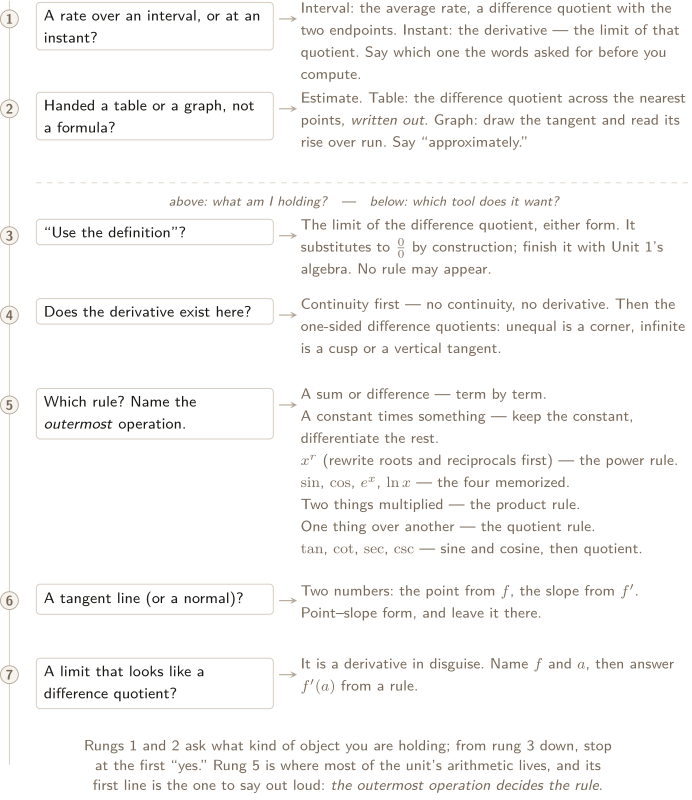
Three of those rungs hide a reason worth carrying.
Why the outermost operation decides. is a product, so the product rule applies, and inside it the power rule and the sine rule handle the factors. is a quotient of the same two pieces and takes the quotient rule. Read the expression from the outside in, name the last operation that was performed to build it, and that operation names the rule. Students who read from the inside out apply the power rule to , the sine rule to , and then have two derivatives and no idea how to combine them — which is precisely the error the College Board describes.
Why continuity comes before any slope. A derivative at is a limit of average rates from ; if is missing or the function jumps there, the average rates have nothing to converge to, and the question of a slope is over before it starts. So rung 4 begins with Unit 1’s checklist and only then computes the one-sided quotients. The reverse order — slopes first, continuity as an afterthought — is how students report a derivative at a point where the function does not exist.
Why “use the definition” forbids the rules. The point of the question is the limit, and the rules are what the limit produces; using a rule to evaluate a definition problem is answering with the conclusion and skipping the argument, and it is scored as skipping the argument. The algebra is Unit 1’s — expand, cancel the , substitute — and it is never as long as it looks.
Where to Look When You’re Stuck
FIND THE SENTENCE THAT SOUNDS LIKE YOUR SITUATION
The tree above is for a problem you are about to start. This table is for one you are already inside. Find your sentence, do the thing in the middle column, turn to the page on the right.
What is happening | First move | Where |
|---|---|---|
“Average or instantaneous — I can’t tell which it wants” | An interval in the words means average, a difference quotient with both endpoints. A single moment means the derivative. | p. 11, Prob. 1 |
“I plugged in and got ” | Correct — that is what the definition does. Expand, cancel the , substitute again. | p. 13, Prob. 2 |
“I have a table and it wants ” | The nearest two points around , the quotient written out with the function’s name, then . | p. 16, Prob. 4 |
“Is it differentiable there?” | Continuity first. Then the slope from each side; equal and finite, or it isn’t. | p. 17, Prob. 5 |
“There’s a square root or a ” | Rewrite as a power of before touching a rule. | p. 19, Prob. 6 |
“I don’t know what to do with , , ” | Four derivatives, memorized; the sign on is the one that leaves. | p. 22, Prob. 7 |
“This limit has but no was given” | It is a derivative at a point. Find the and the hiding in it. | p. 23, Prob. 8 |
“Two things multiplied” | Product rule, two terms, structure written before values. | p. 25, Prob. 9 |
“One thing over another” | Quotient rule — and the minus sign has a side. Or rewrite with a negative power when the bottom is a monomial. | p. 27, Prob. 10 |
“, , , ” | Sine and cosine underneath, quotient rule on top — or the four results, memorized with their signs. | p. 28, Prob. 11 |
“It wants the tangent line” | . The point from , the slope from . | p. 15, Prob. 3 |
“My answer is a number and the question was in words” | Say the rate, with its units, in a sentence. That is the answer. | p. 11, Prob. 1 |
If none of those is your sentence, the last section of this guide is the longer version, organized by what went wrong.
Master Toolbox — Everything These Problems Use
Use these cards as you work. Name the decision you need to make, then open the relevant card. Each card stands on its own; you do not need to read the whole toolbox before attempting a problem.
AVERAGE RATE, INSTANTANEOUS RATE, AND THE TWO DIFFERENCE QUOTIENTS
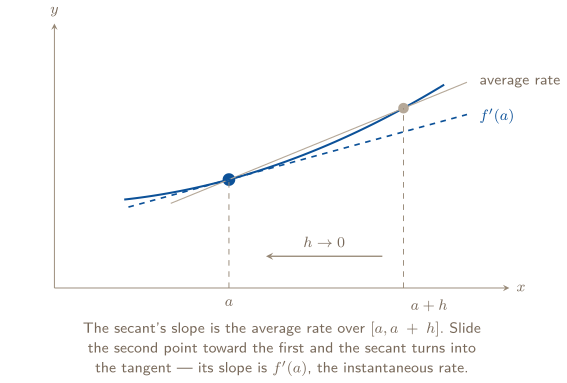
An average rate of change over an interval is a slope between two points on the graph — a difference quotient. The CED writes it two ways, and both appear on the exam:
They are the same fraction. In the first the interval runs from to and its width is ; in the second it runs from to and its width is . Choose whichever makes the algebra cleaner and say which you chose.
The instantaneous rate of change at is what those averages approach as the interval shrinks onto — Unit 1’s opening question, now given a name and a symbol:
provided the limit exists. That proviso is topic 2.4, and it is not fine print.
Three sentences, one number. is the slope of the tangent line at ; it is the instantaneous rate of change of at ; it is the limit of the average rates over intervals containing . The exam asks for all three in words, and it asks for units: if is feet and is seconds, then is in feet per second, and the sentence “at the position is changing at ft/s” is the answer, not .
A check first. One question opens each of the next three cards and is answered where that card ends. Answer it before you read on; getting it wrong is the point, because that is what makes the card stick.
1. TEST THE GRAPH CLAIM
If has a horizontal tangent at , must the graph of cross the horizontal axis there, or only touch it? Decide first, then test your answer on .
THE DERIVATIVE AS A FUNCTION, AND THE FOUR WAYS TO WRITE IT
Do the limit at a general instead of a particular and the result is a new function, :
Its value at any is the slope there. Here it is for , worked the only way Unit 2 allows until the rules are earned:
Substituting at the start gives ; canceling the first gives , which substitution can read. That is Unit 1’s factoring move, and every “use the definition” problem is exactly it.
Four notations, one object. For the derivative is written , , , or . The last two are Leibniz’s, and they are worth understanding rather than tolerating: is with the limit already taken — a slope written as a fraction whose parts have gone to zero together. on its own is an instruction (“take the derivative with respect to ”) waiting for something to act on. The exam uses all four without warning; the CED’s skill 4.C is literally “use appropriate mathematical symbols and notation.”
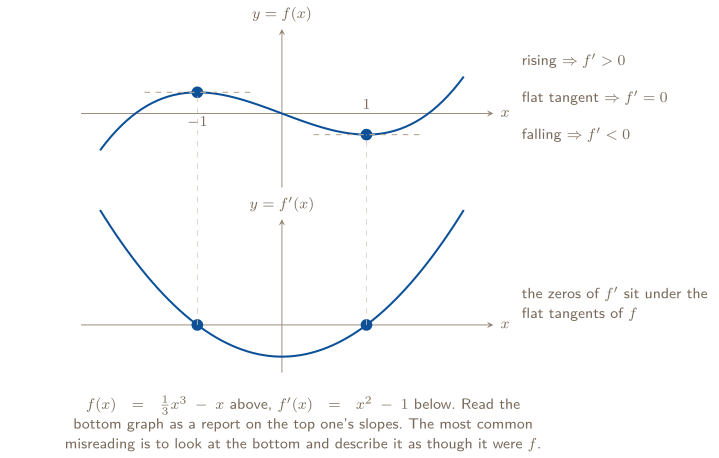
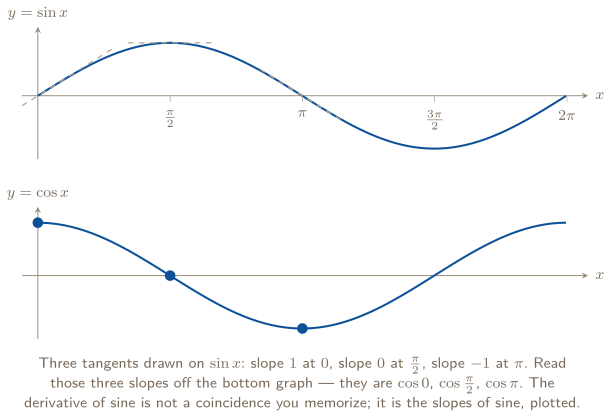
Four representations. A derivative can be given as a formula, as a slope on a graph, as a number estimated from a table, or as a sentence about a rate. The picture below is the one students misread most: the graph of is not a picture of — it is a picture of ’s slopes. Where rises, is positive; where has a horizontal tangent, is zero (it need not cross the axis); where falls, is negative.
CHECK 1 — TEST THE GRAPH CLAIM
Only touch. A horizontal tangent at says , and that is the whole of what it says: the graph of has to reach the axis there, not go through it. Take . Its tangent at the origin is flat, and is zero at and positive on both sides — the parabola touches the axis and turns back up. Crossing would mean changes sign, which is a claim about turning around, and never turns around. The figure above happens to show a case where does cross, because really does have a maximum and a minimum; do not read the picture as the rule.
THE TANGENT LINE — TWO NUMBERS AND A FORM
The tangent line at passes through the point with slope . Point–slope form was built for exactly this:
Two numbers are all it needs, and they come from two different places: the point from , the slope from . Mixing them up — using as the slope, or as the height — is the whole error class on tangent-line questions. Leave the answer in point–slope form unless the question asks for another; rearranging is a place to drop a sign for no credit.
The normal line is perpendicular to the tangent at the same point: same point, slope (and vertical if ).
Why the tangent matters beyond the question that asks for it. Zoom in on a differentiable point and the curve straightens — close enough, the function and its tangent line are the same line. That is what differentiability means geometrically (local linearity), and it is why Unit 4 will use the tangent line to approximate near : . The tangent line is the derivative made visible.
ESTIMATING A DERIVATIVE FROM A TABLE, A GRAPH, OR A CALCULATOR
When there is no formula there is no rule to apply, and the derivative is estimated from the average rate over the smallest interval the data allows.
From a table. For , take the two tabulated points that bracket most tightly and write the difference quotient with the function’s name in it:
That line is the point. The College Board says so directly: a correct number without this structure loses the credit. If is itself a tabulated point, use the points on either side of it (the symmetric difference ) — it is a better estimate, and it is the one graders expect when both neighbors are available. Write , never : a table is evidence, not a formula.
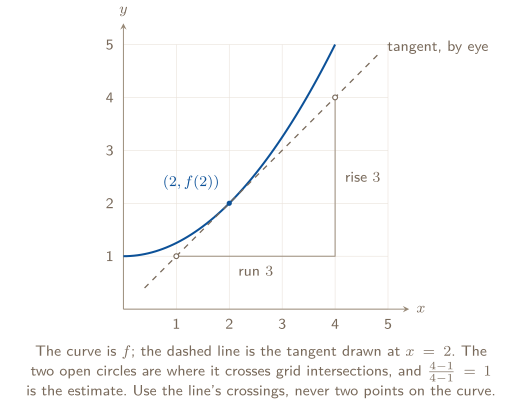
From a graph. Draw the tangent by eye at the point, then find two places where your line crosses grid intersections and read rise over run between them. Below, the tangent at passes through and : rise over run , so . Say “approximately,” and expect a tolerance — the grader has one, and a line drawn by eye that reads or is a correct answer. What is not correct is the slope of a chord that starts at the point and ends somewhere on the curve; that is an average rate, and the question asked for the tangent’s.
With technology. A calculator’s numerical derivative (nDeriv, or at a value) is allowed on the calculator sections; the expression you evaluated is written on the page, and the result is rounded to three places after the decimal point unless told otherwise. Store intermediate values rather than retyping rounded ones.
DIFFERENTIABILITY AND CONTINUITY: WHEN A DERIVATIVE DOES NOT EXIST
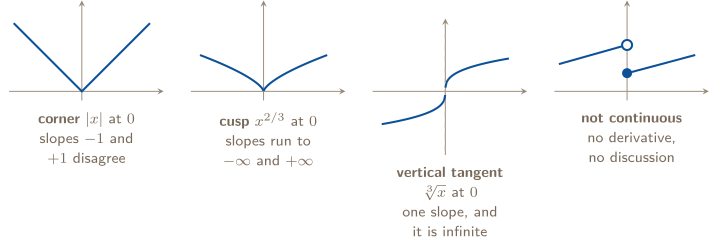
Differentiable implies continuous. If exists, then is continuous at — so a point not in the domain of is not in the domain of , and a jump, a hole, or an asymptote at ends the question. The CED states this one direction only, and the direction matters: continuous does not imply differentiable. A function can pass Unit 1’s checklist at and still have no slope there, in three ways.
The test that scores. Differentiability at is a limit, so it is settled by one-sided limits of the difference quotient, exactly as a limit’s existence was settled in Unit 1:
must both exist and agree. For at the left quotient is and the right is : a corner. For at the quotient is , which runs to from both sides: a vertical tangent, the CED’s own example. A picture of a corner is not a justification; those two limits are.
Piecewise functions. To be differentiable at a seam a function must first be continuous there (Unit 1’s seam equation) and then have matching one-sided slopes — two equations, and “find and so that is differentiable at ” is asking for both. Solving only the slope equation, or only the continuity one, is half credit on a good day.
2. PRESERVE THE DOMAIN
Simplify and differentiate . Does the simplified expression define the original function at zero?
THE POWER RULE — AND THE REWRITING THAT HAS TO HAPPEN FIRST
For any real exponent ,
Bring the exponent down as a coefficient; subtract one from the exponent. It is the definition, computed once: for you saw above; for the same expansion gives ; and the pattern the binomial expansion produces is every time, which is why one rule covers every power.
Rewrite before you differentiate. The rule reads and nothing else, so every root and every reciprocal is rewritten as a power first:
Then the rule, then (if the question wants it) rewrite back: . Students who try to differentiate “as a root” invent a rule; students who rewrite never need one.
The sign on a negative exponent. : the exponent goes more negative, from to , because subtracting one from a negative number makes it smaller. Writing is the standard slip, and it comes from “subtract one” being heard as “move toward zero.”
Constants. A constant has no slope: . A constant times has slope equal to the constant: . And , , are constants too, however much they look like functions — their derivatives are zero.
CHECK 2 — PRESERVE THE DOMAIN
No. For every , , so there — and was never in the original function’s domain, so it is not in the derivative’s either. Rewriting is a move you make on the expression; it does not hand back an input the function could not accept. The graph is the parabola with a hole at the origin, and the hole survives every simplification you do to it. Write the restriction down when you rewrite — Problem 6(c) is this same shape with the point of the question hidden in it.
CONSTANT MULTIPLES, SUMS, AND DIFFERENCES — AND THE TWO RULES THAT DO NOT EXIST
Derivatives pass through addition, subtraction, and constant multiples:
These are Unit 1’s limit laws wearing new clothes: a limit walks through a sum and through a constant factor, and the derivative is a limit. So a polynomial is differentiated term by term, each term by the power rule, each coefficient carried along:
The two rules that do not exist. The derivative of a product is not the product of the derivatives, and the derivative of a composition is not the derivative of the outside evaluated at the inside. Test the first on : the true derivative of is , and the product of the derivatives is . Wrong on the simplest case there is. The product rule (two cards down) is what the limit actually produces; the chain rule for compositions is Unit 3’s, and until then is handled by expanding it or by waiting — never by “” alone, which is the chain rule with its second factor missing and is marked as such.
THE FOUR MEMORIZED DERIVATIVES: , , ,
Four facts, and the sign on the second is the one that leaves: cosine’s derivative is negative sine. Say it aloud when you write it.
Where the sine rule comes from — because a rule you can rebuild is a rule you cannot lose. Apply the definition and the angle-addition identity :
As the first fraction goes to and the second to — Unit 1’s two memorized trig limits, which were never really about limits. They were the derivative of sine at zero, waiting. So the whole thing goes to .
Where the exponential rule comes from. , and the second factor goes to — check it: gives . That limit being exactly is what makes the base calculus prefers: the function whose rate of change is itself. The logarithm’s rule waits for Unit 3, where it falls out of by the inverse relationship; until then it is a fact to carry, with its domain — lives on , so as its derivative means the positive branch only.
A LIMIT THAT IS A DERIVATIVE IN DISGUISE
The CED’s topic 2.7 carries a second learning objective the title hides (LIM-3.A): recognize the definition of the derivative when a limit is written in its shape, and evaluate the limit by a rule instead of by algebra. The tell is the form:
Find the and the . In the function is , the point is (and is , which is the confirmation), so the limit is . No algebra, no identity — a rule. In the function is at , and the answer is ; try that one by factoring and you will see why recognizing is worth learning.
The trap is a limit that almost has the shape: is , not ; is . Match the pieces exactly before you name the derivative.
3. EXPLAIN THE MISSING TERM
In the product rectangle the small corner is . After the whole increment is divided by , why does the corner’s contribution vanish for differentiable factors — and does that mean is zero?
THE PRODUCT RULE — WHY IT HAS TWO TERMS
Each factor gets its turn to change while the other holds still, and the two contributions add. The picture makes it obvious. Let and be the sides of a rectangle, so is its area; grow a little and each side grows a little:
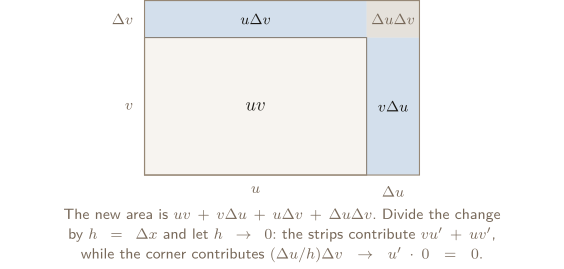
A product changes for two reasons — moves, and moves — so its derivative has two terms, one for each. The corner is the piece that is neither, and it is worth being exact about how it leaves. Divide the area change by and the corner becomes ; for differentiable factors the first part goes to while the second goes to , so the product goes to . Note what that argument does not say. It does not say vanishes — is generally a perfectly good nonzero number, and on it is . It says only that is not the rate of change of , which is the whole reason the wrong rule is wrong. The College Board names this error in the unit’s own overview; it is the most common wrong derivative on the exam that is not an arithmetic slip.
The structure before the values. On the exam, a product rule at a point is written as a structure first — — and only then are the four numbers imported from the table or the graph. The structure is the point; the arithmetic is the answer. Both are needed, and they are scored separately.
When not to use it. is a product, but it is also , and the power rule on the expanded form is faster and safer. Expand when the factors are polynomials; use the rule when one factor is , , , or anything that will not multiply out.
CHECK 3 — EXPLAIN THE MISSING TERM
Divide the corner by and group it as . The first factor goes to , a finite number, and the second goes to , so the product goes to — one factor’s rate times the other factor’s change, and the change is what dies. No: is not zero. On it is while the derivative of is . The corner vanishing and vanishing are different statements, and only the first one is true; keeping the difference quotient in the explanation is what keeps them apart.
THE QUOTIENT RULE — AND THE SIGN THAT HAS A SIDE
The numerator is the product rule’s two terms with a minus between them, and unlike the product rule, the order matters: the derivative of the top comes first. Swap them and the sign of the whole derivative flips — an error that survives every later step and produces a tangent line sloping the wrong way. The denominator is squared, and it is the original denominator, not its derivative.
The self-check that never fails. Run the rule on : , , so the derivative is . The power rule on gives , the same thing. If the quotient rule in your head gives here, the order is backwards and you have found out for free.
When to avoid it. A quotient whose bottom is a single power of is a sum of powers in disguise: , and the power rule term by term is shorter than the quotient rule and has no sign to get wrong. Problem 10 does it both ways so you can watch them agree.
TANGENT, COTANGENT, SECANT, COSECANT — FOUR QUOTIENTS, ONE METHOD
Nothing new is memorized here unless you want it to be. Each of the four is a quotient of sine and cosine, and the quotient rule produces its derivative on demand:
The other three go the same way. The results, for reference:
| Function | Written as | Derivative |
|---|---|---|
The pattern is worth one sentence: every co-function’s derivative carries a minus sign (, , ), and every derivative comes in the same family it started in. A student who remembers that sentence can rebuild the table from in a minute; a student who remembers only the table has four signs to lose.
PROBLEM 1
Average, then instantaneous: a rate the words asked for
A ball is thrown straight up and its height in feet after seconds is . (a) Find the average velocity over , over , and over , with units. (b) Using the definition of the derivative, find the instantaneous velocity at . (c) Explain in a sentence what means in this situation.
BEFORE YOU COMPUTE
Rung 1 of the tree: each part of (a) names an interval, so each is an average rate — a difference quotient with both endpoints, and no limit anywhere. Part (b) names an instant, and adds “using the definition,” which forbids every rule you know: the answer is a limit, it will substitute to , and Unit 1’s algebra finishes it. Part (c) is the sentence the exam grades; decide now that it will have units in it.
Two habits before the arithmetic. Compute once and keep it — every part reuses it. And set up the difference quotient with the function’s name in it before any numbers go in; that line is what the CED calls the structure, and it is scored on its own.
WORKING
feet, used throughout.
(a) Three secant slopes.
where , , and . The intervals are shrinking onto and the averages are climbing: , , . They are heading somewhere, and (b) says where.
(b) The definition, in the -form — written with a different letter for the increment, since is the function’s name here:
Expand the numerator before touching the limit:
so
Substituting at the start would have given ; canceling the first gives , and now the limit is a substitution:
The averages in (a) were , , — and at is exactly , , . Part (a) was the limit being approached from the outside; (b) is where it arrives.
(c) The sentence: At second, the ball is rising at feet per second. Three things in it — the moment, the rate, the units — and “rising” because the sign is positive.
Sense check. The rules of the next cards give , so . The definition and the rule agree, which is the only relationship they are allowed to have.
ANSWER
(a) , , ft/s (b) ft/s (c) at s the ball is rising at ft/s
WATCH OUT
The most expensive error in (b) is not algebraic: it is answering with a rule. “Using the definition” means the limit must appear on the page, with the resolved by cancellation; written down cold earns nothing here, however right it is. The second is substituting into the quotient before canceling and stopping at “undefined.” Both words are in play and they are not the same word. The quotient at genuinely is undefined — you may not divide by zero. What is not undefined is the limit: is an indeterminate form, which says the limit is not yet determined, not that it fails to exist. Unit 1 spent a whole card on that distinction, and this is where it gets paid.
In (a), a velocity is a signed quantity and a unit is part of the answer. “” is a number; “ ft/s” is an average velocity. And in (c), the sentence has to name the instant: “the ball is rising at ft/s” is true only at , and the grader is looking for the .
CONNECTION
The three averages in (a) are the secant slopes in the first toolbox card, and is the tangent’s. Unit 4 will ask the reverse question — given , when is the ball at its highest? — and the answer is where : . Notice that (a)’s average over was while the instantaneous rate at is : the ball is slowing all the way up, so the average over the interval is less than the rate at its start. That comparison — average versus instantaneous, and which is bigger — is a Unit 5 question about concavity, arriving early.
ABOUT THIS EXCERPT
This is the opening of a 39-page guide: the diagnostic tree, the full Master Toolbox, and the first worked problem. 10 more problems follow in the complete guide, each worked the same way — what to notice before you start, every step shown, and the mistake that problem invites. The complete guide is shared with families during the fit conversation.
Engineering Confidence — engineeringconfidence.one
Source and review notes
What this resource is
Complete browser edition of the public excerpt from an original Engineering Confidence AP Calculus AB unit-reference packet. It contains no released free-response, textbook, or teacher-provided problems.
- Published
- Last reviewed
- Printable edition
- 19 pages
Course reference: official College Board course page.
Read this public excerpt above, or save the PDF for printing and offline reading.
Download the 19-page PDF excerpt