Read the public excerpt
The same instruction and worked examples appear here and in the printable PDF excerpt. You can request full guides for upcoming units below.
READ THIS FIRST
About this guide. Unit 2 ended with a molecule: its shape, its polarity, the bonds inside it. Unit 3 puts that molecule next to a billion others and asks what happens between them. The answer to almost every question in the unit is a chain with three links — what the particles are, what force acts between them, what property that force produces — and the exam scores each link. A boiling point without the force behind it is a number; the force without the particle that carries it is a word; the whole chain is chemistry.
The unit has two halves. The first is the chain itself: intermolecular forces, the solids and liquids they build, the gases where they barely act, and the kinetic molecular theory that describes a gas without them. The second is mixtures: what a solution is, how to say how much is in it, how to draw it, how to take it apart, and how to measure it with light. The College Board says this unit builds “proficiency with mathematical reasoning skills essential for success in the remainder of the course” — the ideal gas law, molarity, Beer–Lambert — so every number here is worked with its units on the line and its significant figures decided at the end.
What the exam gives you, and what it does not. AP Chemistry supplies an equations sheet and a periodic table: , , , , , , are all printed for you. What is not printed is which one the question wants, what its symbols mean in the prompt’s units, and the sentence that explains the number afterward. That selection is the skill, and it is why every problem in this guide opens by naming the tool before touching it.
Every topic in the unit, and where it lives. The College Board lists thirteen; card teaches topic , and Problem works it.
- 3.1 intermolecular and interparticle forces — card 1 (p. 16); Problem 1.
- 3.2 properties of solids — card 2 (p. 18); Problem 2.
- 3.3 solids, liquids and gases at the particle level — card 3 (p. 19); Problem 3.
- 3.4 the ideal gas law and partial pressures — card 4 (p. 20); Problem 4.
- 3.5 kinetic molecular theory — card 5 (p. 21); Problem 5.
- 3.6 deviation from the ideal gas law — card 6 (p. 22); Problem 6.
- 3.7 solutions and mixtures; molarity — card 7 (p. 23); Problem 7.
- 3.8 representations of solutions — card 8 (p. 24); Problem 8.
- 3.9 separation of solutions and mixtures — card 9 (p. 25); Problem 9.
- 3.10 solubility — card 10 (p. 26); Problem 10.
- 3.11 spectroscopy and the electromagnetic spectrum — card 11 (p. 27); Problem 11.
- 3.12 properties of photons — card 12 (p. 28); Problem 12.
- 3.13 the Beer–Lambert law — card 13 (p. 30); Problem 13.
How to use it. The pages that follow are your concept reference: a diagnostic decision tree, a symptom map, then a Master Toolbox of thirteen cards — one per College Board topic, in the College Board’s order — carrying every definition, every equation and every figure the thirteen problems use. Use the tree when you are starting a problem; use the map when you are stuck inside one. The Toolbox is a reference, not assigned reading — open the card you need. Then, for each problem: read the prompt, read the “Before you compute” rail, and attempt the problem yourself before reading the worked solution. If it is late, at minimum cover the “Working” section and predict its first line.
WHERE THE POINTS GO ON THIS UNIT
This is the heaviest unit on the exam — 18 to 22 percent of the multiple-choice section — and the College Board’s own note names where the points go. Students “are required to compare the physical properties of substances and relate them to the attractive forces between particles,” and they “often struggle with questions that require them to determine the forces of attraction that are present between molecules.” Harder still is deciding “which forces are most important in explaining the differences in physical properties, such as melting points, boiling points, and vapor pressures.” Two named confusions follow: intramolecular against intermolecular, and explanations that stop at “strong” and “weak.”
Name the force, not its strength. “Water has strong intermolecular forces” earns nothing. “Water molecules hydrogen bond, because each has hydrogen bonded to oxygen and lone pairs on oxygen to accept, and hydrogen bonds are stronger than the dipole–dipole forces in hydrogen sulfide” earns the point. Every force has a name and a cause; write both.
The bond is inside; the force is between. Boiling water breaks no O–H bonds. It overcomes the hydrogen bonds between molecules. A response that says a substance boils when its covalent bonds break has confused the two words the College Board says students confuse, and the scorer knows the sentence.
Every number carries its units on the same line. On a 2025 free-response calculation, 64% of students earned the point for the value and 33% earned the point for its units — half the credit, lost after the chemistry was done. is only if pressure is in atmospheres and volume in liters; temperature is in kelvin or the equation is wrong. Convert first, then substitute, then keep the unit through to the answer.
Particle, force, property — in that order. The scored explanation is a chain. Which particles are present, which attraction acts between them and why, what that attraction makes the substance do. A response with the right property and the wrong particle earns less than one that stops at the right force.
Diagnostic Decision Tree
FIRST THE KIND OF QUESTION, THEN THE CHAIN OR THE EQUATION
Run these in order. The first question sorts the unit into its two halves; the rest pick the tool.
1. Is this about forces between particles, or about a number? A property, a comparison, a drawing, a “justify” — that is the chain: particle force property. A pressure, a volume, a concentration, a wavelength, an absorbance — that is an equation from the sheet, with units. Some prompts are both, in that order.
2. For the chain: what are the particles? Ions, polar molecules, nonpolar molecules, atoms of a metal, atoms in a covalent network. Decide from the formula and from Unit 2’s polarity work before naming any force. Ions and metals are not held by intermolecular forces at all; naming “London dispersion” for sodium chloride is the first lost point.
3. Which force, and is it the strongest one present? Every particle has dispersion forces. Add dipole–dipole if the molecule is polar, hydrogen bonding if hydrogen sits on N, O or F, ion–dipole if an ion meets a polar molecule. Then ask which dominates — and remember that dispersion grows with size, so a large nonpolar molecule can out-pull a small polar one.
4. Which property, and which direction? Boiling point and vapor pressure track the force directly: stronger attraction, higher boiling point, lower vapor pressure. Melting point usually follows, with exceptions the CED itself flags. Solubility follows likeness: similar forces mix.
5. For a number: which equation, and in what units? Gas — with in atm, in L, in K, or Dalton’s law for a mixture. Solution — , and the ion count per formula unit. Light — then , with in meters. Absorbance — , read from a calibration line. Convert before you substitute.
6. What must the answer contain? A drawing: the particles, their relative sizes, their orientation, their number. A calculation: the equation, the substitution with units, the result with units and significant figures. A justification: the chain, all three links, in words.
Where to Look When You’re Stuck
HOW TO USE THIS MAP
The tree above is for a problem you are about to start. This table is for one you are already inside. Find your sentence, do the move in the middle column, then turn to the card or problem on the right.
FORCES, SOLIDS, LIQUIDS AND GASES
What is happening | First move | Where |
|---|---|---|
“I don’t know which force is present” | Name the particle first. Every molecule has dispersion; polar adds dipole–dipole; H on N, O, F adds hydrogen bonding; an ion with water is ion–dipole. | p. 16, Prob. 1 |
“The bigger molecule boils higher and it isn’t even polar” | That is dispersion growing with size. Compare sizes before polarities. | p. 16, Prob. 1 |
“Which of the four kinds of solid is this?” | Read the properties: conducts as a solid, metallic; conducts only molten, ionic; very high melting and hard, network; low melting, molecular. | p. 18, Prob. 2 |
“My gas answer is off by a factor of about 300” | Temperature in Celsius, or pressure in torr with in atm. Convert first. | p. 20, Prob. 4 |
“Two gases at the same temperature — which one is faster?” | Same temperature means the same average kinetic energy; the lighter particle moves faster, by the square root of the mass ratio. | p. 21, Prob. 5 |
“When does a real gas behave ideally?” | High temperature, low pressure, small nonpolar particles. Attractions push below 1; particle volume pushes it above. | p. 22, Prob. 6 |
SOLUTIONS, SEPARATIONS AND LIGHT
What is happening | First move | Where |
|---|---|---|
“How many moles are in this solution?” | Molarity times liters. For an ion, multiply by how many of that ion each formula unit releases. | p. 23, Prob. 7 |
“I have to draw the solution” | Ions separated and surrounded by water pointing the right way; molecules intact; more particles in the box for the higher concentration. | p. 24, Prob. 8 |
“Why won’t filtering separate this?” | It is a solution; the particles are molecular-sized. Use a difference in intermolecular attraction (chromatography) or boiling point (distillation). | p. 25, Prob. 9 |
“Does it dissolve?” | Match the forces: like dissolves like. Ionic and polar in water; nonpolar in hexane; a small molecule with an OH in both. | p. 26, Prob. 10 |
“Which kind of light does this?” | Microwave turns molecules, infrared vibrates bonds, ultraviolet and visible move electrons. | p. 27, Prob. 11 |
“Wavelength to energy” | with in meters, then . Two lines, two units. | p. 28, Prob. 12 |
“Absorbance to concentration” | : the calibration line’s slope is ; divide the unknown’s absorbance by it. | p. 30, Prob. 13 |
If none of those is your sentence, the final section of this guide is the longer version. It is organized by what went wrong, not by the vocabulary term you were supposed to remember.
Master Toolbox — One Card per Topic
Thirteen cards, one per College Board topic, in the College Board’s order. Each is a definition, the mechanism behind it in plain words, and the figure that carries it.
A check first. One question opens three of the cards below and is answered at that card’s end. Answer it before you read on. Getting it wrong is the point — that is what makes the card stick.
1. NAME WHAT CHANGES
Liquid ethanol boils without decomposing. Are covalent bonds within ethanol molecules broken as part of the phase change?
1. INTERMOLECULAR AND INTERPARTICLE FORCES: FOUR NAMES, ONE LAW
Every attraction in this unit is Coulomb’s law from Unit 1 — opposite charges attract, more strongly when the charges are larger and the distance smaller. The four intermolecular forces differ only in where the charges come from.
Force | Where the charges come from | Who has it |
|---|---|---|
London dispersion | temporary, fluctuating dipoles: electrons on one particle bunch for an instant and induce a matching bunch on a neighbor | every particle; the only force for nonpolar molecules and noble-gas atoms; grows with size |
Dipole–dipole | the permanent partial charges of a polar molecule, facing | polar molecules; adds to dispersion, never replaces it |
Hydrogen bonding | a hydrogen bonded to N, O or F — nearly a bare proton — attracted to a lone pair on N, O or F of another molecule | , , HF, alcohols, amines; a strong dipole–dipole case with its own name |
Ion–dipole | a full ionic charge facing the partial charge of a polar molecule | an ion in water; the force that dissolves a salt |
Read downward: stronger, for particles of similar size.
Three cautions the CED writes down. London dispersion is not a synonym for van der Waals; use the specific name. Dispersion forces “are often the strongest net intermolecular force between large molecules” — a large nonpolar molecule can out-attract a small polar one. And hydrogen bonding needs both halves: an H on N, O or F, and a lone pair on N, O or F to accept it; has hydrogens and no hydrogen bonding.
Between two different species. Water and ethanol hydrogen bond to each other. Water and hexane share only dispersion, weaker than water’s hydrogen bonds to itself, which is why they separate. An ion in water is ion–dipole. Ask the same question of a pair that you ask of a pure substance: what charges does each carry?
Intra against inter. The covalent O–H bond inside a water molecule is intramolecular and survives boiling. The hydrogen bond between two water molecules is intermolecular and is what boiling overcomes. The exam scores that distinction by name.
CHECK 1 — NAME WHAT CHANGES
No. Boiling separates molecules from one another; it does not take them apart. The O–H and C–C bonds inside each ethanol molecule are intramolecular and survive intact — the vapour is still ethanol, which is exactly what “without decomposing” tells you. What breaks is the hydrogen bonding between molecules, which is intermolecular and one to two orders of magnitude weaker. This is the first confusion the College Board names for this unit, and the giveaway is in the prompt: if the substance is unchanged, no bond inside it broke.
2. PROPERTIES OF SOLIDS AND LIQUIDS: THE FORCE DECIDES, AND SO DOES THE KIND OF SOLID
Because intermolecular attractions are “overcome completely when a substance vaporizes,” vapor pressure and boiling point are directly related to the strength of those interactions: stronger attraction, lower vapor pressure, higher boiling point. Melting only rearranges the interactions, so melting points correlate more loosely.
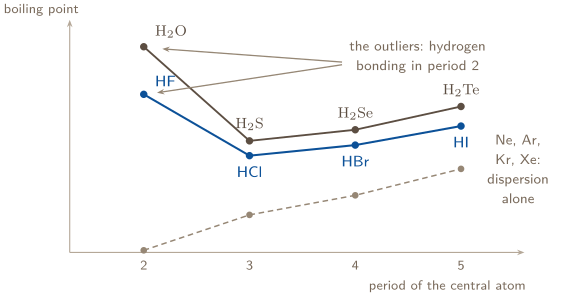
Down each group the molecules get larger, dispersion grows, and boiling points rise — except at the top, where hydrogen bonding in and HF lifts them far above the trend. The noble gases are the baseline: dispersion alone, rising with size. This one picture is most of topic 3.1 and 3.2 together.
The four kinds of solid. Which particles, and which attraction, predict every property in the table.
Solid | Particles | Held by | Melting | Conducts; other |
|---|---|---|---|---|
Ionic | cations and anions in a lattice | Coulombic attraction between ions | high | only when molten or dissolved; brittle (like charges meet on a shear) |
Covalent network | atoms bonded in three dimensions or in layers | covalent bonds throughout | very high | no (graphite excepted); hard and rigid; graphite soft because layers slide |
Molecular | discrete molecules | intermolecular forces | low | no — valence electrons held in bonds and lone pairs |
Metallic | metal cations in a sea of electrons | delocalized electrons | varies | yes, heat and electricity; malleable and ductile; an interstitial alloy is more rigid |
Nonmetals and metalloids make network solids — diamond, graphite, silicon dioxide, silicon carbide. Very large molecules and polymers are still molecular solids, and their shapes, set by noncovalent interactions, decide what they do.
3. SOLID, LIQUID, GAS: WHAT THE PARTICLES ARE DOING
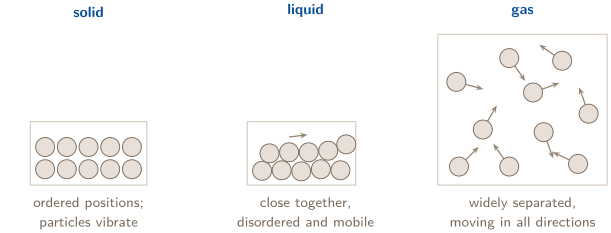
Ten particles in each panel, drawn at the same size. The gas occupies more space; the condensed phases keep neighboring particles close. Container volumes are schematic, not a scale drawing of the roughly thousandfold molar-volume contrast. The solid panel shows a crystalline example.
What the drawing has to show. In a solid the particles touch and do not translate; crystalline means a regular repeating arrangement, amorphous means no long-range order. In a liquid they still touch but move past one another. In a gas they are far apart and in constant random motion, their spacing and collision rate set by temperature, pressure and volume.
Molar volume. Solid and liquid have nearly the same molar volume because in both the particles are in contact; a gas at room conditions occupies roughly a thousand times more. Problem 3 puts the number on it. Phase diagrams are excluded from the exam.
4. THE IDEAL GAS LAW AND PARTIAL PRESSURES: ONE EQUATION, STRICT UNITS
The equation is on the sheet. The units are the test: pressure in atmospheres, volume in liters, temperature in kelvin, and the first . A Celsius temperature or a pressure in torr with the wrong produces a confident number that is wrong by a large factor.
Mixtures. Each ideal gas in a mixture exerts its pressure as if alone; the partial pressure is proportional to the mole fraction:
The three pictures the sheet does not give you.
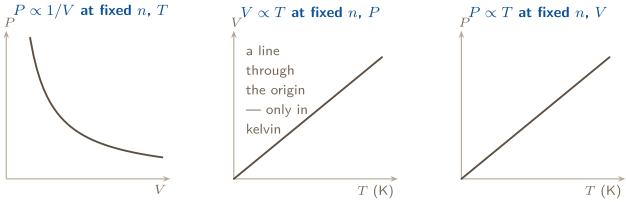
A graph question asks you to say which variable was held constant and to read the shape: a curve that never touches an axis is an inverse relationship; a line through the origin is a direct one, and it goes through the origin only because the scale is kelvin.
2. HOLD TEMPERATURE FIXED
and are at the same temperature. Which has the greater average translational kinetic energy? Which has the greater rms speed?
5. KINETIC MOLECULAR THEORY: TEMPERATURE IS MOTION
Kinetic molecular theory links a gas’s behavior to particles in continuous, random motion. For one particle, . For a sample, average translational kinetic energy is : use root-mean-square speed, not the average velocity vector. Kelvin temperature is proportional to average translational kinetic energy. A Maxwell–Boltzmann speed distribution shows how individual particle speeds vary within the sample.
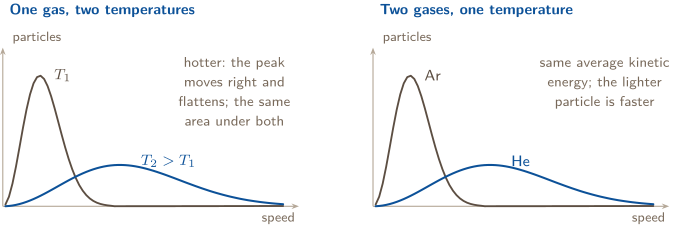
The reading that scores. At a higher temperature the distribution shifts to higher speeds and spreads out; the area stays the same because the number of particles did. Two gases at the same temperature have the same average translational kinetic energy. Their rms-speed ratio is because . The schematic left panel uses , matching Problem 5. Equal areas refer to the full distributions; tails continue beyond the shown speed axis.
CHECK 2 — HOLD TEMPERATURE FIXED
Neither, then nitrogen. Same temperature means the same average translational kinetic energy — that is what temperature is, so the first answer is a tie and saying so is the point. Speed is a different question: with the energies equal, so the lighter molecule must move faster. Nitrogen at 28 against oxygen at 32 gives larger by , about seven percent. One temperature, two answers, and the mass only enters the second.
6. DEVIATION FROM THE IDEAL GAS LAW: WHERE THE THEORY’S TWO ASSUMPTIONS FAIL
The ideal gas law assumes particles have no volume and no attraction for one another. Real particles have both, and the CED names the two places the law fails: interparticle attractions, “particularly at conditions that are close to those resulting in condensation,” and particle volumes, “particularly at extremely high pressures.”
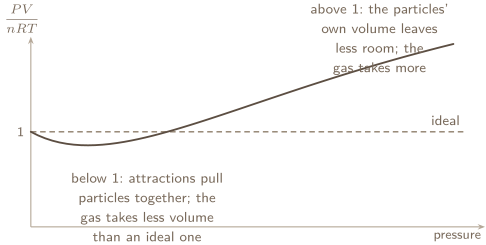
Reading the curve. At low to moderate pressure, especially for a cold or polar gas near its condensation point, attractions win and dips below 1. At very high pressure the particles’ own volume becomes a significant fraction of the container and climbs above 1. Closest to ideal: high temperature (fast particles barely feel attractions), low pressure (far apart), small nonpolar particles (weak dispersion, little volume) — helium at room temperature and one atmosphere is the textbook case; ammonia near its boiling point is the opposite.
7. SOLUTIONS AND MIXTURES: MOLARITY, DILUTION, AND COUNTING IONS
A solution is a homogeneous mixture — solid, liquid or gas — whose macroscopic properties are the same throughout. A heterogeneous mixture’s properties depend on where you look.
Molarity is the laboratory’s measure of composition:
Three consequences do most of the unit’s arithmetic.
- Moles from a volume: (liters). Mass from moles needs the molar mass; that is the route to “how many grams do I weigh out.”
- Dilution: adding solvent changes the volume and not the moles, so . Write it as “moles before equal moles after” and the formula is never memorized wrong.
- Ions: a formula unit releases a known number of each ion. is and . A particle count is moles of that particle times Avogadro’s number.
Excluded from the exam: molality, percent by mass and by volume, and every colligative property. Molarity is the only concentration the scoring guides ask for.
8. REPRESENTATIONS OF SOLUTIONS: WHAT THE DRAWING MUST SHOW
A particulate drawing of a solution communicates two things: the interactions between the components and their relative concentrations. The scorer checks both.
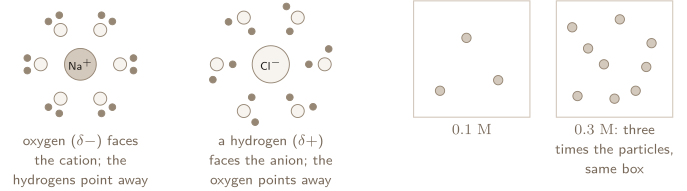
The rules. An ionic solute is drawn as separated ions, each surrounded by water molecules whose partial charges face the ion — oxygen toward a cation, hydrogen toward an anion. That orientation is the ion–dipole force made visible, and a drawing with the water facing the wrong way loses the point. A molecular solute such as sugar or ethanol is drawn as intact molecules among the water, hydrogen bonded where they can be. Concentration is the count: the same box, more particles. Water need not fill the page, but the water that is drawn must be oriented.
9. SEPARATING SOLUTIONS AND MIXTURES: USE THE PROPERTY THAT DIFFERS
The components of a solution “cannot be separated by filtration” — they are molecule-sized and pass through any filter together. A separation exploits a difference in intermolecular interaction or in a property that follows from it.
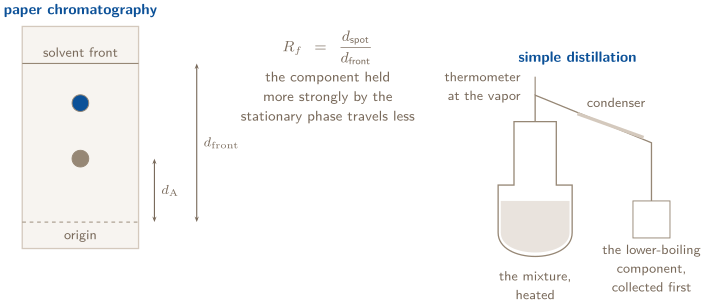
Chromatography — paper, thin-layer or column — moves a mixture in a mobile phase past a stationary phase; each component partitions according to how strongly it interacts with each. On polar paper with a nonpolar solvent, the more polar component clings to the paper and travels less; the resulting chromatogram lets you infer relative polarities. Distillation separates by boiling point, itself set by intermolecular forces. The exam’s skill here is 2.C: choose the procedure that matches the question, and be able to sketch the setup.
10. SOLUBILITY: LIKE DISSOLVES LIKE, SAID PROPERLY
“Substances with similar intermolecular interactions tend to be miscible or soluble in one another.” That is the whole of topic 3.10, and the scoring is in the word similar: name the interactions on both sides.
Solute | Dissolves in | Because |
|---|---|---|
Ionic (NaCl) | water, not hexane | ion–dipole attractions to water replace the lattice’s ion–ion attractions; hexane offers only dispersion |
Polar, hydrogen bonding (ethanol, sugar) | water; small ones in hexane too | hydrogen bonds to water; a short alkyl chain still mixes with hexane by dispersion |
Nonpolar (, hexane, oils) | hexane, not water | dispersion matches dispersion; water would have to give up hydrogen bonds to make room and gains nothing back |
Long chain with one OH (octanol) | mostly hexane | one hydrogen-bonding end cannot pay for eight carbons of dispersion-only chain |
The mechanism in one sentence. Dissolving trades solute–solute and solvent–solvent attractions for solute–solvent ones. When the new attractions are comparable to the old, mixing happens; when the solvent must break strong attractions to itself to make room for a solute that cannot replace them, it does not. Water and oil separate because water’s hydrogen bonds to itself are worth more than its dispersion with oil.
11. SPECTROSCOPY AND THE ELECTROMAGNETIC SPECTRUM: WHICH LIGHT DOES WHAT
Molecules absorb and emit photons whose energies match the spacing between their own energy levels — and different kinds of motion have differently spaced levels. The CED asks for three pairings, and only three.
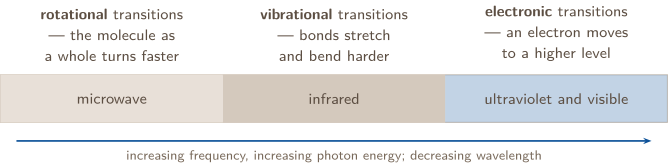
The order is the energy order: rotating a molecule costs least, vibrating its bonds more, promoting an electron most. A colored solution is colored because its molecules or ions have an electronic transition whose energy falls in the visible range; the color you see is what is not absorbed. That is the link to card 13.
12. PROPERTIES OF PHOTONS: TWO EQUATIONS, AND THE UNIT THAT BREAKS THEM
When a photon is absorbed, the atom or molecule gains exactly the photon’s energy; when one is emitted, it loses exactly that much. The energy of a photon rises with its frequency and falls with its wavelength.
The routine. Wavelength to frequency first, then frequency to energy; two lines, each with units. The one conversion that matters: must be in meters before it meets — a nanometer is m, a micrometer m. Multiply a single photon’s energy by Avogadro’s number for the energy of a mole of photons, which is the number to compare with a bond energy in kJ/mol.
3. FOLLOW AN ERROR THROUGH A MODEL
Every calibration standard is 10% more concentrated than its stated value. Absorbance is plotted against the stated values. What happens to the fitted slope, and to the concentration inferred for an accurately measured unknown?
13. THE BEER–LAMBERT LAW: A LINE WHOSE SLOPE IS THE CHEMISTRY
Absorbance (no units) is proportional to three things: the molar absorptivity , how intensely the species absorbs light of that wavelength; the path length of the cell; and the concentration . Path length and concentration are “proportional to the number of light-absorbing particles in the light path,” which is why they multiply.
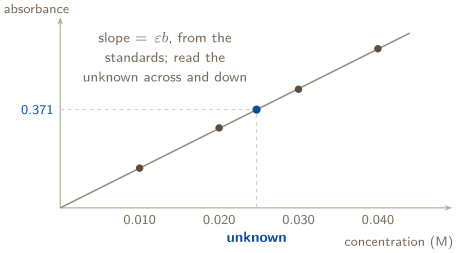
In practice the path length and the wavelength are held fixed, so is proportional to alone, and the instrument is set at the wavelength of maximum absorbance for the species so that a small change in concentration produces the largest change in . A calibration curve from standards gives the slope; the unknown’s concentration is its absorbance divided by that slope. Sources of error the exam asks for (skill 2.E): a wavelength off the maximum, a cell with a different path length or a smudge on it, a standard prepared at the wrong concentration, an absorbance so high that the line no longer holds.
CHECK 3 — FOLLOW AN ERROR THROUGH A MODEL
The slope comes out 10% too high, and the unknown is then reported about 9% too low — not 10%, because the two errors are a factor and its reciprocal. Each standard absorbs as its true concentration does — — but is plotted at , so every point sits higher than it should and the fitted slope is times the true . Dividing an honest absorbance by that inflated slope gives , which is low. Notice the direction reverses between the two halves: a calibration error that makes the standards look strong makes the unknown look weak. Trace the error through the equation rather than guessing its sign.
The Problems — In Topic Order
Thirteen problems, one per topic, in the order the College Board lists them. Every scenario is original; the reference values quoted are approximate and are given in each problem for the student’s use. Work each one before reading its solution.
PROBLEM 1
Which force is present, which is strongest, and what it predicts
(a) For each substance, name every intermolecular force present and the strongest: , , , , argon. (b) Rank , and by boiling point and justify the order. Reference values: C, C, C. (c) Hexane, , is nonpolar and boils at C; acetone, , is polar and boils at C. Explain. (d) Name the strongest attraction between each pair: ethanol and water; hexane and water; and water.
BEFORE YOU COMPUTE
Run card 1’s checklist on each formula before you write a word: every molecule has dispersion; is it polar (Unit 2’s VSEPR); does it have H on N, O or F and a lone pair on N, O or F; is there an ion. The strongest force present is the one that decides the property.
Part (c) is the trap the CED names: dispersion “is often the strongest net intermolecular force between large molecules.” Compare sizes before you compare polarities. Part (d) asks about pairs; ask what charges each partner brings.
WORKING
(a)
Species | Forces present | Why the strongest is what it is |
|---|---|---|
| dispersion only | tetrahedral, four identical C–H bonds, no net dipole; H on carbon does not hydrogen bond |
| dispersion, dipole–dipole | one polar C–Cl bond in a tetrahedral molecule leaves a net dipole; no N, O or F |
| dispersion, dipole–dipole, hydrogen bonding | H bonded to O, and lone pairs on O to accept: hydrogen bonding, the strongest of the three |
| dispersion, dipole–dipole, hydrogen bonding | H on N and a lone pair on N; trigonal pyramidal, so polar |
Ar | dispersion only | a single atom has no permanent dipole; its electrons still fluctuate |
(b) . Methane has only dispersion forces among small molecules, so the attractions to overcome at vaporization are weakest and it boils lowest, at C. Chloromethane is larger — more dispersion — and polar, so dipole–dipole attractions act in addition; it boils at C. Methanol is smaller than chloromethane (32 against 50 g/mol) and still boils far higher, at C, because its molecules hydrogen bond, and hydrogen bonds are much stronger than dipole–dipole attractions between molecules of this size. The chain each time: the particle, the strongest force, the boiling point.
(c) Hexane has no dipole; acetone does. Yet hexane boils higher. Hexane is the larger molecule — six carbons, 86 g/mol, many more electrons than acetone’s 58 g/mol — and its dispersion forces, summed over that larger, more polarizable electron cloud, exceed acetone’s dispersion plus dipole–dipole combined. Polarity adds a force; it does not guarantee the total is larger. This is the sentence the CED writes into topic 3.1: dispersion is often the strongest net force between large molecules.
(d) Ethanol and water: hydrogen bonding — ethanol’s O–H donates to water’s oxygen and water’s O–H donates to ethanol’s oxygen; they mix in all proportions. Hexane and water: dispersion only — hexane has no dipole and no N, O or F; water’s hydrogen bonds to itself are stronger than anything hexane can offer, so they separate. and water: ion–dipole — the full positive charge attracts the partially negative oxygen of each water molecule; stronger than dipole–dipole, and the reason the ion leaves its lattice.
ANSWER
(a)
dispersion;
dipole–dipole (with dispersion);
and
hydrogen bonding (with dipole–dipole and dispersion); Ar dispersion.
(b) :
dispersion only, then dispersion plus dipole–dipole, then hydrogen bonding.
(c) Hexane’s larger electron cloud gives it more dispersion than acetone’s
dispersion and dipole–dipole together.
(d) Hydrogen bonding; dispersion only; ion–dipole.
WATCH OUT
“ has hydrogen bonding because it has hydrogens.” Hydrogen bonding is a specific attraction that needs H bonded to N, O or F and a lone pair on N, O or F in the partner. Carbon-bound hydrogens do not qualify. The same error in reverse: calling every dipole–dipole force a hydrogen bond.
“Polar beats nonpolar, always.” Part (c). Dispersion scales with the number of electrons and the size of the molecule; a large nonpolar molecule routinely boils above a small polar one. Compare sizes first.
CONNECTION
Part (d) is Unit 3’s second half in miniature: the pair that hydrogen bonds mixes (card 10), the pair that shares only dispersion separates, and the ion–dipole attraction is what a drawing of has to show (card 8). Every solubility, chromatography and solution-drawing question in this guide is Problem 1 asked about two substances instead of one.
ABOUT THIS EXCERPT
This is the opening of a 44-page guide: the diagnostic tree, the full Master Toolbox, and the first worked problem. 12 more problems follow in the complete guide, each worked the same way — what to notice before you start, every step shown, and the mistake that problem invites. The complete guide is shared with families during the fit conversation.
Engineering Confidence — engineeringconfidence.one
Source and review notes
What this resource is
Complete browser edition of the public excerpt from an original Engineering Confidence AP Chemistry unit-reference packet. Every problem is original; the reference values quoted are given in each problem for the student’s use.
- Published
- Last reviewed
- Printable edition
- 18 pages
Course reference: official College Board course page.
Read this public excerpt above, or save the PDF for printing and offline reading.
Download the 18-page PDF excerpt