Read the public excerpt
The same instruction and worked examples appear here and in the printable PDF excerpt. You can request full guides for upcoming units below.
READ THIS FIRST
About this guide. Unit 1 carries 8–11% of the multiple-choice weighting, and it is load-bearing. Every unit after it assumes the claim this one exists to teach: structure helps explain function. Some prompts ask for a fact, some for a prediction, and some for the mechanism between a structural feature and an observed outcome. The task verb tells you which job to do.
Aligned to Unit 1 of the 2025–26 Course and Exam Description, Topics 1.1 through 1.7, and to nothing else: every topic is taught here, and the line under each problem’s title names the topics it works. Surface area to volume and water potential belong to Unit 2 in this framework and are worked in the Unit 2 guide; the transcription part of Problem 6 is a Unit 6 bridge, labelled as one. A few structural details arrive as supplied facts because the CED keeps them out of scope — read them off the prompt, as you will on the exam. Start with the problem that matches your need, open only the relevant Toolbox card, and attempt it before reading its solution. Return to the decision tree or symptom map when you can name the place you are stuck. The rail atop each problem says “Before you compute” — here, read it as before you answer.
Diagnostic Decision Tree
HOW TO READ THE PROMPT
AP Biology asks in several registers, and the task verb decides the shape of your answer. Use this as a pass through the prompt, not as a stop-at-the-first-match tree.
1. Is there data? Read it first: the trend, the units, and any point that breaks the pattern. Explaining before reading means explaining the wrong thing.
2. What is the verb? Do each job the prompt actually names.
- Identify / state supply the requested information without elaboration.
- Describe state the relevant feature, pattern, or trend. Use values and units when the data make them relevant.
- Predict state the expected outcome or direction. If the prompt separately says justify, add the evidence and reasoning as a second job.
- Explain / justify / support say how or why, using the requested evidence and reasoning.
- Calculate make the mathematical steps checkable, including substitution, units, and appropriate precision.
- Construct / draw create the requested representation or model with the labels it needs.
- Determine / evaluate reach or judge a conclusion from observations, reasoning, calculations, or evidence.
3. Is this structure-to-function in disguise? Two structures compared, a “why can X do this and Y cannot,” a mutation, a change in temperature or pH. Name the structural difference, say what it does physically, then say what that makes possible or impossible.
4. Am I handed an experiment? Identify what was manipulated and what was measured. Then locate the comparison or baseline, controlled conditions, replication, randomization, and sample-size or design details that apply. Ask which alternative explanation each choice addresses; not every design uses the same four boxes.
5. Is a formula involved? Not in this unit’s own content — the only arithmetic here is counting linkages and keeping the mass honest (Problem 3). Exam-wide, the reference sheet gives water potential, surface area and volume, the statistics, and Hardy–Weinberg; it does not give molarity or dilution. Those are worked in the Unit 2 guide.
Last check, whatever the verb was: did you complete the requested job? For an explanation, connect the cause to a physical or mechanistic consequence and then to the biological outcome. For a prediction, make the direction unambiguous. For a calculation, make the setup and units visible.
Where the Points Are Lost
WHAT THE EXAM REWARDS ON THIS UNIT, AND WHERE CREDIT IS LEFT BEHIND
Three facts, each from the people who write and grade the exam.
1. The last point of a question is almost always the hardest. On one nine-point free-response question from the 2025 exam, the points that asked a student to read something off the data in front of them were earned by 64–89% of the cohort. The points that asked them to link one idea to the next were earned by 16%, 14%, and — for justify a prediction — 2%, the hardest point on the whole paper. The shape is positional: explain and justify sit at the end, so that is where a session starts, not where it runs out of time. The habit that earns it: write the chain, not the endpoints — structural cause, then the physical consequence, then the biological outcome. If you can say the middle clause out loud, you can write it.
2. Vocabulary is scored. The Course and Exam Description says it in its own words: students “tend to struggle with the use of language and similar terms, for example, protein versus proton. This confusion often results in a failure to earn points on free-response questions.” In this unit the near-misses are specific: protein and proton; hydrogen bond (between molecules, weak) and covalent bond (inside a molecule, strong); denatured (shape lost) and hydrolysed (backbone broken); polar (a premise) and the mechanism the polarity produces. The habit that earns it: name the interaction, not “the bond,” and say what it is between.
3. This unit is assessed by argumentation. The suggested skill for lipids and proteins is 6.E: “predict the causes or effects of a change in, or disruption to, one or more components in a biological system.” A prompt that heats a protein, kinks a fatty-acid tail, or swaps an amino acid is asking you to run the structure-to-function chain forward from a change. The habit that earns it: state the change, what it does to the interactions, what that does to the shape, and only then what happens to the function — and make the direction unambiguous.
Where to Look When You’re Stuck
SYMPTOM FIRST MOVE WORKED MODEL
Symptom | First move | Where |
|---|---|---|
I know the fact but cannot build the explanation | Name the structural difference, its physical consequence, and the requested biological outcome. | p. 11, Probs. 1, 4–5, 8 |
I cannot tell which water property is operating | Ask what the water molecules are doing: sticking, changing temperature, or leaving the liquid. | p. 12, Probs. 1–2 |
“Hydrogen bond” only means water to me | The same weak attraction holds water together, pairs the bases, and folds a backbone — name what it is between. | p. 14, Probs. 1, 5–6 |
Elemental composition seems to identify the molecule | Use elements as clues, then inspect subunits, linkages, polarity, and function. | p. 15, Probs. 3–4, 7–8 |
My linkage or water count is one off | Count edges in the connected acyclic structure, not just units. | p. 15, Prob. 3 |
Starch, glycogen, and cellulose blur together | Same monomer — ask linear or branched, and what the organism needs the polymer to do. | p. 15, Probs. 4, 7 |
Heat, pH, and mutation all feel the same | Separate altered conditions from an altered amino-acid sequence. | p. 17, Prob. 5 |
My strand is backwards | Pair, reverse, and label both ends before checking the sequence. | p. 19, Prob. 6 |
I have data but cannot defend the claim | Inventory what the design changed, measured, and failed to isolate. | Prob. 2; Stuck Toolkit |
Master Toolbox — Core Tools
THE UNIT, TOPIC BY TOPIC — WHERE EACH ONE LIVES IN THIS GUIDE
CED topic | Toolbox card | Problems |
|---|---|---|
1.1 Structure of water and hydrogen bonding | One cause, five consequences; One bond, three jobs | 1, 2 |
1.2 Elements of life | The four classes — the element rules | 8 |
1.3 Introduction to macromolecules | The four classes — building and breaking; the rule | 3 |
1.4 Carbohydrates | The four classes — linear or branched | 4, 7 |
1.5 Lipids | The four classes — the lipid roles and the gradient | 4, 8 |
1.6 Nucleic acids | Directionality is chemistry | 6 |
1.7 Proteins | Four levels, and what holds each | 5 |
The exam’s own words for what this unit is for: “describing the structure and function of biological macromolecules and describing the relationship between structure and function.” Every card below is that sentence with the nouns filled in.
A USEFUL CHAIN FOR STRUCTURE-TO-FUNCTION EXPLANATIONS
Five of the eight problems below are the same argument wearing different nouns. Learn the shape once and most of the unit comes with it:
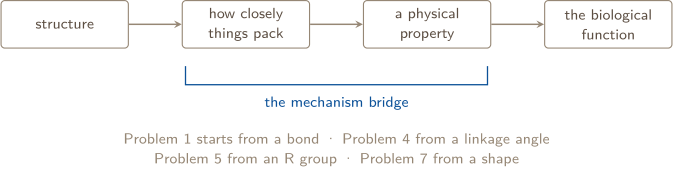
When a prompt asks for an explanation, naming the two endpoints leaves the mechanism implicit. The arrows make the causal claim complete.
A check first. One question opens each of the next three cards and is answered where that card ends. Answer it before you read on; getting it wrong is the point, because that is what makes the card stick.
1. EXPLAIN THE INTERACTION
Water’s O–H bonds are polar covalent bonds. Does boiling water break them? Name what changes and what stays intact.
ONE CAUSE, FIVE CONSEQUENCES: HYDROGEN BONDING
Oxygen is more electronegative than hydrogen — it holds the electrons of each shared O–H pair more tightly. No electron has been given away; the charge is only unevenly distributed. That is what polar means, and everything below follows from it.
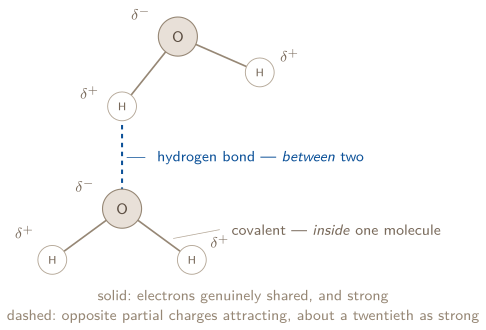
That dashed line is the whole unit. It breaks and re-forms constantly, and nothing in the list below involves breaking a covalent bond. Every property here is what happens when an enormous number of those weak attractions act at once:
- Cohesion — water sticks to water: unbroken columns, droplets, transpiration streams.
- Adhesion — water sticks to other polar surfaces. Capillary action is the two together.
- Surface tension — surface molecules have no water above them, so their bonds pull sideways and down, and the surface behaves like a skin under tension.
- High specific heat — a thermometer reports the average kinetic energy of the molecules, and energy spent disrupting hydrogen-bond interactions during heating is energy not spent speeding molecules up. During cooling, formation of those interactions releases energy as molecular motion is lost. Water therefore changes temperature slowly in either direction. It buffers climate, and cytoplasm buffers the cell.
- High heat of vaporization — escaping into the gas phase requires enough energy to overcome the attractions holding a surface molecule in the liquid. Higher-energy surface molecules are more likely to escape; they carry energy away, lowering the average kinetic energy of what remains. That is evaporative cooling: sweat, panting, transpiration.
Also: water is the solvent for polar and ionic substances, and ice floats because hydrogen bonds lock into an open lattice.
CHECK 1 — EXPLAIN THE INTERACTION
No. Boiling pulls water molecules away from each other; it breaks the hydrogen bonds between molecules and leaves every O–H bond within a molecule untouched. Steam is still — that is the whole proof. The two are not close in strength either: a hydrogen bond runs around and an O–H covalent bond around , more than twenty times as much, which is why one gives way at C and the other does not. So the habit is to name the two particles before you name the bond: hydrogen-to-oxygen inside a molecule is covalent, hydrogen-on-one-molecule to oxygen-on-another is a hydrogen bond, and “the bonds break” is a sentence a grader cannot give a point to.
ONE BOND, THREE JOBS: THE HYDROGEN BOND IN WATER, IN DNA, AND IN A PROTEIN
Students meet the hydrogen bond in water and file it as a water word. It is not. The same attraction — a hydrogen carrying a partial positive charge, drawn to an oxygen or nitrogen carrying a partial negative one — does three of this unit’s jobs, and the exam moves between them without warning:
Three things follow. It is always weak — about a twentieth of a covalent bond — so it is what heat disrupts first: in water (faster evaporation), in DNA (strand separation), in a protein (unfolding). It is never inside a molecule’s skeleton: heating water does not break an O–H bond, and denaturing a protein does not break a peptide bond. And it is directional — a partial-positive hydrogen to a partial-negative oxygen or nitrogen — which is why A pairs with T and not with G. Name what the bond is between, and the grader knows you know which job it is doing.
THE FOUR CLASSES, AND HOW POLYMERS ARE BUILT AND BROKEN
| Class | Monomer | Linkage | What it does |
|---|---|---|---|
| Carbohydrate | Monosaccharide | Glycosidic | Short-term energy (starch, glycogen); structure (cellulose, chitin) |
| Protein | Amino acid | Peptide | Catalysis, transport, structure, signalling, defense |
| Nucleic acid | Nucleotide | Phosphodiester | Stores (DNA) and transmits (RNA) heritable information |
| Lipid | no single monomer — not a polymer | Ester (in fats) | Energy storage, insulation, membranes, signaling, stability |
All four classes commonly contain C, H, and O, so elemental composition narrows identity but does not determine it. Sulfur supports a protein identification; phosphorus supports either a phospholipid or nucleic acid; nitrogen supports a nucleic acid and is also common in proteins. Finish the identification with structural evidence — the subunits, linkage, polarity, or function. Lipids themselves are grouped by shared hydrophobic behavior rather than one repeating monomer structure.
Carbohydrates: one monomer, linear or branched. A monosaccharide (glucose) is quick energy; polysaccharides are glucose units joined by glycosidic linkages into chains that are linear or branched, and that one structural choice is the function. Starch (plants) and glycogen (animals) store glucose; glycogen is far more branched, so it has far more chain ends, and the enzymes that release glucose work at the ends — a highly branched store can be mobilized fast, which is what a liver needs between meals. Cellulose (plant cell walls) is linear and hydrogen-bonds into rigid fibers: structure, not storage. The CED keeps the molecular structure of specific polymers out of scope, so when an exam prompt needs a linkage fact it supplies one — read it off the prompt, then reason from linear versus branched.
Lipids: four roles, and one gradient. Fats store long-term energy and may insulate. Steroid hormones regulate growth, development, metabolism, and homeostasis; cholesterol contributes structural stability to animal cell membranes; amphipathic phospholipids assemble into membrane bilayers. And the gradient the CED states outright: each carbon–carbon double bond in a fatty-acid tail is a kink; the more double bonds, the more unsaturated the lipid; and the more unsaturated, the more liquid it is at room temperature.
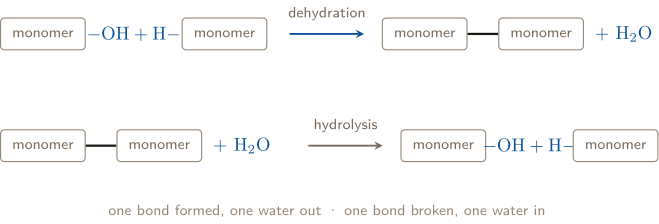
Building and breaking. The departing H and OH form water, and the reaction runs both ways:
The names are the events. Dehydration, water removed; synthesis, something built. Hydro, water; lysis, splitting. Digestion is hydrolysis, from the amylase in your saliva onward.
The counting rule, and why it is . In one connected, acyclic chain or branched tree, the first monomer formed no linkage by being there. Each later monomer joined through one new linkage. So monomers means linkages — therefore waters released while building it, and waters consumed while hydrolysing those linkages. A ring or an additional crosslink adds another linkage without another monomer, so inspect the topology before applying the shortcut.
What that does to the mass. For the dehydration-built linkages modeled here, each linkage released the equivalent of one water, so the polymer weighs less than the monomers you began with: For identical monomers in the stated acyclic structure,
For a heteropolymer, replace the first term with the sum of the individual monomer molar masses. Nothing was destroyed — the missing mass is sitting in the beaker as water. Use that as a check: if a polymer mass comes out larger than the sum of its monomers, you added the water instead of subtracting it.
2. DISTINGUISH STRUCTURE LEVELS
A protein loses its shape when heated, but its amino-acid sequence is unchanged. Which structural level survived — and how can the function change anyway?
PROTEIN STRUCTURE: FOUR LEVELS, AND WHAT HOLDS EACH ONE
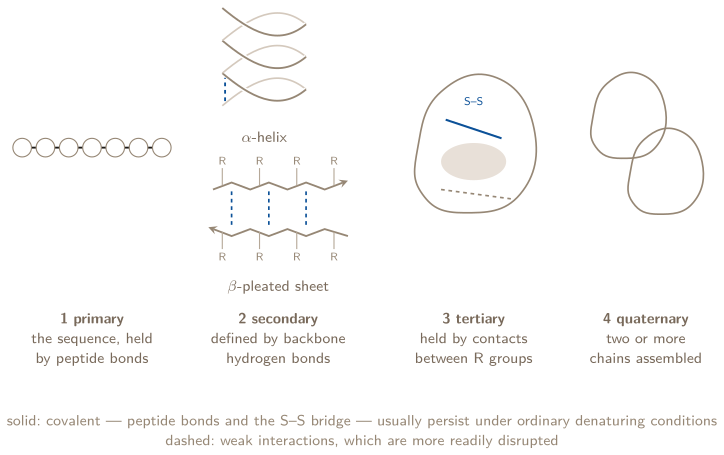
- Primary — the amino acid sequence, held by peptide bonds (covalent). Constrains how the chain can fold.
- Secondary — -helices and -pleated sheets, defined by hydrogen bonds between backbone atoms: the C=O of one residue and the N–H of another. R groups are not the bonds that define this level, though side chains can influence which conformations a sequence favors.
- Tertiary — the whole chain folded into one three-dimensional shape, held by interactions between R groups of residues that may sit far apart in the sequence. Four common classes used here depend on R-group chemistry and local conditions (geometry, solvent, pH, ions, and neighboring residues): hydrogen bonds between polar R groups; ionic bonds between an R group carrying a negative charge and one carrying a positive charge; hydrophobic clustering, where nonpolar R groups cluster away from water; and disulfide bridges, genuine covalent S–S bonds between two cysteines. Three weak, one covalent — that split helps predict which interactions are more vulnerable under the stated conditions.
- Quaternary — two or more separate polypeptides assembled through the same types of interactions that stabilize tertiary structure. A single-chain protein has none.
The common amino-acid plan. Each amino acid has a central carbon bonded to a hydrogen, an amine group, a carboxyl group, and a variable R group. A peptide bond joins the carboxyl group of one amino acid to the amine group of the next. The R group supplies chemical variation that helps determine tertiary interactions; classify its relevant property rather than memorizing twenty structures. The CED’s own vocabulary is three classes — hydrophobic/nonpolar, hydrophilic/polar, and ionic — and those are the words to write on the exam. The table below is the same three with the ionic class split by sign and the one covalent-capable side chain called out, because those are the distinctions the interactions turn on:
| R group class | Examples | What it can form |
|---|---|---|
| Nonpolar | valine, leucine, alanine | Hydrophobic clustering — pushed into the interior, away from water |
| Polar, uncharged | serine, threonine | Hydrogen bonds with other polar R groups |
| Acidic, usually negative near pH 7 | glutamate, aspartate | Ionic bond with a basic R group |
| Basic, usually positive near pH 7 | lysine, arginine | Ionic bond with an acidic R group |
| Thiol, | cysteine only | Disulfide bridge (S–S) — the one covalent R-group bond |
Methionine also contains sulfur, but it lacks the thiol pair used in the usual cysteine S–S bridge.
pH can change the protonation of ionizable groups. AP prompts most often foreground acidic carboxylates and basic side chains: adding can protonate a carboxylate and remove its negative charge; high pH can remove a proton from a positive group. Cysteine’s thiol is also ionizable, so do not turn the common AP examples into an exhaustive rule.
Denaturation follows directly from that split. Heat adds kinetic energy: the chain flexes and vibrates more strongly, making weak noncovalent arrangements less stable. A change in pH works by a different route to the same place: it adds or removes protons from charged R groups, so the charges that were attracting one another stop existing. Either way, it is the weak interactions that are more readily disrupted. The covalent peptide bonds and, under many ordinary denaturing treatments, disulfide bridges are more likely to persist.
As enough stabilizing interactions are disrupted, secondary, tertiary, and, where present, quaternary organization can change while the primary sequence remains. Because a protein’s job depends on a particular three-dimensional arrangement — for example, an enzyme pocket whose geometry and chemistry favor a substrate or family of substrates — a shape change can reduce function. Active-site residues often sit far apart in the sequence and are brought together by folding, which is why unfolding can disrupt catalysis. Under ordinary denaturing conditions, loss of shape need not mean hydrolysis of the peptide backbone.
CHECK 2 — DISTINGUISH STRUCTURE LEVELS
Primary structure survived: the order of the amino acids and the peptide bonds holding them are what heat did not touch. Everything above it is held by weaker interactions — hydrogen bonds along the backbone for secondary, and R-group interactions for tertiary and quaternary — and those are what heat disrupts. Function goes with them, because an active site is a three-dimensional arrangement and its residues are usually far apart in the sequence, brought together only by the fold. So the same sequence can have no function at all once the fold is gone. Two sentences the exam buys: name the level that changed, then say what the change did to a site, not to the molecule in general.
3. READ THE DIRECTION
A DNA strand reads -AGTC-. Write its complementary strand in the direction. What operation comes after the base pairing, and what must not be reversed?
NUCLEIC ACIDS: DIRECTIONALITY IS CHEMISTRY, NOT NOTATION
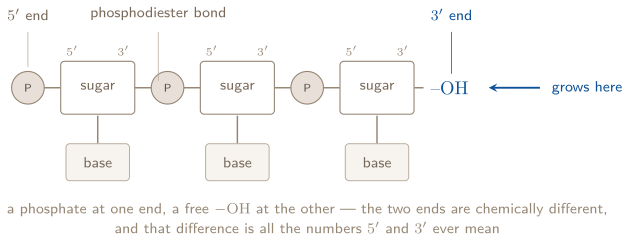
A nucleotide is a phosphate, a five-carbon sugar, and a nitrogenous base. The sugar’s carbons are numbered through ; the phosphate hangs off carbon , and a free hydroxyl sits on carbon . A phosphodiester bond joins nucleotides in the sugar–phosphate backbone. Standard polymerases extend a strand by using its free -OH to react with the activated phosphate of an incoming nucleotide. Biological information is encoded in the order of the nucleotide bases.
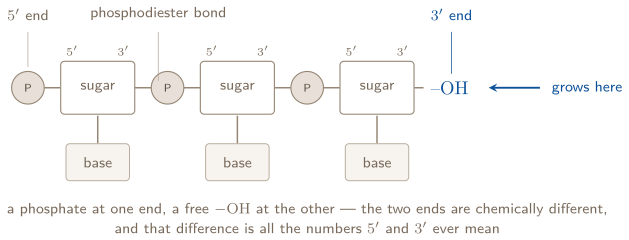
So standard synthesis proceeds by extending the end. That is a property of the polymerase reaction, not a claim that a end can participate in no chemistry. Antiparallel means the two strands of a duplex run in opposite directions — one strand’s end sits beside the other’s end:
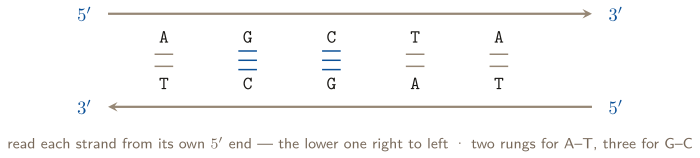
Pairing is A–T (2 hydrogen bonds) and G–C (3), with a purine (two rings: A, G) always opposite a pyrimidine (one ring: C, T, U) — so every rung of the ladder is the same width and the helix neither bulges nor pinches. The bond count has a consequence worth carrying: because a G–C pair is held by three hydrogen bonds and an A–T pair by only two, otherwise comparable high-G+C DNA generally requires more energy to separate. Base-stacking interactions also contribute to duplex stability, so hydrogen-bond count is not the only physical term. DNA vs. RNA: deoxyribose vs. ribose, thymine vs. uracil, double- vs. typically single-stranded. The CED’s word is typically, and it is worth writing: an RNA strand can fold back and pair with itself, so “RNA is always single-stranded” is the kind of absolute a grader marks down.
CHECK 3 — READ THE DIRECTION
-GACT-. Do it in two separate steps and neither one is hard. First pair, base by base, in the order given: A with T, G with C, T with A, C with G, which writes -TCAG- underneath — and it is written right to left because the strands run antiparallel. Second, the question asked for , so reverse the reading: GACT. What must not be reversed is the pairing itself. Writing the complement of AGTC as “TCAG read forwards” is the standard wrong answer, and it comes from doing the two steps at once. Pair first, then turn the strand around — and label both ends every time, because an unlabelled strand is a sequence with no claim attached to it.
PROBLEM 1
Four observations, one cause: reading water off its bonds
Topic 1.1
Each observation has the same molecular cause. Name the property responsible and give the causal chain from hydrogen bonding to what is observed. (a) An unbroken water column is pulled from the roots of a 40 m tree to its highest leaves. (b) A water strider stands on a pond without breaking through. (c) A lakeshore town has milder summer nights than a town 60 km inland at the same latitude. (d) A runner’s skin cools as her sweat evaporates — even though the sweat left her body at body temperature, and the air around her is warmer than she is.
BEFORE YOU COMPUTE
Naming “cohesion” is recall; the exam wants the chain from the bond to the behavior. Write the cause once — it is the same cause four times — then spend your effort on the routes it takes.
WORKING
The cause, stated once. Water is polar, so the partially positive hydrogen of one molecule is attracted to the partially negative oxygen of another: a hydrogen bond — weak on its own, constantly breaking and re-forming, and present in enormous numbers.
(a) Cohesion, working with adhesion. Begin with the fact that is easy to miss: nothing is pushing this column upward. The pull comes from the top.
Water evaporates out of the leaves — transpiration — which removes molecules from the top of the column and leaves everything below under tension.
Now the chain. Because water molecules hydrogen-bond to one another, the column behaves as one continuous body rather than as a stack of separate molecules; therefore removing a molecule at the top drags the molecule beneath it upward, and that one drags the next, and the pull is transmitted all the way down to the root; therefore the column rises without breaking, since the hydrogen bonds re-form as fast as they break. That is cohesion. Adhesion does the second job: water hydrogen-bonds to the polar, hydroxyl-rich cellulose of the xylem walls, which helps support the column’s weight and keeps it from pulling away from the wall and snapping.
(b) Surface tension. A molecule deep in the liquid is hydrogen-bonded in every direction at once, so its pulls cancel. A molecule at the air–water boundary has no water above it, so its bonds pull only sideways and downward. Because those pulls are unbalanced, the surface layer is drawn inward and held more tightly than the bulk liquid below; therefore the surface resists being stretched or pushed apart and behaves like a thin elastic skin under tension; therefore an insect light enough, with its weight spread across enough leg area, dimples that skin instead of breaking through it. Note what this is not: ordinary buoyancy alone. Surface tension supplies the dominant support in this observation, though displaced water can contribute some buoyant force.
(c) High specific heat. Start with what a thermometer actually reports: the average kinetic energy of the molecules — how fast they are moving. That matters because energy added to water has two places it can go. Because water molecules are held to one another by hydrogen bonds, much of the energy delivered goes into breaking those bonds rather than into speeding molecules up; therefore the same energy input produces a smaller rise in average molecular speed than it would in a liquid without those bonds. During cooling, hydrogen-bond formation releases some energy as molecular motion is lost. Therefore water’s temperature changes slowly in both directions — slow to warm and slow to cool.
Now the town. Because the lake absorbs the day’s energy with only a small temperature rise, and gives that energy back to the air as it slowly cools overnight, the air over the shore is being warmed all night by the water beside it; therefore the shore town’s overnight low sits closer to its daytime high than the inland town’s does. The lake is not making the town warm. It is making it less variable.
(d) High heat of vaporization. This is the property most often merged with (c), so hold them apart from the start: (c) is about water staying liquid and getting warmer. This is about water leaving the liquid altogether.
For a surface molecule to escape into the air as vapor, it must have enough energy to overcome the intermolecular attractions retaining it in the liquid. Because many hydrogen-bond interactions act throughout liquid water, moving molecules into the gas phase requires substantial energy; “high heat of vaporization” names that energetic cost.
The chain. Higher-energy surface molecules are more likely to escape, so the escaping population carries away more energy than an average sample of the liquid. The average kinetic energy of the sweat left behind falls; because that sweat contacts the skin, heat can flow from the skin into it and the skin cools.
Then answer the “even though.” Warm surroundings can add heat to the skin, but they do not eliminate latent-heat export by evaporation. The skin cools when that export exceeds the competing heat gain. High humidity reduces the net evaporation rate; in saturated air at equilibrium, return to the liquid can balance escape and eliminate net evaporative cooling.
ANSWER
(a) Hydrogen-bonded cohesion transmits transpiration tension through the water column; adhesion helps support contact with xylem. (b) Unbalanced cohesive attractions make the surface resist deformation. (c) Disrupting interactions during heating and forming them during cooling buffers temperature change. (d) Higher-energy surface molecules escape and carry latent heat away. All four begin with polar water molecules forming hydrogen bonds.
WATCH OUT
“Water is polar” is a premise, not a complete mechanism. When a prompt asks for an explanation, the property you name begins the sentence; the physical consequence and observed outcome complete it.
One question separates (c) from (d): does the water change state? Specific heat is the energy required to make liquid water warmer while it stays liquid. Heat of vaporization is the energy required to turn liquid water into gas — and the temperature need not change at all for that to happen. If a prompt is about a lake moderating climate, cytoplasm resisting a temperature swing, or a coolant, you want specific heat. If it is about sweating, panting, transpiration, or anything drying, you want heat of vaporization.
One more, on (a): do not write that the roots “push” the water up. Root pressure is real but nowhere near strong enough to raise a 40 m column — the transpiration pull does the work, and the column is under tension the whole way. That is precisely why cohesion is the property that matters here. A column being pushed from below would not need to hold itself together.
CONNECTION
Problem 2 tests the specific-heat claim in (c) with a beaker and a thermometer, and Problem 5 finds the same weak bond folding a protein backbone. The card One bond, three jobs is the map: one attraction, three places the exam sends it.
ABOUT THIS EXCERPT
This is the opening of a 38-page guide: the diagnostic tree, the full Master Toolbox, and the first worked problem. 7 more problems follow in the complete guide, each worked the same way — what to notice before you start, every step shown, and the mistake that problem invites. The complete guide is shared with families during the fit conversation.
Engineering Confidence — engineeringconfidence.one
Source and review notes
What this resource is
Complete browser edition of the public excerpt from an original Engineering Confidence AP Biology unit-reference packet. The scenarios and explanatory problems were written for this guide.
- Published
- Last reviewed
- Printable edition
- 18 pages
Course reference: official College Board course page.
Read this public excerpt above, or save the PDF for printing and offline reading.
Download the 18-page PDF excerpt