AP Biology Tutoring. They know what the figure says. They cannot say why.
The point is the explanation, not the value off the graph: structure, then property, then cause. That chain is the model I build in your student, on their own work, until it runs without me. The score moves because the thinking does.
One 50-minute session each week.
Remote, nationwide
One engineer, deliberately few families.
UT Austin ECE · Former director at Microsoft · Formerly Elite Guide, Alpha/GT School · 3,000+ recorded 1:1 hours
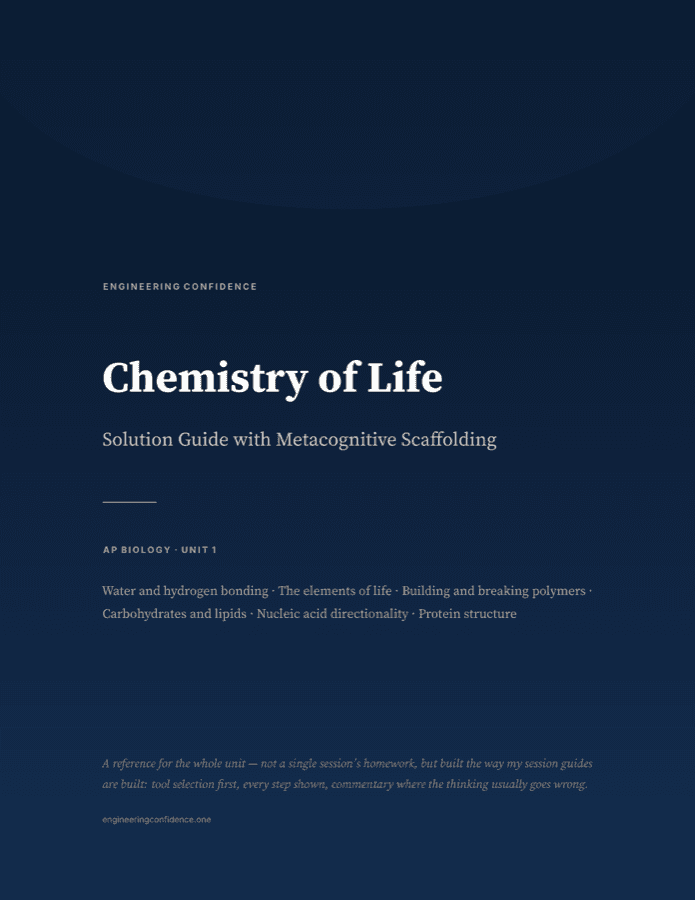
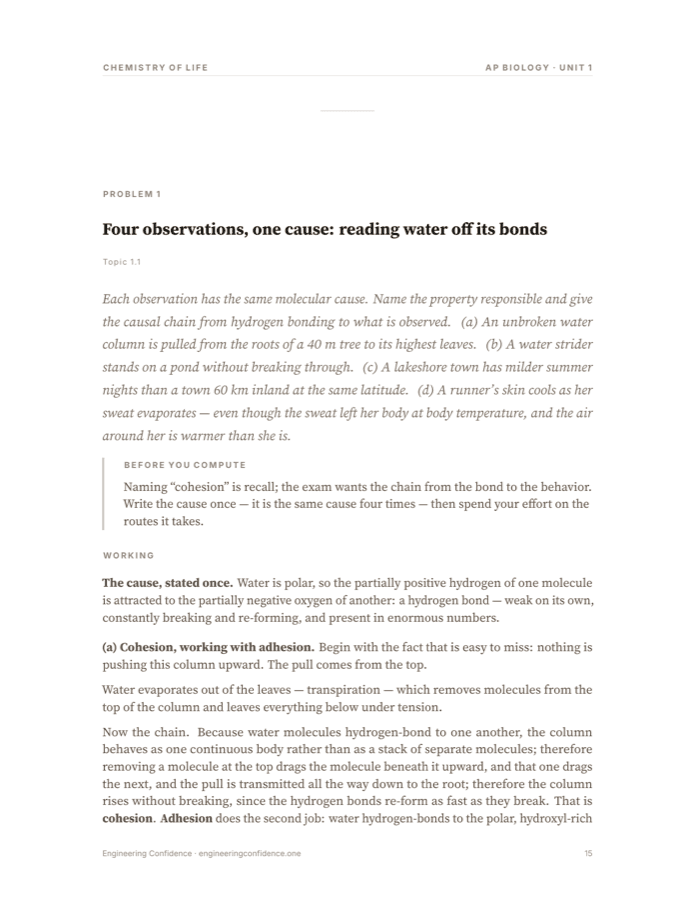
Biology · Chemistry of life
A worked excerpt you can inspect. Your student receives a guide to the session's problems that evening, in this format.
How the week works
The subject is the vehicle. The student is the work.
An A in the course. Ownership of the work.
Vince's first AP Precalculus test came back a C-minus. What alarmed his mother was not the grade. It was the distance between the grade and the kid she knew.
At the end of the year his teacher interviewed every student across the whole course and exempted from the final only those who showed mastery of everything raised. Vince walked in, answered everything, and walked out exempt, with an A in the class.
The following year he began sending his own materials before sessions, as he continued into calculus and chemistry — running the system himself. He wants to be an engineer. His parents have asked about his younger brother.
AP Precalculus, 2025–26 · name changed
One student's experience, not a guaranteed result.
Where AP Biology actually gets hard
The exam rewards a causal chain written in precise language: structure to property to behavior. A student who has only ever been asked to recall stalls when half the score is a written argument.
In 2025, students pulled values off the data at 72% to 89%. On the same paper, the point for justifying a prediction from that data was earned by 2% of students. Same question. Same data. The retrieval was not the exam.
The guide works those explanations to the sentence after the answer — the part the rubric actually pays for — so you can see the standard before you write to me.
Judge the work before you write to me:
Every AP Biology guide published so far, in course order:
AP Biology · one question from the 2025 exam, worth nine points
One part of this question, 89% of students got right. Another part, 2% did.
Same question, same nine points, scored one at a time. College Board publishes how many students earned each. Read them in the order the question asked.
- 64%1
- 79%2
- 16%3
- 83%4
- 76%5
- 89%6
- 49%7
- 14%8
- 2%9
It does not get steadily harder as it goes. It collapses at point 3, recovers for three points, and then falls away to nothing — 49%, 14%, 2%.
Reading the shape is mine, not College Board’s: the points that hold up are the ones asking a student to pull something off the data in front of them, and the points that collapse are the ones asking them to link one idea to the next. College Board publishes the nine numbers and names only the last one — justify a prediction, the hardest point on the entire 2025 paper. What it does confirm is the pattern: across the exam, the last point of a question is almost always the hardest.
So that is the half of the exam I teach.
The points most of the cohort already earns are the ones where the answer is on the page in front of them. Nothing here suggests they need me for those. The ones almost nobody earns are the whole job.
- Start where the question ends
- The collapse is positional — the “explain” and “justify” parts sit at the end, so that is where a session starts, not where it runs out of time.
- Say the chain out loud before writing it
- Structure, to property, to behavior, in that order and in precise language. A student who can say the link can write it; one who cannot say it was never going to write it under time.
My guide works those explanations to publication standard, so you can see the bar before you write to me.
Where every 2026 score landed
- 5
- 15.0%
- 4
- 25.0%
- 3
- 31.0%
- 2
- 21.0%
- 1
- 8.0%
71% earned a 3 or higher in 2026; the 3 is the widest band.
Chief Reader Report, AP Biology, 2025, and College Board’s published 2026 score distribution, released July 2026 in whole percentages. The nine point-level means are College Board’s 2025 figures; the grouping of them is mine.
Nobody else publishes this.
College Board publishes the rubric means and the scoring worksheets. Nothing connects them to what your student should do differently on exam morning. Working that out — which point the rubric actually pays for, which one collapses, and what that means for how a student prepares — is the same work I do in a session. It is on this page so you can check it before you write to me.
A student who knows exactly where the points are does not walk in hoping. That is most of what confidence actually is.
AP Biology is one of thirteen AP courses I tutor
One engineer across all of them: the same preparation, the same second read, the same standard, whatever the course.
See the courses
plus pre-calculus and honors calculus
algebra-based through calculus-based
and honors chemistry
AP Biology
and honors biology
from an engineer who has shipped software
and college intro statistics
from an engineer who passed all three CFA exams on the first attempt
AP Business with Personal Finance
new for 2026–27; first exam May 2027
and honors precalculus — where calculus readiness is decided
What this asks of your student, and of you
There is no secret. It's smart work.
I prepare the sessions, explain the ideas, build the practice, and grade what comes back. Your student brings the class materials, works through the practice, and sends back what they finish. You support the follow-through at home.
Think of a personal trainer. You hire one for the roadmap, the knowledge, and someone in your corner — not to do the work for you, and not to make you do it. I am not an enforcer, and I am not your student's parent. If the end of our session is the end of your student's work for the week, the session will still help. It will not get them a five.
Your student does not have to arrive confident. The one thing I cannot supply is the wanting. A course the parents chose and the student did not is a hard year for everyone, and I will say so on the fit call, not in March.
The engagement
One 50-minute session each week, with preparation, the evening guide and parent report, and one set per session, graded when your student returns it.
A twice-weekly cadence is available; the scope and fee are agreed before you begin.
Tell me about your student
I read your note personally and reply within 24 hours.