AP Computer Science Tutoring. They can read the Java. They cannot write it when nothing runs.
The exam is typed into an editor that does not run the code. The skill that survives that is the trace — holding every value in your head, one operation at a time. That is a way of thinking, and it is what I build in your student on their own work, until they do it without me.
One 50-minute session each week.
Remote, nationwide
One engineer, deliberately few families.
UT Austin ECE · Former director at Microsoft · Formerly Elite Guide, Alpha/GT School · 3,000+ recorded 1:1 hours
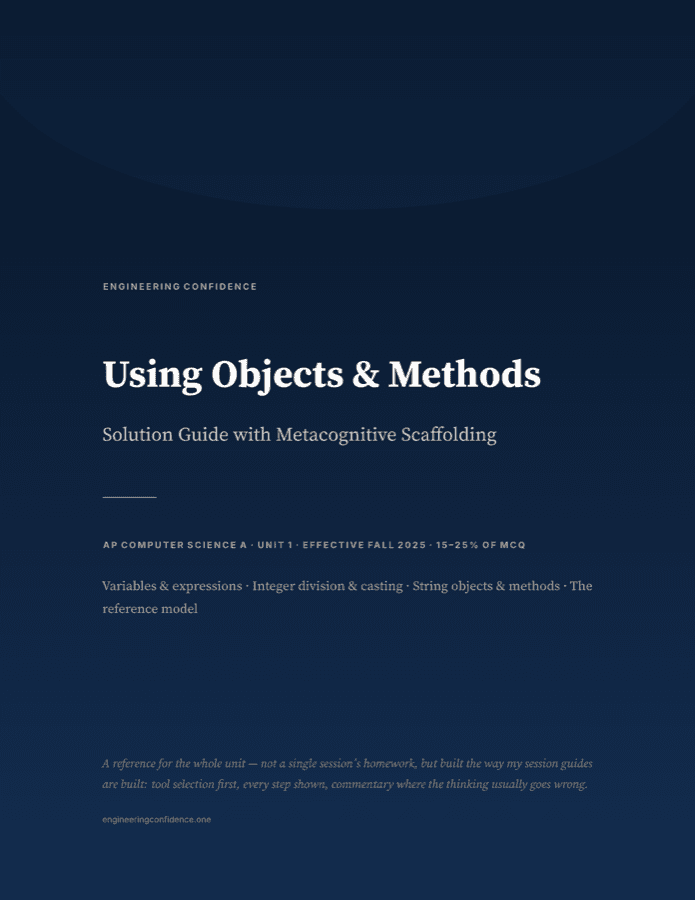
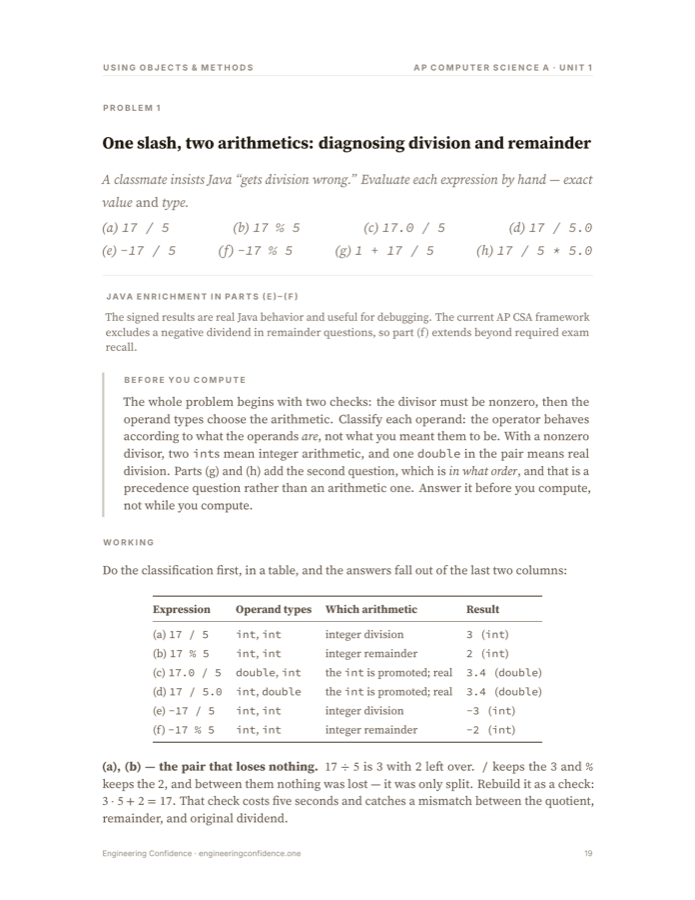
Computer Science A · Using objects and methods
A worked excerpt you can inspect. Your student receives a guide to the session's problems that evening, in this format.
How the week works
The subject is the vehicle. The student is the work.
An A in the course. Ownership of the work.
Vince's first AP Precalculus test came back a C-minus. What alarmed his mother was not the grade. It was the distance between the grade and the kid she knew.
At the end of the year his teacher interviewed every student across the whole course and exempted from the final only those who showed mastery of everything raised. Vince walked in, answered everything, and walked out exempt, with an A in the class.
The following year he began sending his own materials before sessions, as he continued into calculus and chemistry — running the system himself. He wants to be an engineer. His parents have asked about his younger brother.
AP Precalculus, 2025–26 · name changed
One student's experience, not a guaranteed result.
Where AP Computer Science A actually gets hard
The free-response asks for working Java — methods, classes, array algorithms — typed into that editor. The dependable skill is the trace: write the type and current value of every piece, execute one operation at a time, update state visibly. A multiple-choice trace becomes bookkeeping.
On the 2025 paper — every published free-response mean describes this retired 36-point form — calling a method on the correct object was earned by 27% of students. Handling the special case — the empty list, the first element, the value that is not there — was earned by 12%.
My guide works the course’s opening — objects and methods — the way I review production code: does the method actually run, including the case you did not want to think about.
Judge the work before you write to me:
Every AP Computer Science A guide published so far, in course order:
AP Computer Science A · the 2026 exam
Nearly half this cohort finished at one end or the other.
25% scored a 5. 23% scored a 1. More students took a 1 than took a 3.
Where every 2026 score landed
- 5
- 25.0%
- 4
- 26.0%
- 3
- 15.0%
- 2
- 11.0%
- 1
- 23.0%
66% earned a 3 or higher in 2026.
The free-response section pays for production, not recognition. A student writes a working method or does not, and a task like that separates a cohort rather than bunching it in the middle. Read that as where students landed in 2026, not as a law of the subject.
Which end a student lands on is decided long before exam day.
The free response pays for production, not recognition — and recognition is what school practices. Reading code and answering questions about it is a different act from writing a method that has to work, in an editor that does not compile it and tells you nothing.
- Produce before you recognize
- Every session ends with code the student wrote from nothing, not code they corrected. That is the act being scored, and it is the one most students have never rehearsed under time.
- Trace it on paper, because nothing runs
- Write the type and current value of every piece, execute one operation at a time, update the state visibly. It is how you get feedback in a room that gives you none — and it turns a multiple-choice trace into bookkeeping.
My guide works the course’s opening the way I review production code: does the method actually run, including the case you did not want to think about.
College Board’s published 2026 score distribution, AP Computer Science A, released July 2026 in whole percentages.
Nobody else publishes this.
College Board publishes the rubric means and the scoring worksheets. Nothing connects them to what your student should do differently on exam morning. Working that out — which point the rubric actually pays for, which one collapses, and what that means for how a student prepares — is the same work I do in a session. It is on this page so you can check it before you write to me.
A student who knows exactly where the points are does not walk in hoping. That is most of what confidence actually is.
AP Computer Science A is one of thirteen AP courses I tutor
One engineer across all of them: the same preparation, the same second read, the same standard, whatever the course.
See the courses
plus pre-calculus and honors calculus
algebra-based through calculus-based
and honors chemistry
and honors biology
AP Computer Science A
from an engineer who has shipped software
and college intro statistics
from an engineer who passed all three CFA exams on the first attempt
AP Business with Personal Finance
new for 2026–27; first exam May 2027
and honors precalculus — where calculus readiness is decided
What this asks of your student, and of you
There is no secret. It's smart work.
I prepare the sessions, explain the ideas, build the practice, and grade what comes back. Your student brings the class materials, works through the practice, and sends back what they finish. You support the follow-through at home.
Think of a personal trainer. You hire one for the roadmap, the knowledge, and someone in your corner — not to do the work for you, and not to make you do it. I am not an enforcer, and I am not your student's parent. If the end of our session is the end of your student's work for the week, the session will still help. It will not get them a five.
Your student does not have to arrive confident. The one thing I cannot supply is the wanting. A course the parents chose and the student did not is a hard year for everyone, and I will say so on the fit call, not in March.
The engagement
One 50-minute session each week, with preparation, the evening guide and parent report, and one set per session, graded when your student returns it.
A twice-weekly cadence is available; the scope and fee are agreed before you begin.
Tell me about your student
I read your note personally and reply within 24 hours.