AP Microeconomics Tutoring. They can draw the graph. They cannot explain it.
The graph is an argument: what moved, why, and who paid. Students who learn each graph as a picture start over every unit; students who learn the constraint see one model. That model is what I build, on your student’s own work — an engineer who passed all three CFA exams on the first attempt.
Engagements start at $750 every four weeks.
One 50-minute session each week.
No contract or minimum term · Remote, nationwide
One engineer, deliberately few families.
UT Austin ECE · Former director at Microsoft · Formerly Elite Guide, Alpha/GT School · 3,000+ recorded 1:1 hours
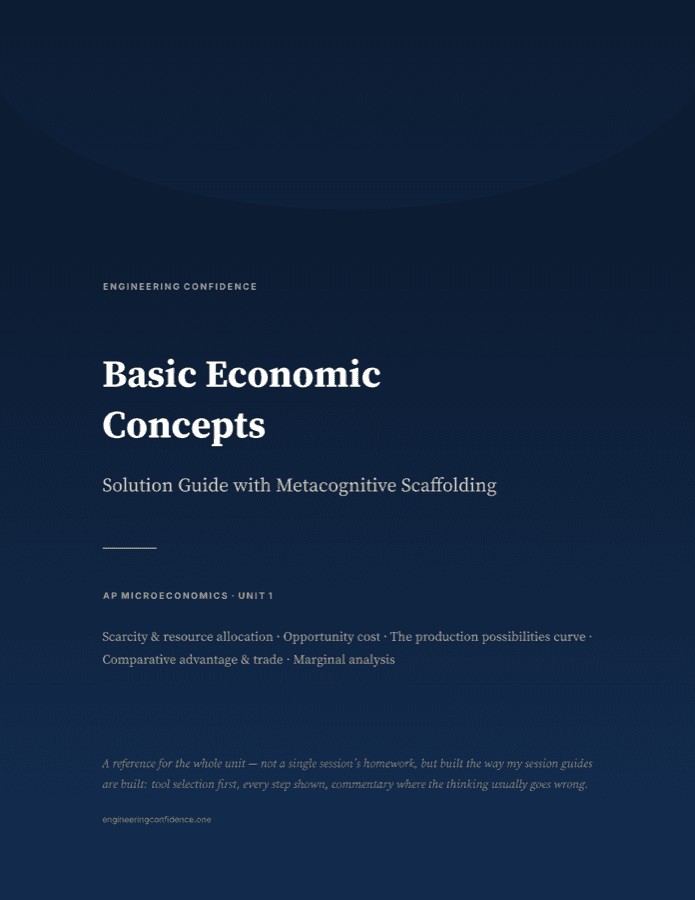
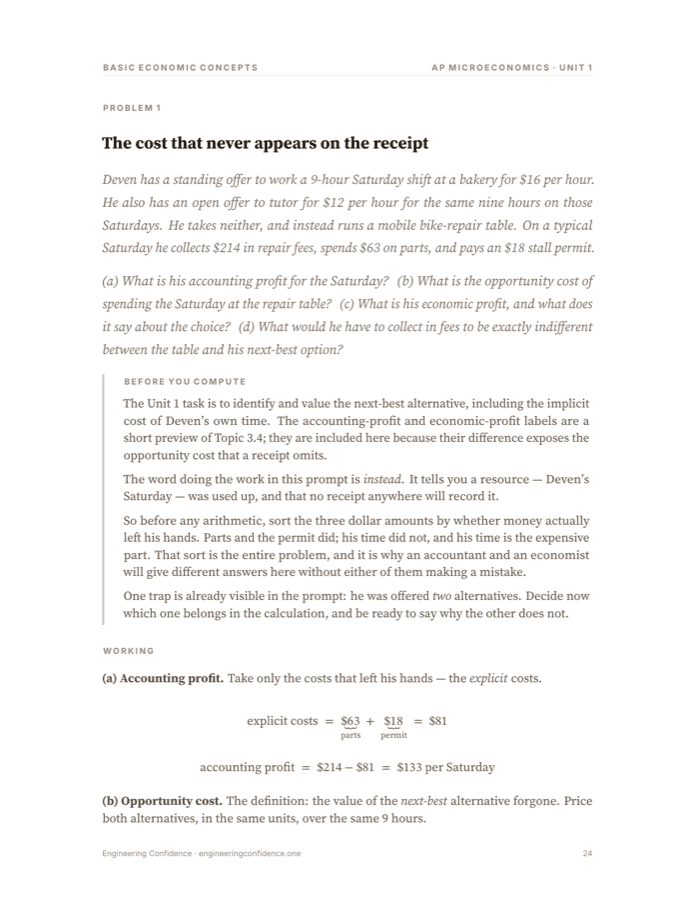
Microeconomics · Basic economic concepts
A worked excerpt you can inspect. Your student receives a guide to the session's problems that evening, in this format.
How the week works
The subject is the vehicle. The student is the work.
Every session is a session on how your student thinks. Two things move that: master a concept before moving past it, and work one to one, so the work is built for the student in front of me. I do both. Four times out of six is not mastered. Near automatic is.
Before
Your student's coursework arrives before the session — the problem set, the quiz that went sideways — and the session is built on it.
Together
I ask far more questions than I answer. A right answer with no why is the gap the exam finds.
That evening
A worked guide to your student, a written report to you — both written against the transcript, not from memory.
Between sessions
One set per session: the same idea with the shape changed, never the same problem with new numbers. What comes back is graded, every problem.
Next time
The transcript gets a second read, and that review is what I prepare the next session from.
One real summary, sent the same night — names changed, dates removed
Hi Dana and Nate,
A quick recap of tonight’s session.
What went well
- Vince showed strong number sense throughout the session. On one sigma-notation problem, he bypassed the standard algebra and came up with his own mental shortcut immediately — fast and correct.
Looking ahead
- Wednesday — Unit 10 test
Excerpt from the family's report.
An A in the course. Ownership of the work.
Vince's first AP Precalculus test came back a C-minus. What alarmed his mother was not the grade. It was the distance between the grade and the kid she knew.
At the end of the year his teacher interviewed every student across the whole course and exempted from the final only those who showed mastery of everything raised. Vince walked in, answered everything, and walked out exempt, with an A in the class.
The following year he began sending his own materials before sessions, as he continued into calculus and chemistry — running the system himself. He wants to be an engineer. His parents have asked about his younger brother.
AP Precalculus, 2025–26 · name changed
One student's experience, not a guaranteed result.
Purdue Honors
Aerospace Engineering admit
3,000+
recorded one-to-one hours
F → 88
precalculus, eight weeks — walked at graduation
Individual examples from Matt's one-to-one work; experiences vary and are not guarantees.
“Why are we just now finding you? Where have you been the last few years?! You have greatly impacted my son's life in the short time that you've been his teacher.”
Kirstie W., parent of game-design admit
Where AP Microeconomics actually gets hard
Students who learn each graph as a separate object have to start over every unit. Students who learn the constraint — scarcity, cost, the next unit of the thing — see one picture.
In 2025, drawing the market graph on a subsidy question scored 73%. Shading the area that was the total cost of that subsidy scored 8%. Same question. The graph was right. The area on it was not identified.
My packet works the opening unit — basic economic concepts — with every scenario original and every solution complete.
Judge the work before you write to me:
Every AP Microeconomics guide published so far, in course order:
AP Microeconomics · one 2025 free-response question
They drew the graph. They could not say what one part of it meant.
drew the market correctly
Axes, curves, the subsidy applied. The picture was right.
shaded what the subsidy cost
One area, on the graph they had just drawn correctly.
Drawing it is recall. Reading it is economics. Sixty-five points of difference between the two, on one question.
The pattern is not confined to that question. Elsewhere on the same 2025 paper, 11% completed the marginal-revenue-product chain in factor markets; on a 2024 question, 29% verified a Nash equilibrium using the actual numbers rather than asserting it.
An unlabeled area earns nothing, however right the picture is.
Graphing is 30–50% of every free-response point here — a tenth to a sixth of the whole score, sitting in the task students treat as decoration. The 8% above is not a drawing failure. It is a reading failure.
- Name the area out loud before shading it
- Which area is the subsidy’s cost, and why that one. A student who can say it shades it correctly; a student who shades first is guessing at a rectangle.
- Learn the constraint, not the pictures
- Students who memorize each graph as a separate object start over every unit. Students who learn what is actually scarce, and what the next unit of it costs, are drawing one picture all year.
My packet works the opening unit with every scenario original and every solution complete.
Where every 2026 score landed
- 5
- 19.0%
- 4
- 26.0%
- 3
- 23.0%
- 2
- 20.0%
- 1
- 12.0%
68% earned a 3 or higher in 2026. And the bar for a 5 is not the same across courses: on the last worksheet College Board released for this exam, in 2012, a 5 began at 78.9% of the composite — on Calculus AB’s 2012 worksheet, 62%.
Chief Reader Reports, AP Microeconomics, 2024 and 2025, and College Board’s published 2026 score distribution, released July 2026 in whole percentages. Cut points are from the 2012 released worksheet, the last one published for this course.
Nobody else publishes this.
College Board publishes the rubric means and the scoring worksheets. Nothing connects them to what your student should do differently on exam morning. Working that out — which point the rubric actually pays for, which one collapses, and what that means for how a student prepares — is the same work I do in a session. It is on this page so you can check it before you write to me.
A student who knows exactly where the points are does not walk in hoping. That is most of what confidence actually is.
One engineer across the whole load.
I teach these subjects from having used them: UT Austin electrical and computer engineering, a cybersecurity startup where I was the third employee, then a director role at Microsoft. When your student asks where an idea is used, I can connect it to concrete work.
AP Microeconomics is one of thirteen AP courses I tutor
One engineer across all of them: the same preparation, the same second read, the same standard, whatever the course.
See the courses
AP Calculus AB & BC
plus pre-calculus and honors calculus
AP Physics 1, 2 & C
algebra-based through calculus-based
AP Chemistry
and honors chemistry
AP Biology
and honors biology
AP Computer Science A
from an engineer who has shipped software
AP Statistics
and college intro statistics
AP Micro & Macroeconomics
from an engineer who passed all three CFA exams on the first attempt
AP Business with Personal Finance
new for 2026–27; first exam May 2027
AP Precalculus
and honors precalculus — where calculus readiness is decided
The gap is in the model, not the answer.
A gap rarely looks like a wrong answer. More often it is a right answer with no why — the student can work the problem and cannot explain the step. That is the difference between a procedure and a model, and the AP exam is built to find it: the free-response section is a handful of problems worth half the score, and it pays for the reasoning, not the number.
Most of the gaps I find in bright students are small and old — a word like “term” that never landed in seventh grade, carried silently into calculus. It takes one conversation to fix and years to hide. The student who has been telling themselves they are not good at math usually has the engine. They do not have the right fuel and parts in it yet.
We fix the model, not the problem.
Your first four weeks
You are not buying a standing appointment. Here is the actual sequence, and you can hold me to it.
- Week one — I find out what they do alone.
- I give your student AP Microeconomics work I have not taught them and watch how they open it. Not to grade it. The way a student attacks a problem they have not seen is the whole diagnosis — the model they are using — and it is the thing a report card cannot tell you.
- Weeks two and three — the habit, not the topic.
- We work whatever the class is on, but the thing I am installing is the move above, written into how every solution is set down, until it stops being something they remember to do. Topics come and go. The habit is what sits the exam.
- Week four — you get a straight read.
- What has moved, what has not, and whether I am the right person for this. If the answer is no, I will say so and tell you what I think they need instead. That has happened and it will happen again.
What this asks of your student, and of you
There is no secret. It's smart work.
I prepare the sessions, explain the ideas, build the practice, and grade what comes back. Your student brings the class materials, works through the practice, and sends back what they finish. You support the follow-through at home.
Think of a personal trainer. You hire one for the roadmap, the knowledge, and someone in your corner — not to do the work for you, and not to make you do it. I am not an enforcer, and I am not your student's parent. If the end of our session is the end of your student's work for the week, the session will still help. It will not get them a five.
Your student does not have to arrive confident. The one thing I cannot supply is the wanting. A course the parents chose and the student did not is a hard year for everyone, and I will say so on the fit call, not in March.
The engagement
Engagements start at $750 every four weeks.
One 50-minute session each week, with preparation, the evening guide and parent report, and one practice set per session, graded when your student returns it.
A twice-weekly cadence is available; the scope and exact fee are agreed before you begin. No contract or minimum term.
Tell me about your student
I read your note personally and reply within 24 hours.
Engagements start at $750 every four weeks.
One 50-minute session each week, with preparation, the evening guide and parent report, and one practice set per session, graded when your student returns it.
No contract or minimum term · Remote, nationwide
A one-minute fit check
Is this the right kind of support?
A good fit should survive a few honest questions. See where it looks strong — and where another kind of support may serve your student better. No email required.
Guides for the year ahead
Get the next AP Microeconomics guide.
The public excerpts are free to read now. Leave one course below and I send the full guides by email as the year progresses, about a week before most classes reach each unit.